The Flory interaction parameter measures the free-energy penalty of unlike block contacts relative to like contacts, in units of . The degree of polymerization counts the reference segments per chain, using the segment-volume convention associated with . Their product, the block copolymer segregation strength , compares the tendency to avoid unlike contacts with the entropy cost of organizing and stretching connected chains.
At small , the diblock copolymer is disordered. Increasing can cause microphase separation: the blocks form distinct domains, but their covalent connection prevents complete macroscopic separation. Domain interfaces cost energy while chain stretching and lost configurations cost entropy; their competition selects a finite domain scale.
A common temperature law is , so increasing temperature often decreases segregation when . This is not a universal sign law for every polymer pair. For an intact, fixed chain, does not change just because temperature or solvent concentration changes.
Adding a nonselective good solvent usually dilutes unlike-block contacts and reduces an effective segregation strength; it does not chemically shorten the chain. A selective solvent additionally changes domain swelling and solvent-block interactions. One needs a ternary-mixture description, or a clearly defined effective , rather than treating the melt's as a universal solvent-concentration function.[ref]
Polyisoprene-polystyrene diblock copolymer phase diagram near the order-disorder transition by Ashish K. Khandpur and others. Definition of the segregation and composition variables and experimental phase behaviour
For the dry diblock copolymer, the block volume fractionis the volume assigned to the polyisoprene block divided by total polymer volume, not its mass fraction or the volume fraction of polymer in the whole solution. It controls domain curvature and topology. Similar block volumes favor alternating lamellae; a smaller minority block generally favors curved interfaces, cylinders and eventually isolated spherical domains.
The chemical block lengths are fixed. Temperature changes their volumes only through thermal expansion, so is often approximated as temperature independent; unequal expansion coefficients can produce a small change.
Solvent requires a distinction between dry composition and swollen domain composition. The dry remains fixed. If solvent volumes and partition into the two domains, an effective swollen fraction isA polystyrene-selective solvent therefore lowers , whereas a polyisoprene-selective solvent raises it. Equal proportional swelling leaves this effective ratio unchanged.
Reading the lowest point of the order-disorder boundary in the supplied experimental diagram gives approximately(about –, allowing for the graphical resolution). The ordered region just above that minimum is lamellar.
This is a reading of the supplied polyisoprene-polystyrene phase diagram. It should not be replaced by the often quoted symmetric-chain mean-field theory value : that refers to a different idealization and is not the minimum drawn here.
The starting point is in the lamellar region. Preferential swelling of polystyrene makes polyisoprene the increasingly small minority domain, so the relevant effective composition moves left from .
If segregation stayed near , following the horizontal path in the supplied diagram would give lamellae → hexagonally perforated layers → hexagonally arranged PI cylinders → PI spheres, before sufficient asymmetry reaches the disordered region. The perforated-layer interval is narrow, around – at this segregation strength; precise boundaries should not be read more accurately than the figure allows.
Solvent also changes effective segregation, so the actual trajectory need not be horizontal. If it passes closer to the order-disorder boundary, it can enter the narrow double gyroid region instead of, or after, the hexagonally perforated layer phase. Greater dilution can cause disorder before all the ordered morphologies appear. Thus a plausible alternative is lamellae → gyroid → cylinders → disorder.
The robust prediction is the change toward minority-PI curved structures, not a guarantee that every named phase occurs. A solvent partition coefficient and a concentration-dependent interaction model would be needed to locate the actual path quantitatively; applying a dry-melt diagram to a swollen material is an effective approximation.
Refraction changes the propagation direction, and hence the momentum, of transmitted light. The particle receives the opposite momentum change by conservation of momentum. For a ray carrying power , a useful force scale iswith corrections for reflected rays and their momentum fluxes. Here is the surrounding refractive index; this is a ray-force scaling rather than a complete electromagnetic stress calculation.
For fixed geometry and refractive indices, , so the force contribution is proportional to the local intensity . Refraction toward the normal on entry and away from the normal on exit must both be included: a force inferred from only the first interface can have the wrong direction.
The specified size is larger than the wavelength, so a geometrical optics treatment is appropriate despite the generic “nanoparticle” label. A dipole/Rayleigh-particle formula would use the opposite size limit.
Because the sphere lies below the optical axis, a ray passing through its upper half samples a brighter part of the Gaussian beam than a comparable ray through its lower half. For a particle with higher refractive index than its surroundings, the stronger upper ray is deflected downward overall and transfers an upward reaction to the particle. The weaker lower ray gives a smaller downward reaction. Their transverse sum is therefore upward, toward the brighter axis.
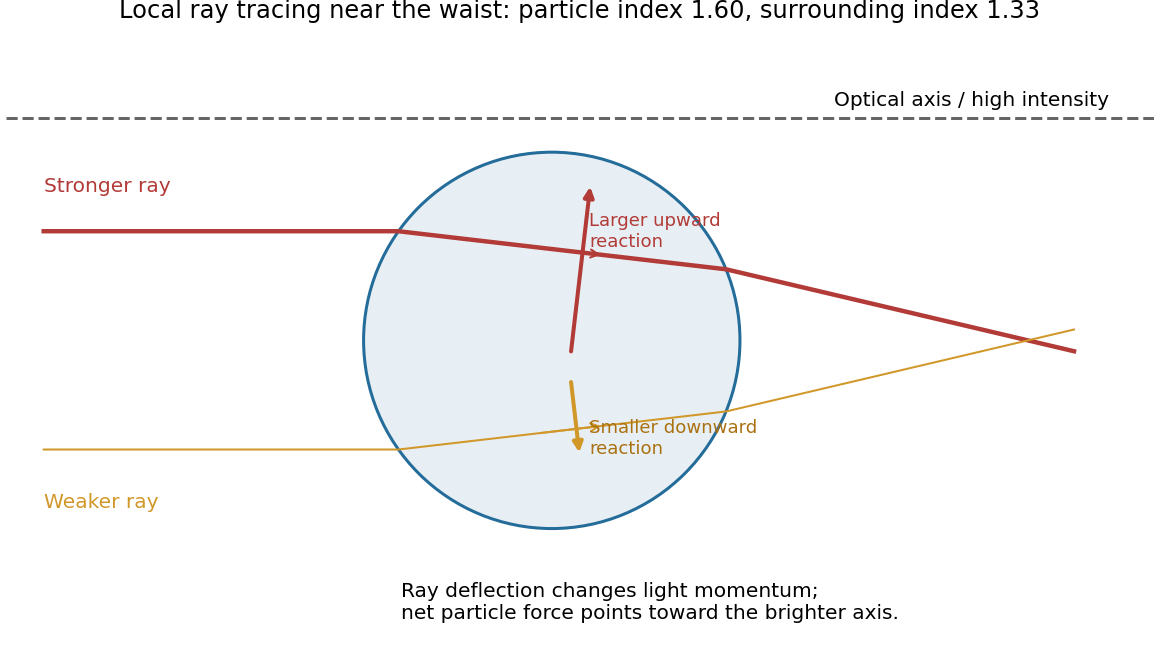
Unequal refracted rays give a transverse restoring force
. Original local ray tracing near a beam waist, with chosen refractive indices. The sphere is below the optical axis. The stronger ray contributes the larger upward reaction; the diagram isolates transverse restoration rather than reconstructing the examination figure. Source. Details.
If the displacement reverses, the force reverses, so the central position is transversely stable. Summing all the rays gives an optical gradient force toward the intensity maximum. There is also a forward optical scattering force. A tightly focused beam can have an axial restoring component that balances it, generally at a small displacement downstream of the ideal focus.[ref]
Observation of a single-beam gradient force optical trap for dielectric particles by Arthur Ashkin and others. Single-beam trapping by a sufficiently strong intensity gradient
Three-dimensional stability requires the restoring axial component to exceed the forward force over part of the trajectory. A Gaussian transverse intensity profile alone does not prove that condition; insufficient focusing can yield transverse confinement while the particle still moves downstream.
Homeotropic anchoring means that the nematic director is locally normal to the particle surface, hence radial on a sphere. Far away, the uniform nematic liquid crystal has a fixed director , with and physically equivalent.
One plausible configuration is a quadrupolar Saturn-ring defect: the director is radial near the particle, bends into far away, and has a disclination loop just outside the particle's equator, in the plane perpendicular to . A meridional section cuts the loop at two points.
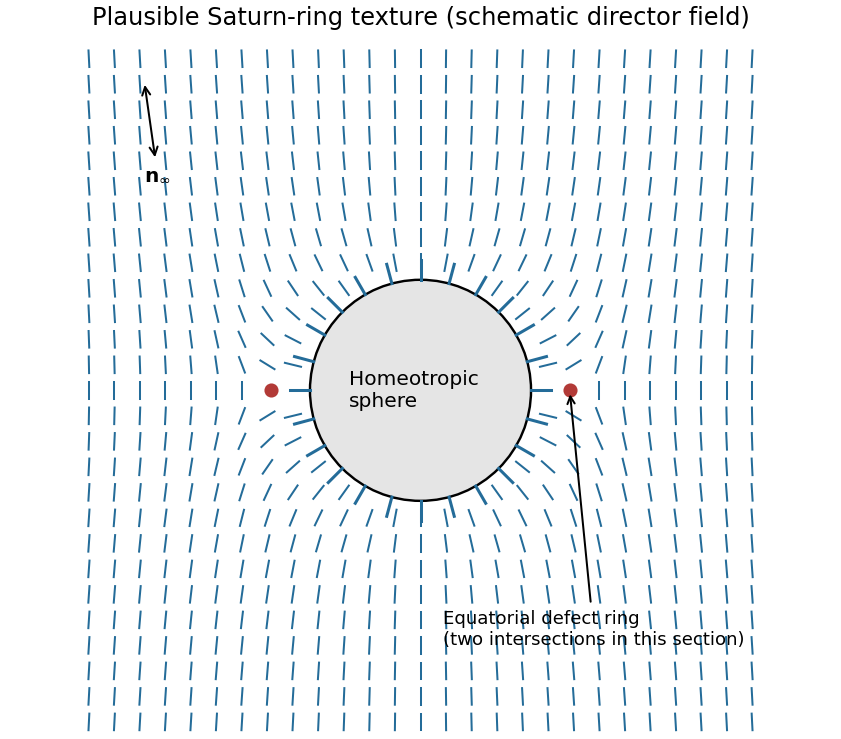

The defect compensates the topological distortion introduced by the radial surface boundary condition. A dipolar configuration with a nearby hyperbolic point defect is another possible texture. Which is stable depends on particle size, anchoring strength, elastic constants and external confinement; the boundary conditions alone do not uniquely select one.[ref]
Director field configurations around a spherical particle in a nematic liquid crystal by Holger Stark. Competing dipolar, Saturn-ring and surface-ring configurations
Absorption converts part of the incident optical power into heat. Increasing laser power can therefore raise the local temperature, potentially driving a thermotropic nematic liquid crystal through its nematic-isotropic transition. The associated loss or change of orientational order, refractive index and anchoring can alter the trapping force or destabilize the trap.
Even below that transition, thermal gradients can induce convection, thermophoretic drift and changes in viscosity or Brownian fluctuations; sufficiently strong heating can damage the particle or host. Thus increasing laser power need not simply strengthen an otherwise unchanged optical trap.
Articles by others on the same topic
There are currently no matching articles.