Put . In natural units, a stationary target proton and a beam proton of total energy have the Mandelstam invariantAt fixed-target production threshold the final particles have zero relative momentum in their centre-of-mass frame, so . Restoring , the total beam energy and its kinetic energy areUsing rounded masses in , , gives and .
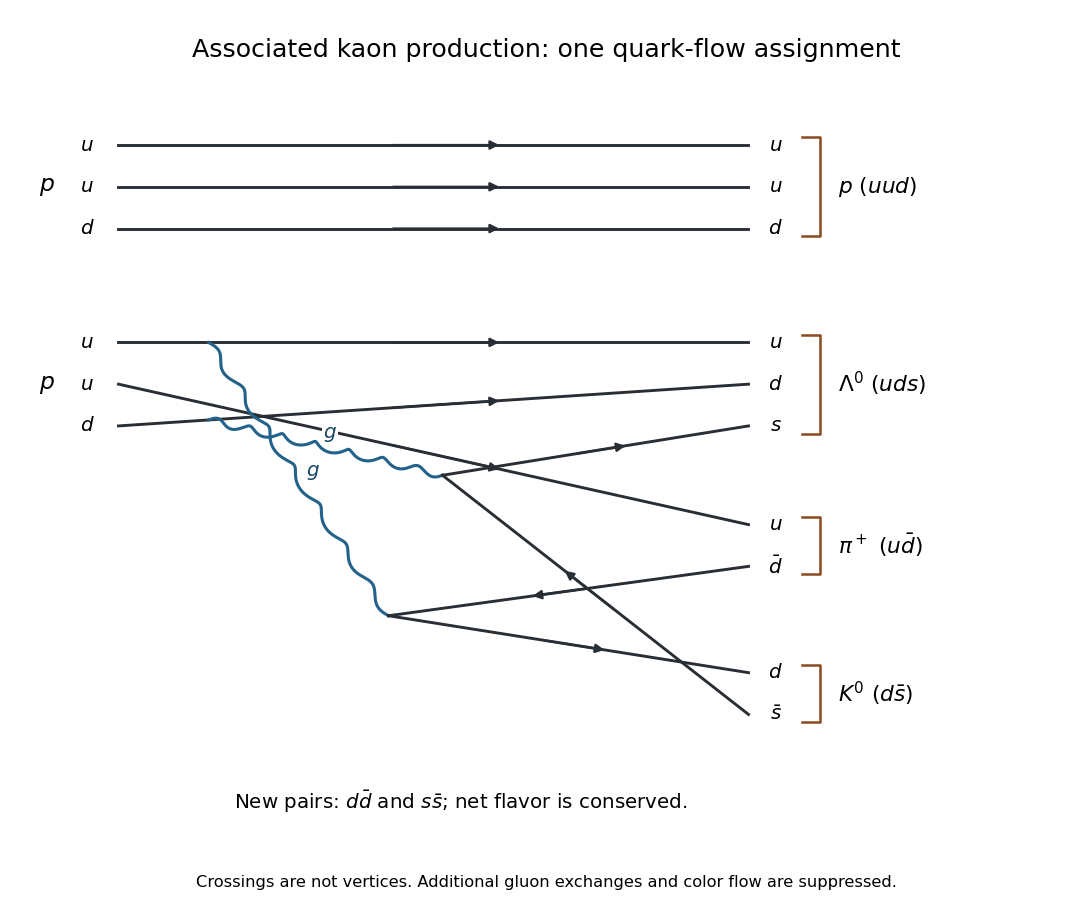
One possible strong interaction quark-line flavour rearrangement isIt needs newly created and pairs, with no net change of any quark flavor. For example, keep the first as the outgoing proton; allocate the second incoming and the new to , the remaining incoming and new to , and the new to . Two gluon splittings illustrate this flow. This is a possible hadronization topology, not a unique perturbative description of the proton collision.

After several short mean lifetimes, the surviving coherent beam is approximately . In ordinary matter the forward scattering amplitudes of and differ. For example, the in a neutral antikaon can enter a strange baryon through strong absorption; the opposite strangeness assignment has different available channels. If their forward transmission amplitudes through a thin block are and , respectively, thenThus the transmitted forward beam contains a regenerated short-lived component, with prompt two-pion decays after the block. Differential absorption changes the intensities as well as the relative phase. Scattered particles outside the forward beam can provide an incoherent component. This neutral kaon regeneration does not require CP violation: the material itself distinguishes matter and antimatter.
Articles by others on the same topic
There are currently no matching articles.