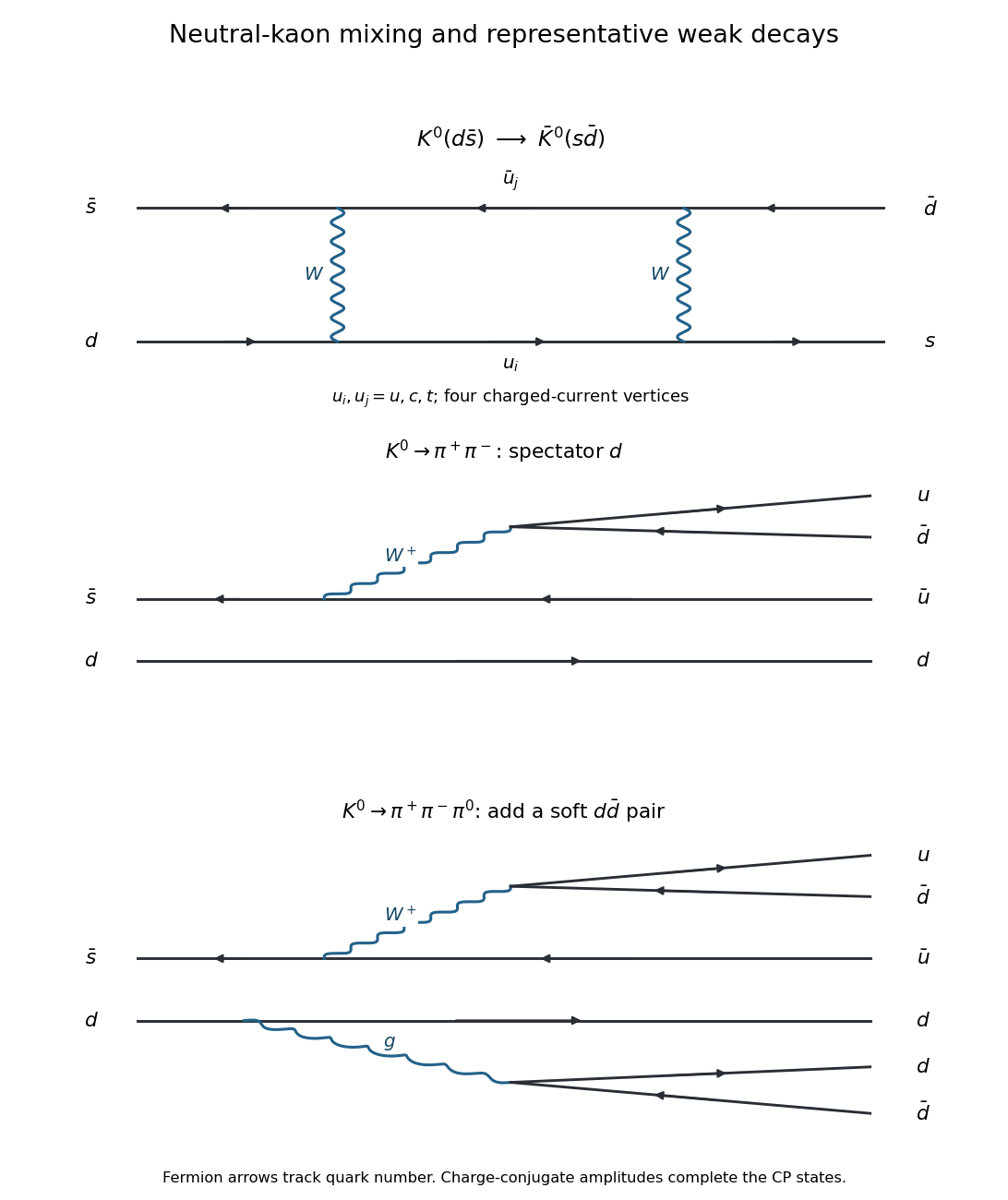
With the valence quark assignments and , neutral kaon mixing changes strangeness by two units. A representative leading Standard Model contribution is a box Feynman diagram with two W bosons and two internal up-type quarks:The two lines exchange the two W bosons. There are four weak charged current interaction vertices, so the scattering amplitude is fourth order in the weak gauge coupling, or second order in the Fermi constant. The full result sums the internal quark flavors with their Cabibbo-Kobayashi-Maskawa matrix factors; one box alone illustrates the mechanism.
A kaon is a pseudoscalar meson, with intrinsic parity . At rest, . Combining this with the specified CP eigenvalues givesEquivalently, in the exchange-positive CP convention for neutral kaon mixing fixed by the question, and . This sign is a convention for the flavor states; the specified CP eigenvalues and physical predictions must be kept consistent with it.
For two spin-zero pions, conservation of total angular momentum fixes the relative orbital angular momentum to zero. The resulting or state has CP . The lowest partial waves of and have CP . Thus the dominant nonleptonic assignments in the CP symmetry approximation areThe two-pion mode has substantially more available kinetic energy and larger Lorentz-invariant phase space; the three-pion mode has an additional final particle and lies closer to its decay threshold. This helps explain why the CP-odd state has the longer mean lifetime. The actual mean lifetimes also depend on the decay amplitudes and on semileptonic channels, so counting final particles alone is not a quantitative prediction.
The middle panel of the figure in part (a) shows , , with the as a spectator quark. The outgoing and form and . In the bottom panel, an additional gluon produces , supplying the neutral pion component for . The charge-conjugate diagrams supply the other component of each of the kaon CP eigenstates. The drawn gluon splitting represents nonperturbative hadronization, rather than a quantitatively reliable perturbative prediction at the kaon scale.
These multiplicities describe the dominant low-orbital angular momentum modes, not an absolute rule for every three-pion configuration. In , odd orbital angular momentum values of the charged pair and of its motion relative to can couple to total zero and give CP , but are strongly suppressed near decay threshold. Physical also occurs through CP violation.
Put . In natural units, a stationary target proton and a beam proton of total energy have the Mandelstam invariantAt fixed-target production threshold the final particles have zero relative momentum in their centre-of-mass frame, so . Restoring , the total beam energy and its kinetic energy areUsing rounded masses in , , gives and .
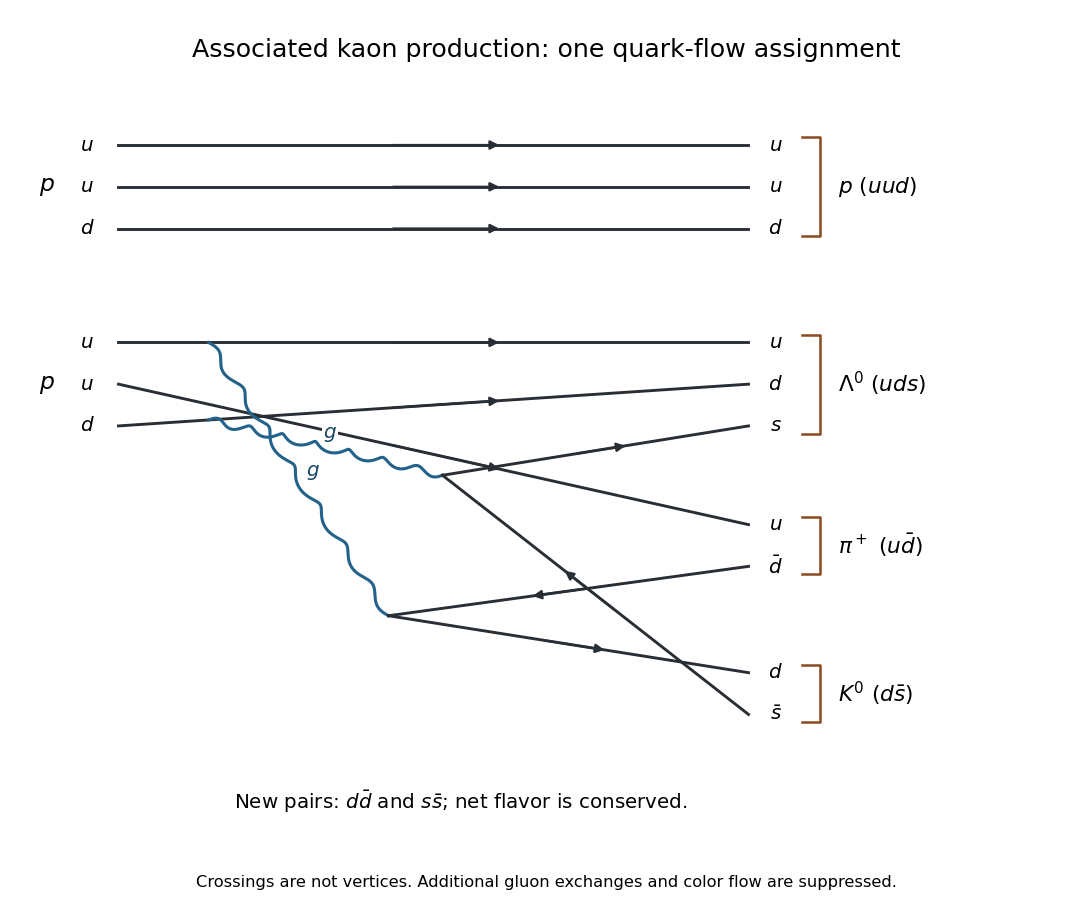
One possible strong interaction quark-line flavour rearrangement isIt needs newly created and pairs, with no net change of any quark flavor. For example, keep the first as the outgoing proton; allocate the second incoming and the new to , the remaining incoming and new to , and the new to . Two gluon splittings illustrate this flow. This is a possible hadronization topology, not a unique perturbative description of the proton collision.
After several short mean lifetimes, the surviving coherent beam is approximately . In ordinary matter the forward scattering amplitudes of and differ. For example, the in a neutral antikaon can enter a strange baryon through strong absorption; the opposite strangeness assignment has different available channels. If their forward transmission amplitudes through a thin block are and , respectively, thenThus the transmitted forward beam contains a regenerated short-lived component, with prompt two-pion decays after the block. Differential absorption changes the intensities as well as the relative phase. Scattered particles outside the forward beam can provide an incoherent component. This neutral kaon regeneration does not require CP violation: the material itself distinguishes matter and antimatter.
For a narrow unstable state, the effective Hamiltonian has the complex eigenvalue . With natural units and , its Schrödinger equation givesThe first factor is the ordinary energy phase; squaring the second gives the exponential decay of the survival probability, . This assumes the approximately constant decay rate regime; exact very early and very late behavior need not be exponential.
Writing the surviving state as , invert the two kaon CP eigenstates definitions:Here is the proper time. For a relativistic beam of fixed Lorentz factor , substitute ; in ordinary units the mass phase is .
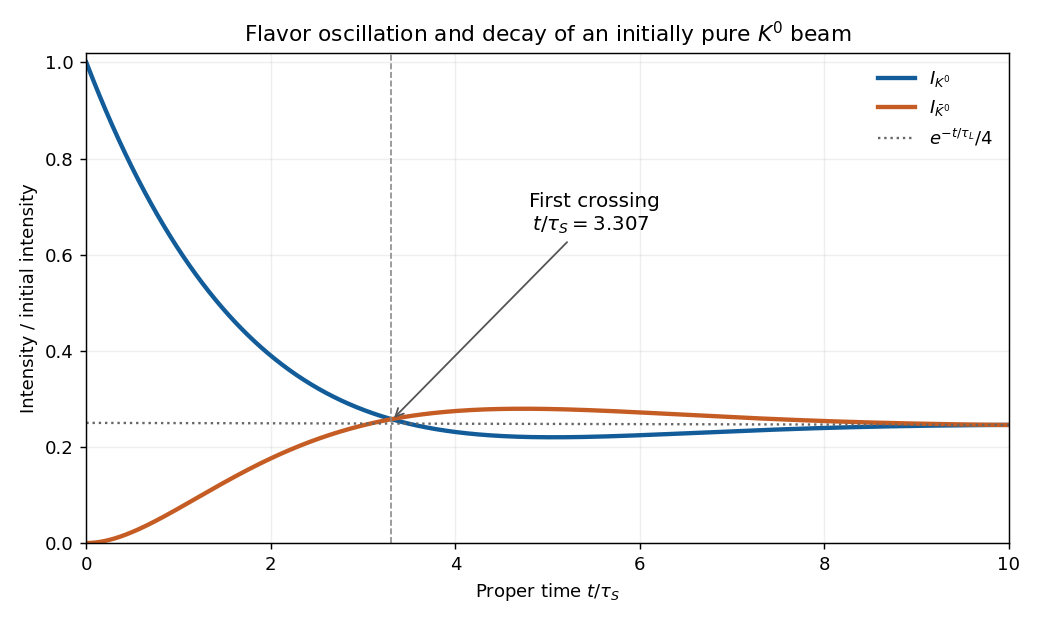
Normalize the incident intensity to one. Since , the initial probability amplitudes are . Define . The flavor probability amplitudes are and . Their absolute squares arewhere in natural units. Thus for both, , andMultiplying all three coefficients by the incident intensity gives any other normalization. Crucially, is time dependent. The printed template cannot hold with all of constant. For example, a nonzero constant would leave an undamped oscillation at arbitrarily late times, even after both unstable components have decayed.
In seconds, . With , the supplied mass difference and mean lifetimes giveInitially the intensities are one and zero. Their sum is , so these are unconditioned survival intensities, not probabilities conditioned on survival. The curves first meet at . Thereafter the neutral antikaon component briefly exceeds the component, before the interference dies away and both approach the surviving long-lived intensity .


Articles by others on the same topic
There are currently no matching articles.