Each quark has baryon number , and each antiquark has baryon number . A strange quark has strangeness , a strange antiquark has strangeness , and the light have zero strangeness. The isospin projections of are , with the opposite values for their antiquarks. ThusFor three valence quarks, and . The baryon octet is reproduced by the following quark model assignments:
Consequently the top-left and top-right states in the source diagram are . Here the source's label means the unknown particle at the top right; the conventional symbol elsewhere in this solution denotes flavor hypercharge.
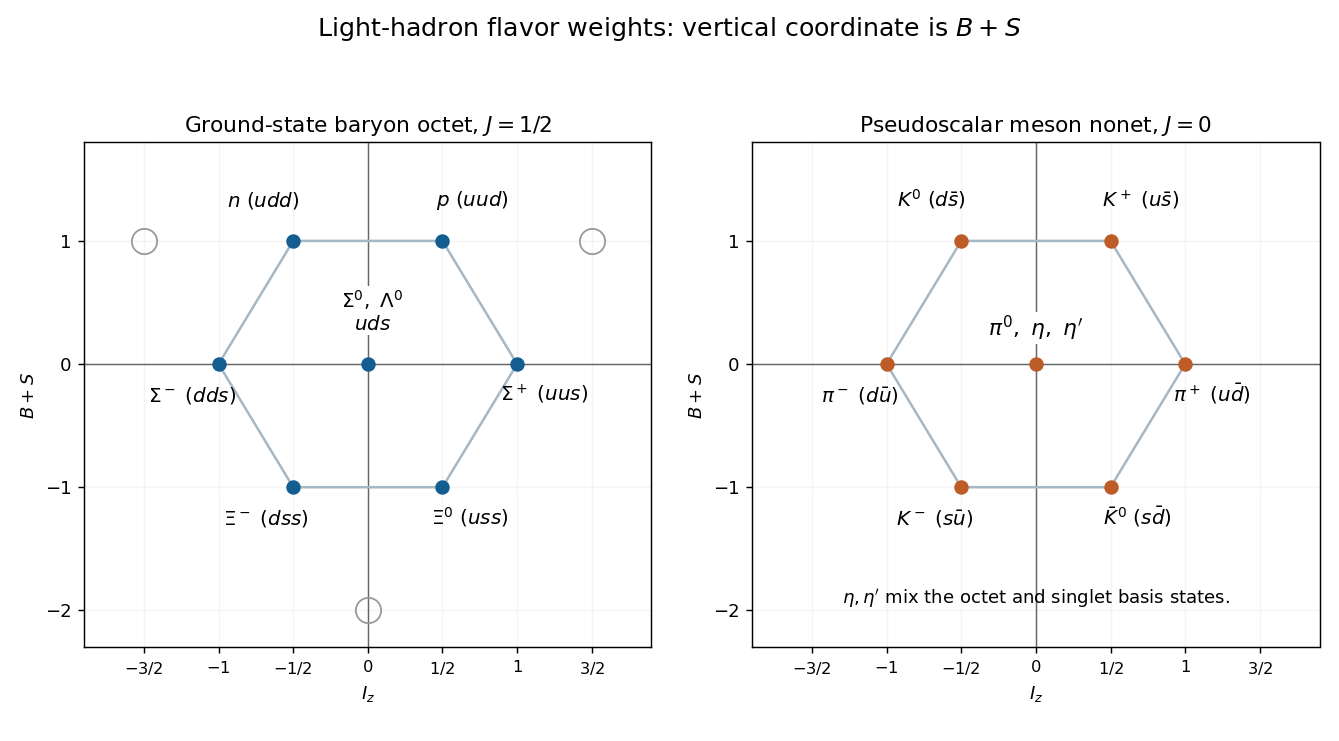
Original baryon-octet and pseudoscalar-meson-nonet weight diagrams in the full hypercharge convention
. Details. 
The diagram refers to ground state, , color singlet baryons. Their spatial wavefunction is symmetric and their color wavefunction is antisymmetric. The Pauli exclusion principle therefore requires a symmetric combined spin-and-flavor wavefunction. One cannot independently attach every three-spin coupling to each flavor assignment.
For three spin- particles, there are formally two ways to couple to total spin . In the ground state quark model these are tied to the corresponding mixed-symmetry flavor functions. Their required symmetric combination yields one physical spin- flavor octet, not two independent species at each peripheral weight. In spin-flavor symmetry notation,under flavor and spin . Thus there is one peripheral species in the baryon octet, each still possessing its two ordinary spin projections. The two abstract flavor-octet copies in do not double the physical ground state octet.
At the dotted positions, the flavor content would be , or . These flavor wavefunctions are completely symmetric. The spin wavefunction must then also be completely symmetric, which means total spin , not . The corresponding baryon decuplet states are , and . This exclusion is for the stated ground state spin- multiplet; it is not an exclusion of all excited baryons at those weights.
Both central baryons have valence quarks , baryon number , strangeness and isospin projection zero. Their total isospins differ:The flavor part is symmetric for the Sigma baryon and antisymmetric for the Lambda baryon. In the usual ground state coupling, the associated pair has spin one for and spin zero for , with the strange quark giving total spin in both cases. Distinct total isospin makes these orthogonal states despite their coincident position in the weight diagram.
Measured half-integer spin and fermionic behavior rule out a simple quark-antiquark pair: two spin- constituents have integer total spin, and adding integer orbital angular momentum does not change that. Their measured baryon number , inferred through production and conservation bookkeeping, corresponds to . Their pattern of electric charges, strangeness and isospin then agrees with three light valence quarks.
Baryon magnetic moments provide a more detailed check. The additive quark model gives, for example,Approximately equal up and down constituent masses give , hence , close to the measured ratio of about .
These observations support three valence quarks; they do not prove the absence of extra quark-antiquark pairs. For instance, also has and can have half-integer spin. Ordinary Quantum chromodynamics baryons also contain sea pairs and gluons. The stronger interpretation that the measurements exclude every antiquark component is therefore false.
Write the charge in units of as . The proton and neutron have and , so their measured charges imply and . Thus , :This is the Gell-Mann--Nishijima formula, with the full flavor hypercharge . Applying the quark baryon number and the isospin and strangeness assignments from part (a),Physical electric charges are these numbers multiplied by the positive elementary charge .
The observed dominant two-body transition is . Both baryons have valence quarks and the same strangeness; an electromagnetic interaction transition is therefore possible. Their mass difference is only about , below the lightest pion mass, so no additional on-shell strongly interacting particle fits. A photon is neutral and massless, and can carry the required angular momentum through a magnetic dipole transition between the two positive-parity spin- states. A single neutrino would violate lepton number and would not give the required fermion parity.
At rest, four-momentum conservation gives and . ThusThe result is slightly below because the Lambda baryon recoils; rounded masses give about .
The channels and are actually kinematically open: their total rest energies are about and , below . Their suppression is therefore not a decay threshold prohibition. Each changes strangeness from to zero and so requires a weak interaction. The much faster allowed electromagnetic transition makes such weak branching fractions extremely small. “Not observed” should be understood as overwhelming electromagnetic competition, not an exact ban in the Standard Model. The photon identification likewise uses the known low-energy spectrum and dominant transition mechanism, not neutrality alone.
A ground state spin-zero meson is a color singlet with and constituent spin zero, hence a pseudoscalar meson. The nine flavor combinations form . Here , so the vertical coordinate equals strangeness. The six peripheral weights in the right panel of the figure in part (a) are
At the center, all have . A useful orthonormal flavor basis isThe neutral pion has ; and have . The Eta octet state belongs to the octet, while is the flavor singlet. The physical eta and eta prime mesons are predominantly mixtures of these two isoscalar basis states,Unequal quark masses and the chiral anomaly prevent exact flavor symmetry and a degenerate nonet. The three central physical species are consequently , rather than three separately observable pure diagonal flavor pairs. Small isospin-breaking admixtures are neglected here.
Articles by others on the same topic
There are currently no matching articles.