With , the Karush-Kuhn-Tucker conditions areUnder a suitable constraint qualification, such as the linear independence constraint qualification on active constraint gradients, they are necessary for a local minimum. Smoothness alone is insufficient. The sign convention here corresponds to constraints written as and a minus sign in the optimization Lagrangian.
Write the constraint as and its multiplier as . The KKT conditions becomeIf is positive definite, is positive definite for every , so is the only critical point.
For indefinite , the origin remains a critical point, contrary to an unqualified reading of the question. Every nonzero critical point is an eigenvector with , so its eigenvalue is nonpositive. A negative-eigenvalue vector must lie on the unit sphere, with multiplier equal to the negative of that eigenvalue. A nonzero vector in may have any norm at most one and has multiplier zero. Positive-eigenvalue directions do not satisfy the multiplier sign condition. These first-order critical points include saddles; the global minimum selects a unit vector in the lowest-eigenvalue eigenspace.
The logarithmic barrier isIts gradient is . Thus every nonzero stationary point satisfiesA fixed negative-eigenvalue branch exists for . The zero point is stationary for every as well, and it is not an eigenvector; at zero the displayed scalar need not be an eigenvalue of . Thus the claimed eigenvalue conclusion requires the nonzero-point qualification. This distinction is essential for the following Hessian analysis.
Put . Differentiating the barrier gradient givesAt a nonzero stationary point on the branch , . Choose an orthonormal eigenbasis of the symmetric matrix whose first vector is . On each of the remaining eigenvectors the rank-one term vanishes, so the corresponding Hessian eigenvalues areAlong , the first two terms cancel and the remaining eigenvalue isIf repeats, a transverse eigenvalue can be zero. If a lower eigenvalue than exists, a transverse eigenvalue is negative, identifying this stationary branch as a saddle rather than a minimum.
Along a fixed nonzero branch, and the radial Hessian eigenvalue grows like . The nonzero transverse eigenvalues stay fixed. If is simple, the ratio of the largest to smallest absolute eigenvalue therefore tends to infinity. If it repeats, the Hessian is already singular because of the zero transverse directions; there is no finite spectral condition number to begin with. These conclusions concern the nonzero branches: at the stationary origin , and the same blowup is not implied.
Ill-conditioning does not invalidate barrier minimizers as approximations to the constrained solution. Let . At radius , the smallest possible quadratic value is , so global barrier minimization reduces to minimizing for . For its unique minimizing radius satisfiesThus every limiting unit vector in that eigenspace solves the original problem, with objective . For the barrier minimizer is the origin instead. The increasing condition number concerns the numerical difficulty of small-parameter subproblems, which can call for scaling or a primal-dual interior-point method; it does not prevent the mathematical convergence just established. This is the quadratic-ball barrier eigenvalue branch.
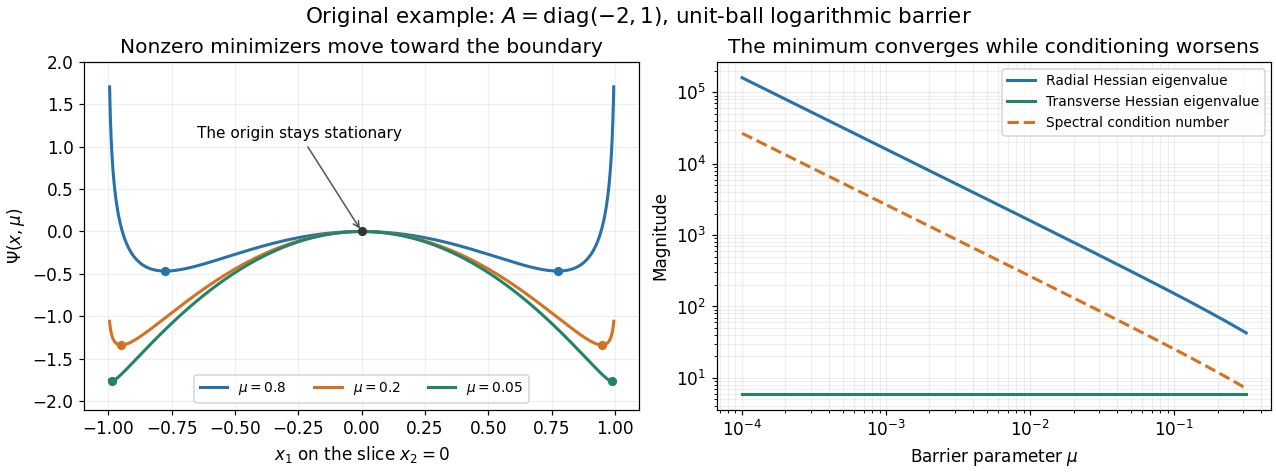
The nonzero barrier minimizers approach the unit sphere while their Hessian condition number grows; the origin remains stationary
. Details. 
Articles by others on the same topic
There are currently no matching articles.