Let run from the charge's present position to the observation point, and let be constant. Lorentz-transforming the Coulomb field givesAt fixed R, the radial magnitude is proportional to . It is reduced by along the motion and enhanced by perpendicular to it. The field is therefore concentrated around the transverse plane at high speed. For negative charge all electric-field arrows reverse.
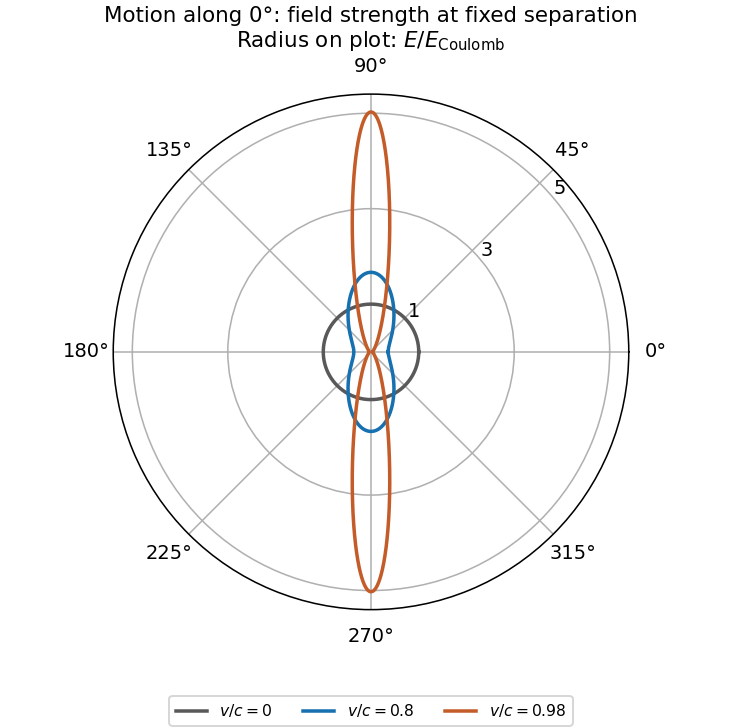
Original angular field-strength comparison for a uniformly moving charge, measured from its instantaneous position, with the direction of motion marked
. Details. 
Although the fields depend causally on retarded motion, for constant velocity the electric-field direction points along the separation from the present position. This does not imply instantaneous action: the velocity-dependent part of the retarded field removes a naive directional lag. Both fields fall as ; uniform straight-line motion produces no acceleration-radiation term proportional to .
Sunlight is approximately unpolarized before its interaction with the environment. For Rayleigh scattering by small isotropic scatterers, the induced electric dipoles radiate only their components transverse to the viewing direction. For unpolarized incident light scattered through angle , the perpendicular and parallel intensities are proportional to 1 and . The degree of linear polarization is thereforeAt single scattering is fully linearly polarized perpendicular to the scattering plane. This explains the polarized sky away from the Sun; multiple scattering and aerosols reduce the ideal contrast.
Reflection at a dielectric surface treats the two linear polarizations differently. At Brewster incidence, , the reflected p component vanishes for ideal transparent nonmagnetic media. The remaining reflected glare is s polarized, perpendicular to the incidence plane, approximately horizontal for a horizontal water surface. Away from this angle the reflection is generally partially polarized. The transmitted beam also has unequal s/p transmission.
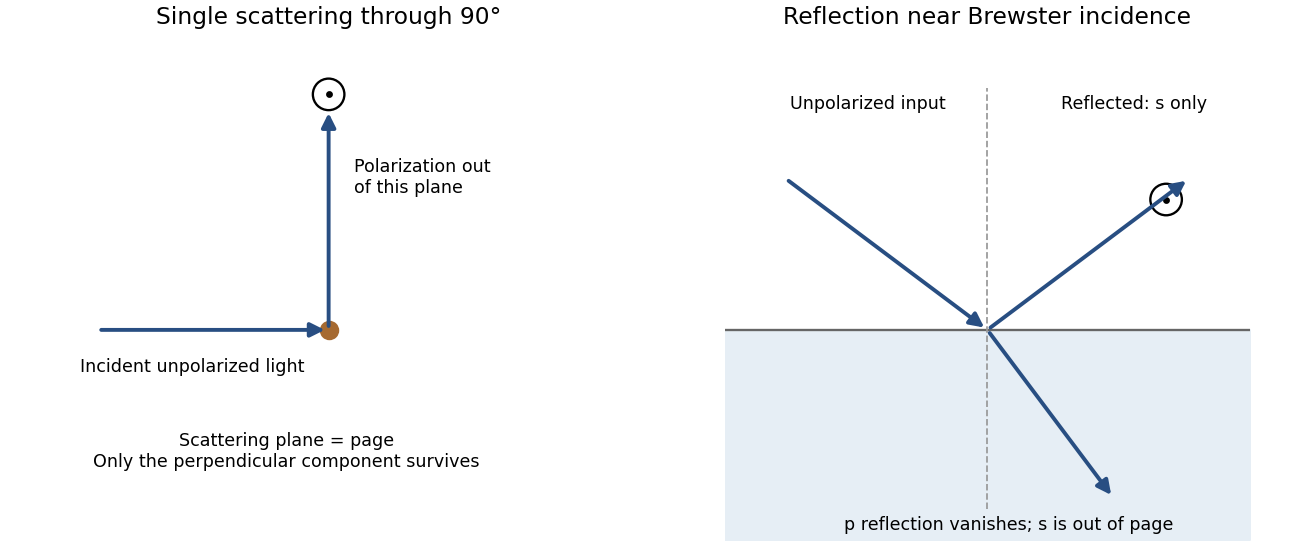
Original diagrams of polarization perpendicular to a single-scattering plane and of s-polarized reflection near Brewster incidence at a dielectric surface
. Details. 
Refraction and internal reflection in water droplets likewise have polarization-dependent Fresnel coefficients, producing strong linear polarization in rainbow light. These are generic scattering and boundary-condition mechanisms; no biological detection mechanism is required.
An accelerated charge radiates. For ultrarelativistic circular motion, the emitted radiation is concentrated into a cone of angular width of order about the instantaneous velocity. As the cone sweeps past a distant observer, propagation-time compression produces a short pulse of width of order , where is orbit curvature radius. Its Fourier spectrum extends to high harmonics, with conventional critical angular frequencyThis is a spectral scale, not a sharp upper cutoff. For transverse acceleration and , the classical radiated power isThe radiation is linearly polarized for an observer in the orbit plane, with elliptical polarization away from it. The two sides of the orbit plane have opposite handedness. The strong forward preference and high-frequency spectrum follow from the relativistic radiation calculation.[ref]
On the Classical Radiation of Accelerated Electrons by Julian Schwinger. 1949, abstract: angular distribution, forward preference and high-frequency radiation
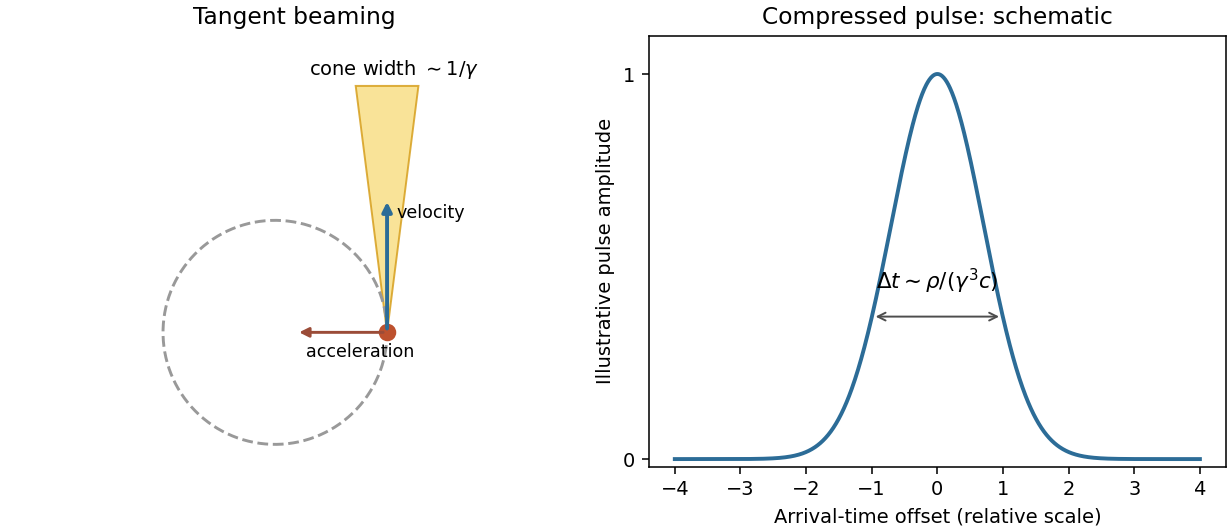
Original tangent-beaming geometry and normalized illustrative pulse showing the origin of a broad synchrotron spectrum; the pulse curve is schematic rather than measured
. Details. 
Magnetic bending fields steer the charge but do no work, so maintaining a storage-ring beam requires energy replacement by accelerating fields. Bright electron beams provide useful radiation from infrared to X-rays; stronger curvature or higher electron energy shifts the spectral scale. The classical formulas assume negligible quantum recoil.
Articles by others on the same topic
There are currently no matching articles.