The Faraday effect rotates the plane of linear polarization when light propagates through a material with a magnetic field component along the ray. In the weak-field transparent regime,with a stated propagation and transverse-basis convention; is the Verdet constant. For a uniform longitudinal field and sample length , the magnitude is . A scalar intensity change without a corresponding polarization analysis would not establish this effect.
The microscopic field breaks the equivalence of the two circular polarization modes: the Lorentz force and the Zeeman shifts of optical transitions produce different susceptibilities for their opposite senses of rotation. A linearly polarized wave is an equal-amplitude superposition of these two modes. If their real refractive refractive indices are , their relative wave phase after the sample is . Recombination rotates the line byEqual transmitted circular amplitudes preserve linear polarization. Unequal absorption produces circular dichroism and generally elliptical polarization as well, so pure rotation is an approximation appropriate away from strong absorption.
A modern motivating experiment sends polarized laser light through a glass rod inside a solenoid, then through a rotatable analyzer onto a photodiode. Scan the analyzer first to calibrate its angular response. Driving the solenoid sinusoidally and recording the detector synchronously separates a small rotation signal from unsynchronized noise; the conversion to angle still requires the analyzer slope and the magnetic-field integral through the rod. A first-party William & Mary laboratory manual specifies this apparatus and measurement procedure.[ref]
Physics 251: Experimental Atomic Physics, Fall 2019. Faraday Rotation laboratory chapter, pp. 2–7: solenoid, glass rod, analyzer calibration and synchronized readout
Additional controls are equal-magnitude field reversals, zero-field readings before and after each pair, and a blocked-beam pickup test. The odd-in-field rotation is ; a fixed analyzer offset cancels. Heating, stressed-glass birefringence, source drift and field-dependent transmission need separate checks. A single reading near crossed extinction loses the sign because its leading response is quadratic; an analyzer near gives a linear small-rotation response.
Faraday rotation is nonreciprocal. With the magnetic bias held fixed, retracing the path adds rotation in the same laboratory sense rather than undoing it, unlike reciprocal natural optical activity. This permits an optical isolator with a Faraday rotator between appropriately oriented polarizers. One must compare the returned polarization in a consistently defined laboratory basis; merely reversing the sign of while retaining the old ray-basis convention gives an incorrect cancellation.
A spectral line has finite width when the emitted or absorbed field loses coherence, or when different emitters have different transition frequencies. It is useful to distinguish homogeneous spectral broadening of each emitter from inhomogeneous spectral broadening across the ensemble.
Finite lifetime and dephasing. For an upper-state population lifetime and a stable lower state, the radiating amplitude decays as . Its Fourier spectrum is Lorentzian, with full width at half maximumMore generally, an optical coherence time gives . Both level lifetimes and pure dephasing can contribute to . Distinguishing population lifetime from amplitude coherence time prevents the usual factor-of-two error.
Thermal motion. To first order in velocity, . A Maxwell-Boltzmann velocity distribution therefore produces a Gaussian profile, withThis is inhomogeneous doppler broadening: different velocity classes have different resonance frequencies. A distribution of bulk velocities can add further broadening, while a common bulk velocity shifts the line.
Interactions with the surroundings. Collisions can interrupt the dipole wave phase and perturb the energy levels, producing pressure broadening and shifts. In the impact approximation, approximately exponential wave phase relaxation produces a Lorentzian contribution; its rate increases with perturber density times an appropriate velocity-averaged collision cross section. Slowly varying electric microfields can instead produce non-Lorentzian Stark profiles. Neutral perturbers, charged perturbers and resonance interactions need not produce the same line shape. These mechanisms and the Gaussian thermal limit are distinguished in NIST's atomic-spectroscopy compendium.[ref]
Atomic Spectroscopy - A Compendium of Basic Ideas, Notation, Data, and Formulas by William C. Martin and Wolfgang Wiese. section 20, Spectral Line Shapes, Widths, and Shifts: Doppler and pressure broadening
Finite observation time limits coherence; transit-time broadening also occurs for particles crossing a narrow optical beam. Strong resonant excitation causes power broadening: for an ideal lifetime-limited two-level transition, with population decay rate and saturation parameter . Unresolved fine structure, hyperfine structure, isotope components, or spatially varying Zeeman and Stark shifts may look like a single broadened feature even though several frequencies are present.
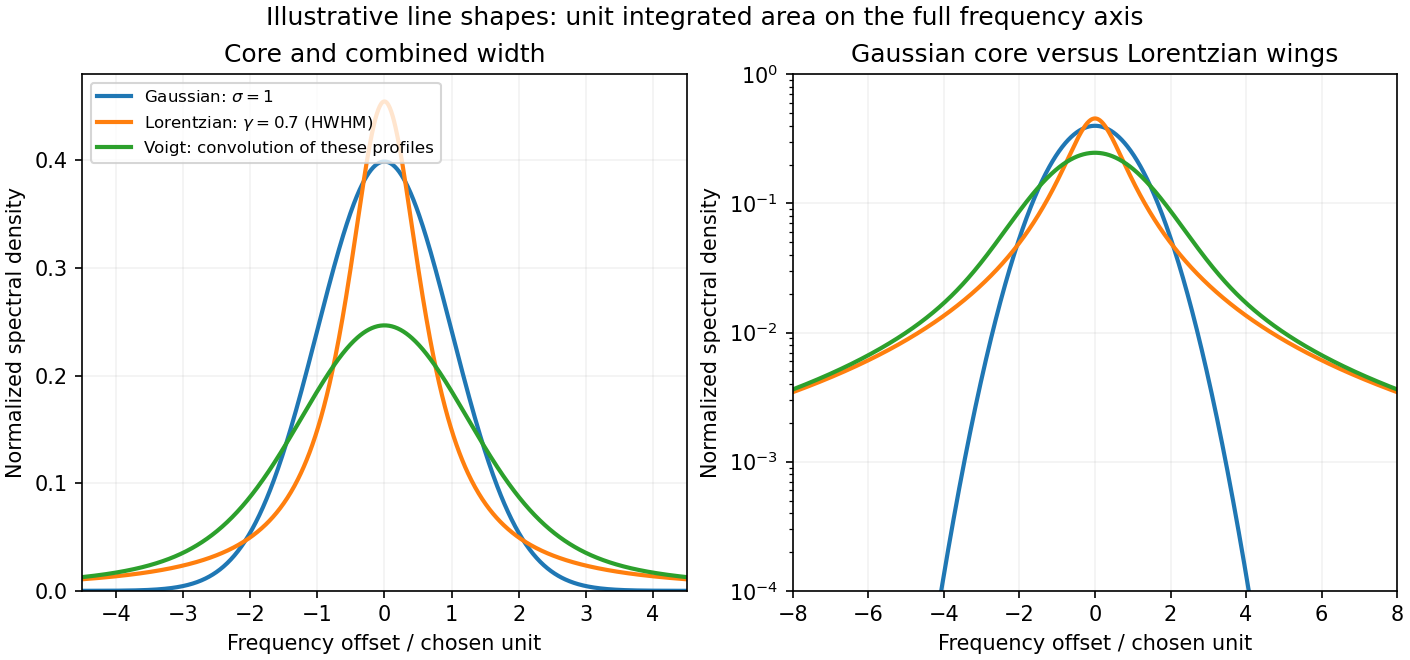
The observed spectrum is additionally convolved with the instrument response. A Gaussian Doppler contribution convolved with Lorentzian homogeneous broadening gives a Voigt profile; their full widths do not generally add in quadrature. An informative experiment varies temperature, perturber pressure and excitation intensity separately, calibrates the spectrometer response with a narrower reference, and checks optical thickness or self-absorption. Extrapolation to weak excitation and low pressure helps isolate the lifetime contribution, while a Doppler-free technique is needed if velocity spread still dominates.

Both Thomson scattering and Rayleigh scattering can be understood as radiation from a dipole driven by the incident electric field. Their different frequency dependences come from the response of a free charge compared with a bound charge.
For a free particle of charge and mass , a harmonic field gives , hence . The radiated field contains two time derivatives of , cancelling the response's . The Thomson cross section is consequently independent of frequency in the classical low-recoil regime:For incident linear polarization with unit polarization , summing over outgoing polarizations gives . Radiation vanishes along the acceleration and is strongest perpendicular to it. Averaging an incident unpolarized light beam giveswhere is the scattering angle. Scattering through is fully linearly polarized perpendicular to the scattering plane for this ideal isotropic dipole model. The electron case dominates over equally charged heavier particles because the cross section scales as . recoil corrections become necessary when photon energy is no longer small compared with .
For a bound charge with natural frequency and damping rate ,Far below resonance, is approximately constant, soThis is Rayleigh scattering. It requires a scatterer small compared with the wavelength and, for the simple expression, an isotropic linear dipole response. Atoms, molecules and small dielectric particles provide examples. The stronger scattering of shorter visible wavelengths explains blue skylight; absorption and the nonuniform solar spectrum prevent treating that simple scaling as a complete color calculation.[ref]
Rayleigh Scattering by Richard Fitzpatrick. section 9.6, bound-charge response and low-frequency limit
For isotropic electric scatterers the normalized angular and polarization patterns are the same as in Thomson scattering. The frequency scaling distinguishes their limits: a free charge has a displacement proportional to , whereas a tightly bound charge has an approximately frequency-independent displacement. Near resonance, far outside the small-particle limit, or with anisotropic polarizability, the simple Rayleigh formula must be modified. In particular, the electric-only pattern must not silently be applied to a perfectly conducting sphere whose magnetic dipole response is also retained.
A scattering measurement should subtract stray-light and detector backgrounds, control scatterer density and optical thickness, and calibrate detector response and incident power when comparing wavelengths. A polarization analyzer at tests the dipole pattern; multiple scattering or unresolved nonisotropic contributions can reduce its polarization.
Articles by others on the same topic
There are currently no matching articles.