The characteristic polynomial of the given Jones matrix isso a convenient choice of eigenvalue labels isDirect multiplication gives , and . They represent opposite circular polarizations. Since are real, is a Hermitian matrix and both eigenvalues are real, but they need not be positive. A negative eigenvalue adds a wave phase reversal to that mode. The labels are algebraic: is the larger numerical eigenvalue only when . If , the eigenvalue is degenerate and every nonzero Jones vector is an eigenvector; the circular pair remains a valid basis.
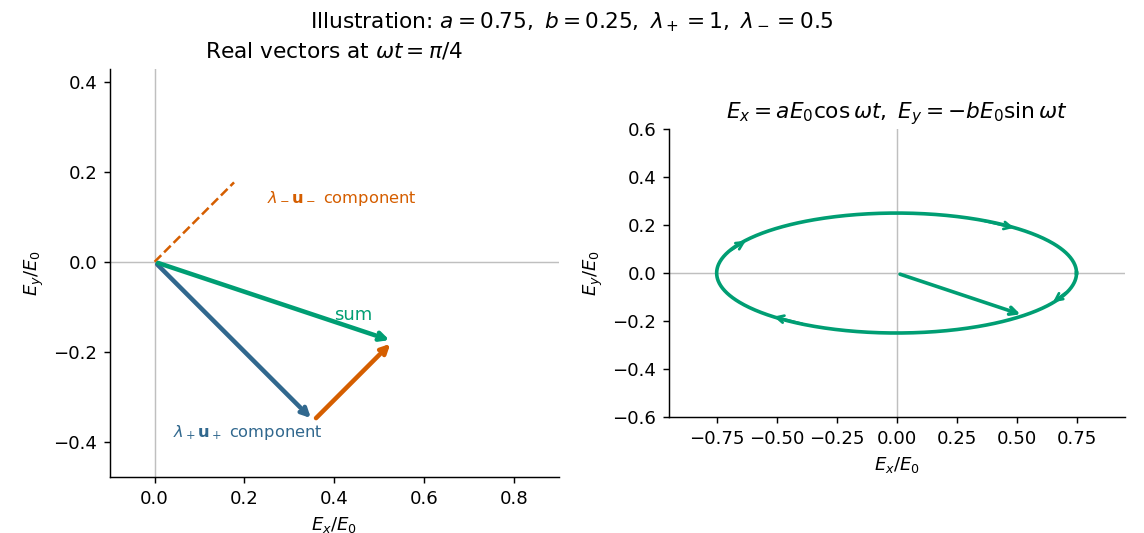
Take an incident field along , without loss of generality because this component has the same circular eigenmodes for every direction of input linear polarization. Resolve its Jones vector into equal circular components:Using the complex amplitude convention , the real circular contributions areThey counter-rotate and add toIn general the tip traces an ellipse with semiaxis lengths and . Equal transmitted circular wave amplitudes produce a line; removal of one circular mode, or , produces a circle. The special zero-output case has no defined polarization of waves.

The normalized circular eigenvectors from part (a) define the orthogonal projection matricesThus the spectral decomposition of the Jones matrix isThis simply substitutes and and makes each eigenmode's wave amplitude transmission explicit.
There are errors in the original PDF at this point, not merely in the TeX transcription. The second exponential must denote the eigenvalue , not the propagation coefficient itself. More substantially, the printed prefactor is inconsistent with the stated exponential eigenvalues. It must be . The original's primed Jones-matrix label distinguishes the distributed component from the earlier static matrix; below write to avoid confusing that prime with a derivative.
Complex eigenvalues have no intrinsic largest/smallest ordering, so and are modal labels. Keep the circular eigenvectors fixed, put and , and use the spectral decomposition from part (c):Its diagonal entries are , and its upper off-diagonal entry is . ThereforeWhere , this can be factored asThe unfactored expression is valid even at zeros of the cosine-like factor when is imaginary. The printed expression is times this correct matrix; its eigenvalues are consequently rather than those specified. A second check is , whereas the printed version has determinant . Thus the requested printed identity cannot be proved except in the degenerate case ; the following parts use the consistent propagator.
When are real, and are real. The two opposite circular polarizations retain their wave phases but are attenuated at different wave amplitude rates. This circular dichroism changes the ellipticity without rotating the principal axis of the ellipse.
For input , the corrected Jones matrix givesThe common factor describes the mea wave amplitude attenuation. The factor reflects the sum of the two transmitted modal wave amplitudes; fixes their imbalance and hence the signed ellipticity. The real field has components proportional to and , soThe ellipse's principal axis stays along the original input direction. For large differential optical depth it approaches the less attenuated circular eigenmode. A passive medium has , or , so the growing hyperbolic function factor does not imply net optical gain. Using the printed prefactor would give a spurious extra attenuation inconsistent with the modal laws.
Write , and . Then and . With and , the corrected matrix becomesThe scalar is a common propagation wave phase and the real rotation matrix rotates the input linear polarization through . There is no attenuation and no generated ellipticity: the field map is a unitary matrix. The two circular eigenmodes accumulate different wave phases, giving circular birefringence and optical activity.
The correct unfactored matrix remains finite where . In contrast, the printed form would give times the rotation matrix, including unphysical divergent gain in this stipulated lossless case. This provides a direct physical check on the correction in part (d).
The circular eigenmode orthogonal projection matrices obey , and . Define the uniform-medium generatorExpanding its matrix exponential by its power series and using these projection identities givesEquivalently, with , one has , and . This is exactly the corrected matrix of part (d). The entries of have units of inverse length, and the map satisfies , and the homogeneous propagation law .
The extra factor in the printed version violates this last law for nonzero , so it cannot be generated by one constant with the stipulated eigenvalues. The constant- description assumes uniform coefficients and fixed circular eigenmodes.
Articles by others on the same topic
There are currently no matching articles.