On , the Joukowski map gives , so the image is the segment . Solving the resulting quadratic gives the inverse candidatesOn , choose the analytic square root of characterized by at infinity. One explicit definition iswhere the square root on the right is the principal square root. Its argument never lies on the nonpositive real axis for , so this defines the required holomorphic function. Then .
The two quadratic roots have product . For , neither root lies on , since that circle maps into . Consequently exactly one root lies outside the circle, and it is the branch chosen at infinity. Also, if two exterior points have the same image, thenwhose second factor cannot vanish. Thus the Joukowski map is a conformal map from onto , and is conformal throughout . The two endpoints are branch points and are excluded.
The complex potential in the circle plane is the sum of the uniform flow term , its circle-image term , and the point vortex term . On , the first two sum to , which is real, while the imaginary part of the vortex term is the constant . Hence the circle is a streamline, giving no normal flow. At infinity the first term gives the required uniform flow; the logarithmic term supplies circulation . The potential may be multivalued by a real constant, but its velocity is single-valued.
Conformal transport therefore givesIn the frame where the plate is horizontal, its length is and the stream has angle ; rotating the frame gives the equivalent incidence description. The complex velocity isAt the trailing edge , corresponding to , the denominator has a simple zero. Finite velocity requiresso the Kutta condition isWith this choice, cancellation of the common zero givesThus the limiting velocity has zero transverse component and is tangent to the plate.
The free surface is material, so applying the material derivative to gives the exact kinematic boundary conditionFor an incompressible fluid with constant density, the Euler equations areSince the flow is irrotational, and . Integrating the resulting gradient equation gives a function of time on the right of Bernoulli equation. Adding a time-dependent constant to removes that function, without changing velocity, and choosing the atmospheric-pressure reference givesThe pressure immediately above the surface is atmospheric; the liquid-side pressure includes the stated surface tension jump.
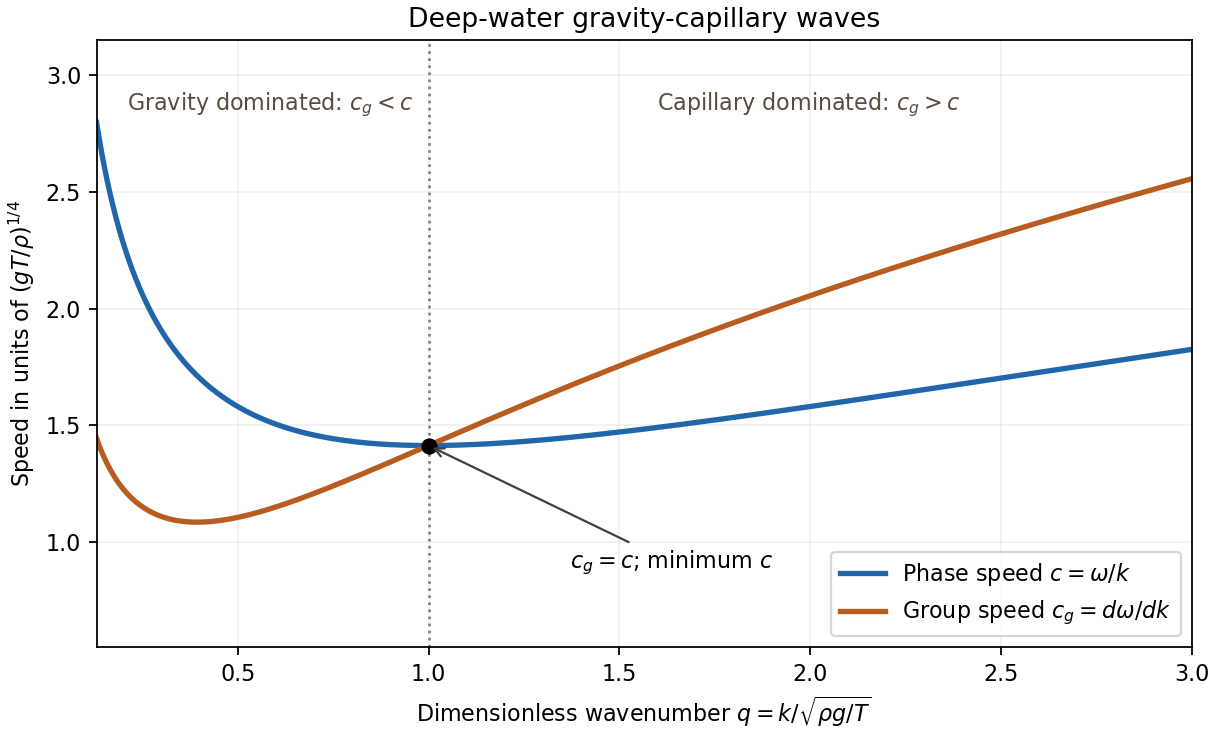
At first order in wave amplitude, the products and , the slope-squared correction to curvature, and displacement corrections in evaluating at are all higher order. Hence, on ,For , a harmonic velocity potential decaying as and satisfying the first condition isIndeed and . Substituting in the second condition yields the dispersion relation for a gravity-capillary wave:Taking the positive-frequency branch, the phase velocity and group velocity areSubtracting givesSince ,The threshold is also the wavenumber at the minimum phase speed of a gravity-capillary wave.

Articles by others on the same topic
There are currently no matching articles.