Options II, Honour School of Mathematics Part A, Trinity Term; Thursday 30 June 2011, 9.30am–12.30pm. The complete sixteen-page source was supplied through the past-papers disclosure, in original Part A bundle pages 282–297. The private editable transcription retains the complete cover and every printed question.
New solutions cover the eighteen questions without an exact worked-answer advertisement found in the bounded availability check. H2 is recorded separately because Oxford explicitly advertises solutions for its students in the Classical Mechanics revision notes. No new solution is supplied for that question.
A splitting field of over is a field extension in which is a product of linear factors and which is generated over by its roots. The generation condition rules out adjoining unrelated elements.
For existence, induct on the degree of a polynomial. Choose an irreducible polynomial divisor of . The quotient ring is a field because is a maximal ideal; the class of is a root of , hence of . Over this field extension, divide out and apply induction to the remaining polynomial. This gives an extension in which splits. Inside it, the subfield generated by all roots is a splitting field. The induction starts with a linear polynomial, whose splitting field is already . Thus every positive-degree polynomial has a splitting field; being monic is unnecessary for existence.
The cubic has no root in , since its values at and are both . A cubic over a field is irreducible precisely when it has no root. Consequentlyis a field extension of degree , with eight elements. The Frobenius endomorphism takes a root of a polynomial over to another root, so the roots are . They are distinct: equality between any two would make the Frobenius endomorphism orbit have length less than , contradicting the minimal polynomial of . They all lie in , and one of them generates . Hence
The roots are and , so the splitting field is . The first adjunction has degree . To see that the second does too, suppose with . Squaring and comparing rational and irrational parts gives and . If , then ; if , then . Neither is a rational square, as follows by comparing prime exponents in numerator and denominator. Thus . The tower law now yieldsA basis is .
A composition series is a finite chainwhose inclusions are strict and whose quotients are simple. These quotients are the composition factors. The normal subgroup condition is relative to the next member, rather than necessarily to all of .
Induct on the order of a finite group. The trivial group has the empty composition series. Otherwise choose a maximal normal subgroup , which exists because there are finitely many subgroups. The subgroup correspondence theorem identifies normal subgroups of with normal subgroups of containing , so maximality makes a simple group. By induction has a composition series; appending gives one for .
In the Klein four-group , the chainsare distinct composition series. All their composition factors are .
The Jordan–Hölder theorem states that any two composition series of a group have the same length and the same composition factors up to permutation and group isomorphism. Thus the subgroup chains may differ, while the multiset of simple quotients is intrinsic.
Write and set . The order of is , so . Every subgroup of an abelian group is a normal subgroup. The quotient group is generated by and has order , hence is and is a simple group. By the subgroup correspondence theorem, there is no proper normal subgroup strictly between and . Therefore is a maximal normal subgroup with the required quotient group.
Supposeare two factorizations into primes. Repeatedly apply the cyclic-subgroup construction of part (c), first removing , then , and so on. This constructs a composition series for whose composition factors are . The second factorization constructs another composition series with composition factors .
By the Jordan–Hölder theorem, and these composition factors agree up to group isomorphism and permutation. Since isomorphic finite groups have the same order, the corresponding primes agree. This proves uniqueness of prime factorization up to permutation, using existence of prime factorizations but not their uniqueness.
For an odd prime number , a nonzero class is a quadratic residue if for some integer not divisible by . The Legendre symbol isWhen discussing solvability of without a coprimality assumption, zero is also a square. This convention matters in the final local characterization of integer squares.
The Euler criterion states that for an odd prime number and ,The same modular congruence remains true when , with both sides zero.
If divides or , both sides of the claimed multiplicativity identity are zero. Otherwise the Euler criterion givesEach side is or . Since is odd, these two integers represent different residue classes. Hence the modular congruence gives equality:
For odd ,is even. Induction over the prime factors of , repeated according to multiplicity, therefore givesUsing the supplementary law for each Legendre symbol in the definition of the Jacobi symbol,For , the empty product and the displayed expression are both .
If , both Jacobi symbols vanish, so the formula holds. Otherwise write and , retaining repeated factors. Multiplicativity of the Jacobi symbol and quadratic reciprocity giveThe exponent isby the parity identity from part (i). The product of the reversed Legendre symbols is . Thus the Jacobi reciprocity law isThis also covers or by empty products.
Here is odd and nonzero. Choose . This is a positive odd integer, , and . By multiplicativity of the Jacobi symbol,The coprimality condition ensures that the squared Jacobi symbol is rather than .
Choose a nonzero quadratic nonresidue . There is one because the squaring map on is two-to-one, so exactly half its elements are squares. The moduli are pairwise coprime, so the Chinese remainder theorem gives a positive integer satisfyingWhen , the last condition is vacuous. In particular is odd and coprime to . Since , Jacobi reciprocity givesAs is odd, multiplicativity of the Jacobi symbol now yields
Every integer square remains a square modulo every prime number, including the zero class at its prime divisors. Conversely, let be an odd integer which is not an integer square. If is the negative of a square, part (i) supplies an odd with . In every other case, the prime factorization of has an odd exponent at some odd prime . Write with odd and , and apply part (ii).
In either case, factor the resulting into primes. Since its Jacobi symbol is a product of Legendre symbols and equals , at least one prime factor has . Thus is not a square modulo that prime. This proves an odd integer is an integer square exactly when it is a square modulo every prime. If the phrase quadratic residue is restricted to nonzero residue classes, the final statement must instead say “a square modulo every prime”; for example, reduces to zero modulo .
False. Take the bounded measurable functionIt tends to zero at positive infinity, butThus decay to zero alone does not imply Lebesgue integrability.
False. LetThis is a bounded measurable function, and the intervals are disjoint, soNevertheless for every positive integer , while . Hence it has no limit at infinity. Narrow spikes separate Lebesgue integrability from pointwise decay.
Set . By periodicity and countable additivity of the Lebesgue integral of a nonnegative function,Thus is Lebesgue integrable for every .
Use the nonnegative-part convention , where and . The zero-mean assumption givesFor , write the integral over the th period as , whereBoth and lie in the interval . Their difference therefore satisfies the stronger estimateConsequently converges absolutely as a series of numbers, proving the requested limit of integrals over whole periods. This does not assert absolute integrability of the original function: the cancellation took place inside each period.
Indeed, setting , we haveThe harmonic series diverges, so is Lebesgue integrable only if . Conversely means almost everywhere on one period, and hence on all periods, so almost everywhere. ThereforeThis is an example of integrating a mean-zero periodic function divided by x.
The monotone convergence theorem states that if are nonnegative measurable functions on a measure space and almost everywhere, thenEither side is allowed to be ; no integrable dominating function is required.
The partial sums are nonnegative measurable functions and increase to an extended-valued function . By the monotone convergence theorem,A nonnegative function with finite Lebesgue integral cannot equal on a set of positive measure: otherwise its integral would exceed times that measure for every . Thus the series converges to a finite value almost everywhere. Redefine it to be zero on the exceptional null set if a finite-valued representative is desired. The resulting function is Lebesgue integrable, with
Put . Thenwhere the second substitution is and the final integral is the given gamma function value. The formula also holds for , with value .
For , the exponential function expansion givesEvery term is nonnegative. By the monotone convergence theorem, integration can be interchanged with summation, and henceThis identity is one form of Sophomore's dream.
Expand . The absolute values of all terms have total integralThe series converges, for instance because for . Part (b) applied to the absolute values, followed by subtraction of positive and negative parts, therefore justifies termwise integration. It gives the other Sophomore's dream identity:Equivalently, the partial sums are dominated by , so the dominated convergence theorem gives the same justification.
A connected space has no expression as the union of two disjoint nonempty open subsets. A continuous surjection to the two-point discrete space would pull back its singleton sets to such a separation. Conversely, a separation defines a continuous surjection by taking the values on and on . Thus these two conditions are equivalent, including for the empty space.
If a subset contains but omits some between them, its intersections with and separate it. Hence every nonempty connected subset is an interval. Conversely, let an interval have a separation and choose in its opposite sides. Restrict the associated two-valued continuous function to and regard it as a real-valued function. The intermediate value theorem forces the value , a contradiction. Singletons and the empty set are connected directly.
For the union assertion, let be continuous. Each restriction is constant because is connected. Since every pair of the intersects, these constants agree, so is constant on . There is no continuous surjection, and is connected. The empty indexing case gives and is harmless.
To apply this to the plane, for each take the union of the horizontal line at height with the vertical axis. Its two lines are connected and intersect; all such unions share the vertical axis and cover . Thus the plane is connected. For the punctured plane, take, for every , the circle of radius together with the positive horizontal ray. The circle is the continuous image of , and intersects that connected ray. These unions share the ray and cover , so the punctured plane is connected too. Translation gives the same conclusion after removing any one point.
Finally, suppose were a continuous injection. Its image is a connected interval with at least three points. Choose an interior point of and its unique preimage . The restriction of to is a continuous surjection onto . Its domain is connected, whereas its image is separated by the two half-lines on either side of . This contradicts preservation of connectedness under continuous images. Therefore no continuous injection of the plane into the line exists.
A metric space is sequentially compact if every sequence has a convergent subsequence whose limit belongs to the space. A limit point of is a point for which every open ball about contains a point of other than .
Let lie in a compact metric space. If one value occurs infinitely often, take a constant subsequence. Otherwise its set of values is infinite. If had no limit point, every point of the space would have a neighborhood containing at most one member of . A finite subcover of these neighborhoods would force finite, a contradiction. Thus has a limit point; the stated subsequence result supplies a convergent subsequence. This proves sequential compactness.
Assume now that is nonempty, as is necessary for the requested minimum and fixed point. The function is continuous, as a composition of with the metric. The extreme value theorem on a compact space implies that attains its infimum, say at . If , strict decrease of distances givescontradicting minimality. Thus . If were distinct fixed points, then , another contradiction. Hence there is exactly one fixed point. This is the fixed point theorem for a strictly distance-decreasing map on a compact metric space.
Compactness is essential. On , takeHere , so there is no fixed point. Nevertheless everywhere, and the mean value theorem gives for distinct . There is no uniform Lipschitz constant less than , since as .
Writing , the th partial derivative at is the vector limitwhen it exists. The total derivative is a linear map satisfyingThe Jacobian matrix has entries . If the total derivative exists, its matrix in the standard bases is precisely , because substitution of identifies every column. Existence of the partial derivatives alone does not in general imply existence of the total derivative.
For a scalar-valued differentiable function, its gradient is the column vectorIt represents the total derivative by the Euclidean inner product:Thus is a row matrix; the gradient and the total derivative represent the same first-order information but have different types.
The chain rule states that is differentiable at andIn terms of Jacobian matrices,The factors have dimensions and , respectively, giving the required Jacobian matrix.
At the gradient is . Therefore the total derivative is the linear maprepresented by the Jacobian matrix .
The total derivative of sends a scalar increment toSince , the function composition is constantly , so . Directly, the Jacobian matrix product isThis verifies the chain rule at every .
The partial derivatives satisfy a global bound of in absolute value. For example,because and ; the same argument applies to . Apply the one-dimensional mean value theorem first along a horizontal segment and then along a vertical segment:Thus is Lipschitz with constant for the coordinate-sum norm.
For a regular isoperimetric constraint, introduce a constant Lagrange multiplier and set . With fixed endpoint values, the Euler-Lagrange equation isIf and have no explicit dependence, the Beltrami identity gives the first integralThe regularity assumption excludes the exceptional case in which the constraint itself has zero first variation for every admissible perturbation.
Parametrize the surface of revolution by . The magnitude of is . Integrating the resulting surface area element over , and integrating the circular cross-sectional areas for the volume, givesHere because it is a radius. For a regular connected closed surface, take in the interior; the closing endpoints can have unbounded even when the surface itself is smooth.
After dividing by , its integrand is . The Euler-Lagrange equation and Beltrami identity becomeAs tends to zero at an endpoint, also tends to zero, so . On the positive interior this implies and, writing ,The Euler-Lagrange equation also yields . Thereforeincluding at the maximum where . Integrating and using the first integral givesThus the regular extremal is a sphere. The two zeros fix its center and radius:Equivalently, the prescribed volume fixes . If are fixed in advance, their separation and the prescribed volume must be compatible with these equations; there is no positive regular stationary profile of the stated type for an incompatible volume.
For minimality, the three-dimensional isoperimetric inequality states that every sufficiently regular closed surface enclosing volume haswith equality precisely for a sphere. Our extremal has and , so it attains equality and is a global minimum of area at the fixed volume. This also makes clear the connected-surface assumption behind uniqueness: allowing several disconnected components introduces stationary collections of spheres, rather than the single positive generating profile used here.
Oxford advertises worked solutions to this exact question for its students in the Classical Mechanics revision notes. This question is intentionally omitted from the newly authored solutions.
The stationary Schrödinger equation isThe Laplacian represents the kinetic-energy operator. For a spherically symmetric function, . The attractive Coulomb potential of the nucleus is ; is the energy eigenvalue. Multiplication by produces the displayed radial equation with Bohr radiusFor a normalizable bound state, write and take . Substitution of ingives, after division by the exponential, the coefficientsIf and , these force and . If , the first coefficient gives , the second gives , and the third gives . Up to nonzero scalar factors, the two radial bound states and their energies are consequentlyThey are linearly independent as functions and correspond to different energy eigenvalues. Strictly, they are not two solutions of one fixed-energy differential equation: each is a solution at its own energy.
For the higher-energy state, the spherical Born rule includes the radial factor . Its normalization constant and the angular factor cancel in the ratioThe given integral formula makes the denominator and the numerator . Thus
On , the Joukowski map gives , so the image is the segment . Solving the resulting quadratic gives the inverse candidatesOn , choose the analytic square root of characterized by at infinity. One explicit definition iswhere the square root on the right is the principal square root. Its argument never lies on the nonpositive real axis for , so this defines the required holomorphic function. Then .
The two quadratic roots have product . For , neither root lies on , since that circle maps into . Consequently exactly one root lies outside the circle, and it is the branch chosen at infinity. Also, if two exterior points have the same image, thenwhose second factor cannot vanish. Thus the Joukowski map is a conformal map from onto , and is conformal throughout . The two endpoints are branch points and are excluded.
The complex potential in the circle plane is the sum of the uniform flow term , its circle-image term , and the point vortex term . On , the first two sum to , which is real, while the imaginary part of the vortex term is the constant . Hence the circle is a streamline, giving no normal flow. At infinity the first term gives the required uniform flow; the logarithmic term supplies circulation . The potential may be multivalued by a real constant, but its velocity is single-valued.
Conformal transport therefore givesIn the frame where the plate is horizontal, its length is and the stream has angle ; rotating the frame gives the equivalent incidence description. The complex velocity isAt the trailing edge , corresponding to , the denominator has a simple zero. Finite velocity requiresso the Kutta condition isWith this choice, cancellation of the common zero givesThus the limiting velocity has zero transverse component and is tangent to the plate.
The free surface is material, so applying the material derivative to gives the exact kinematic boundary conditionFor an incompressible fluid with constant density, the Euler equations areSince the flow is irrotational, and . Integrating the resulting gradient equation gives a function of time on the right of Bernoulli equation. Adding a time-dependent constant to removes that function, without changing velocity, and choosing the atmospheric-pressure reference givesThe pressure immediately above the surface is atmospheric; the liquid-side pressure includes the stated surface tension jump.
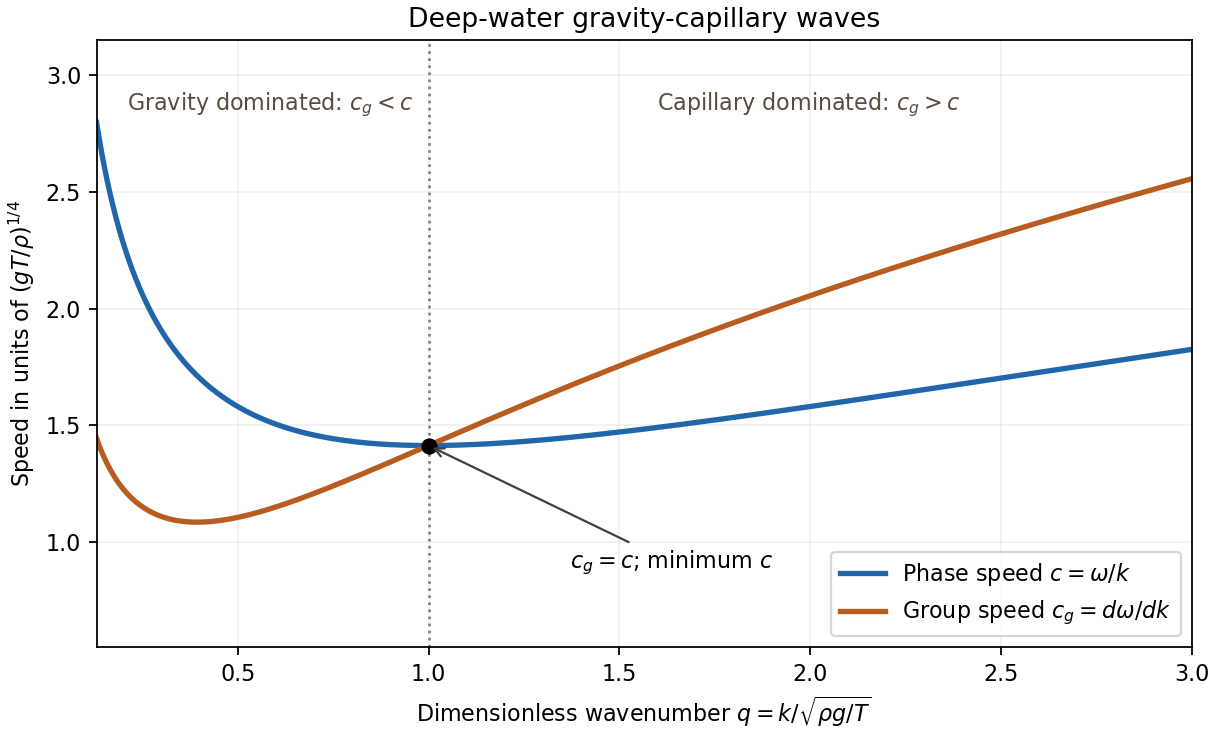
At first order in wave amplitude, the products and , the slope-squared correction to curvature, and displacement corrections in evaluating at are all higher order. Hence, on ,For , a harmonic velocity potential decaying as and satisfying the first condition isIndeed and . Substituting in the second condition yields the dispersion relation for a gravity-capillary wave:Taking the positive-frequency branch, the phase velocity and group velocity areSubtracting givesSince ,The threshold is also the wavenumber at the minimum phase speed of a gravity-capillary wave.

Articles were limited to the first 100 out of 175 total.
Articles by others on the same topic
There are currently no matching articles.