In the Breit-Wigner resonance cross section, is the total centre-of-momentum energy, the resonance energy, and either incident particle's center-of-momentum momentum magnitude. The total decay width is , while and are partial widths into the entrance and specified exit channels. Their ratios to are the corresponding branching fractions. The factor averages over incident spin states and sums over the resonance's magnetic substates.
In natural units, , the resonant partial-wave cross-sectional scale is an area proportional to the squared reduced de Broglie wavelength, . Equivalently a partial-wave scattering amplitude carries one factor , and its squared modulus supplies . In SI area units the same scale is ; if is expressed in energy units, multiply the final inverse-energy-squared answer by .
For unpolarized spin-half incident muons, the unpolarized resonance spin factor isHence and . The outgoing tau spins do not supply another independent multiplicity here: their allowed final states are already included in .
Near a narrow resonance, treat the smooth prefactor and the partial widths as constant across the line. At the peak the denominator is . Half its height occurs when , namely at . Thus the full width at half maximum is within the Breit-Wigner narrow-line approximation. A varying prefactor or convolution with the beam-energy distribution can modify an observed line shape.
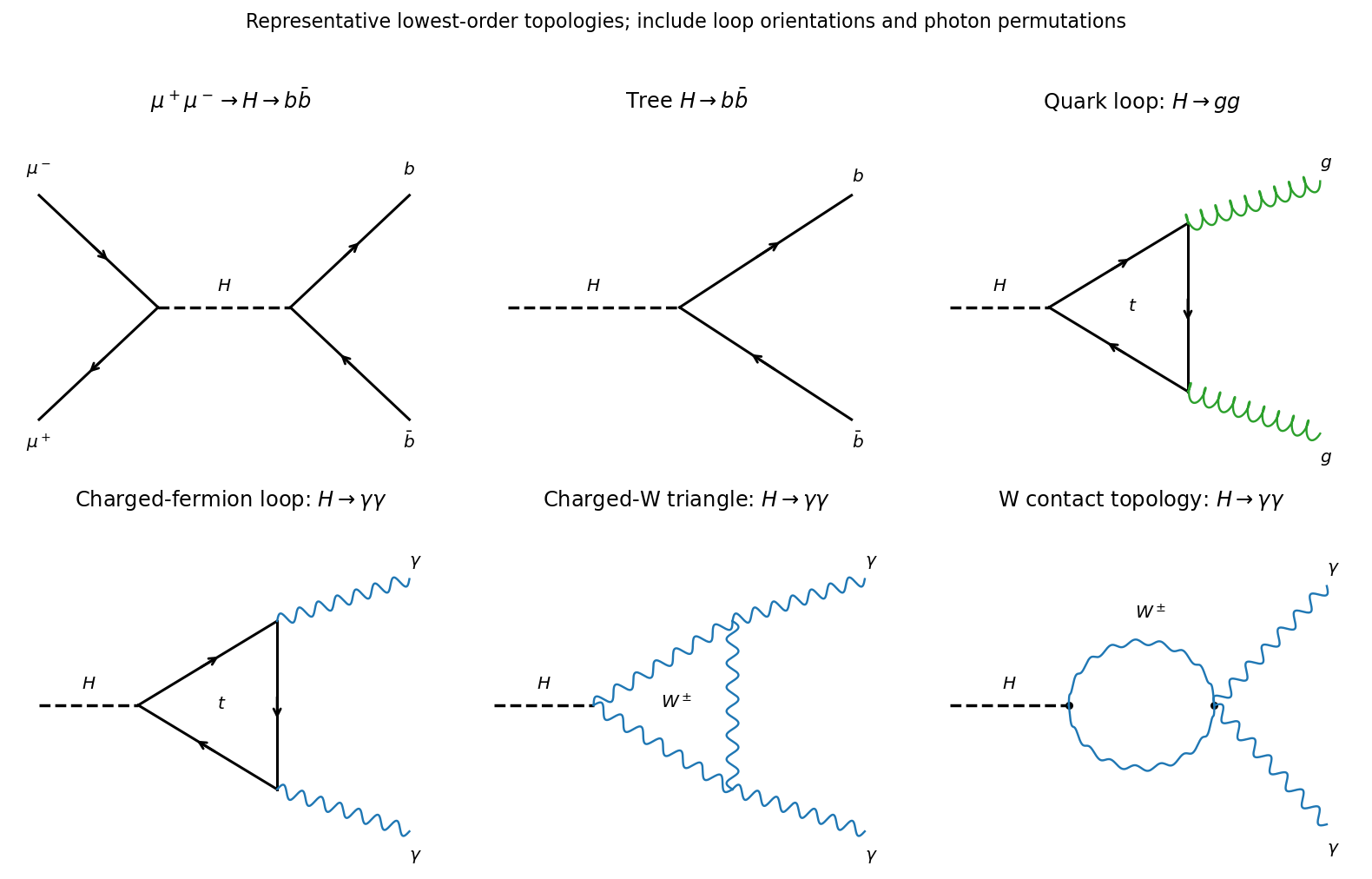

The production amplitude has a muon pair joined to a Higgs propagator through their Yukawa coupling, followed by the bottom-quark pair at a second Yukawa vertex. The separate graph is a tree-level Higgs–fermion vertex. There are no tree-level or vertices in the renormalizable Standard Model: their lowest nonzero graphs are loops. A quark triangle, dominated by the top contribution, produces two gluons. Charged-fermion triangles contribute to two photons; charged-W loops also contribute and are dominant in the Standard Model amplitude. Photon permutations and the W contact topology belong to the full amplitude; the diagram shows these topologies rather than claiming one triangle alone is the entire gauge-invariant W contribution.[ref]
At leading order the Higgs decay to a fermion pair hasEach quark contributes three distinguishable colour states, whereas a lepton has one. Neglecting the small phase-space factors for these masses, radiative corrections and the scale dependence of quark masses, the requested ratio isThe numerical masses here are those printed with question 3; the tau and electron approximations deliberately differ from those in question 1. Omitting the quark colour multiplicity would give the wrong relative rates.
Use the same leading-order assumptions as in part a. Let , so the partial widths are times their mass-squared and colour weights. The stated three-channel branching sum fixesThe Higgs branching-fraction normalization from mass-weighted channels therefore givesNo numerical value of is needed. At resonance, and , neglecting the incident muon mass in the kinematic factor. The peak resonance cross section and branching fractions relation givesUse the supplied rounded , rather than silently substituting a different conversion:This is the ideal unsmeared peak for the simplified inputs, not a beam-averaged collider event rate. Finite energy spread, radiation, polarization and radiative corrections require additional treatment.
The entrance Yukawa coupling is proportional to the incident lepton mass, so the partial Higgs width into that lepton pair is proportional to its mass squared. With the question's masses,The same factor enhances direct s-channel Higgs boson formation when all other factors are held fixed. The much larger muon Yukawa coupling motivates a muon-collider Higgs resonance. Heavier muons also radiate less strongly in a curved orbit, but their decay lifetime makes a collider technically demanding. The resonance remains narrow, so a sufficiently small beam-energy spread is essential to retain a large fraction of the ideal peak.
The inequality forbids two on-shell W bosons in a two-body final state. It does not forbid the four-fermion states reached through a virtual W propagator. The physical channel iswith at least one W off shell. The virtual particle need not satisfy ; the final stable particles still obey total four-momentum conservation. The W propagator and reduced phase space suppress the rate relative to an above-threshold two-on-shell-W decay, but do not make it zero. The label commonly includes this off-shell contribution to Higgs decay to two W bosons.
Articles by others on the same topic
There are currently no matching articles.