A positive-parity nuclear rotational band in an even-even nucleus has and excitation energiesThe four nonzero levels give . These approximately constant coefficients, together with the even-spin positive-parity sequence, support a rotational interpretation. The roughly eight-percent decline means a constant-inertia rigid rotor is only an approximation: the effective moment of inertia increases along the sequence.
Using the lowest excited level givesUsing the highest level instead gives , showing the scale of the departure from a constant inertia. This is a comparison of nuclear rotational inertia relative to a rigid sphere, not evidence for an exactly spherical rotating intrinsic state.
For a conventional size estimate, explicitly take a uniform sharp radius with and mass . These are standard scale approximations, not additional measured properties of this isotope supplied by the paper. They give andThus the fitted rotational inertia is substantially smaller than the rigid-body scale. Nuclear pairing provides a physical reason collective nuclear inertia need not equal the classical rigid-body value. The comparison's numerical radius dependence is explicit; it is not an independently determined radius.
A physical baryon is a colour singlet. Its three-quark colour factor is antisymmetric, proportional to . In the hypothetical scalar-quark theory, the quarks obey Bose-Einstein statistics, so the complete three-particle state must be symmetric under exchange. At the spatial factor is symmetric, and three zero spins supply no nontrivial spin factor. The flavour factor must therefore be antisymmetric to cancel the antisymmetry of the colour factor.
There is exactly one completely antisymmetric state made from three flavour basis states: the flavour singlet of three scalar quarks,Equivalently, . A repeated flavour gives zero under complete antisymmetrization. Only one ground-state flavour singlet, containing and having , remains. Keeping fermionic exchange antisymmetry while changing the spins to zero would contradict the assumed Spin-statistics theorem. The standard antisymmetric colour factor and the ordinary-quark flavour decomposition are documented in the quark-model review.[ref]
Review of Particle Physics by Particle Data Group (2022). Quark Model, §15.5, equations (15.22)–(15.24)
Use natural units and invariant squared center-of-mass energy . For a massless incident neutrino and an initially stationary electron,At the production threshold the final massless neutrino can have arbitrarily small center-of-mass energy, so the lower endpoint is . The charged-current neutrino-electron threshold is consequentlyFor the three flavours, using precisely the masses given in this part, the answers are for , for , and for . The zero threshold for the electron flavour is an infimum for elastic scattering; it does not imply a nonzero interaction rate at zero incident energy. The large heavy-lepton thresholds arise because most laboratory energy becomes center-of-mass motion against a very light target.
Evidence for quarks comes from several kinds of observation that test different aspects of their interpretation. The light meson and baryon spectra organize into approximate flavour multiplets with the charges and strangeness expected for and . In particular, the baryon octet and baryon decuplet encode the three light quark flavours and their spin couplings. This is an economical account of hadron quantum numbers, but spectroscopy alone would not establish that the constituents behave as localized scattering centers.
Deep inelastic scattering supplies that second test. In energetic electron–proton scattering the outgoing lepton measures the energy and momentum transferred through a virtual photon, while the broken-up target is summed over. Approximate Bjorken scaling means the structure functions depend primarily on rather than varying rapidly with the resolving momentum scale . It indicates nearly pointlike constituents. In the leading spin-half parton model,The charge-squared weights and the second relation test the constituents' fractional charges and spin-half nature. Scaling violations reflect quark and gluon radiation rather than a failure of the constituent picture.[ref]
Review of Particle Physics by Particle Data Group (2022). Structure Functions, §§18.1–18.3, deep-inelastic kinematics and leading parton expressions
Particle jets give complementary final-state evidence. A high-energy quark produces a collimated spray of hadrons because confinement prevents it from emerging as an isolated particle. Back-to-back jets fit quark–antiquark production; three-jet events show hard gluon radiation. Their angular correlations test a spin-one radiated parton. This distinguishes constituents of hadrons from a literal observation of free fractional-charge particles.
Three independent arguments identify an additional threefold colour degree of freedom. First, the spin-aligned state of a ground-state would have symmetric space, spin and flavour factors. The Pauli exclusion principle requires an antisymmetric additional factor. The three-quark colour singlet supplies it. The same construction accommodates the spin-aligned state of the without altering its measured quantum numbers.
Second, the inclusive hadronic R ratio, away from thresholds and narrow resonances, is at leading electromagnetic orderEach quark flavour has distinguishable colour final states. With , the predicted plateaux for three, four and five accessible flavours are , and ; without the factor three they would be a third as large. The measured inclusive normalization is therefore a colour-counting test, with radiative and threshold corrections included in precision comparisons.[ref]
Review of Particle Physics by Particle Data Group (2022). Plots of Cross sections and Related Quantities, inclusive electron–Positron hadronic cross sections and R plots
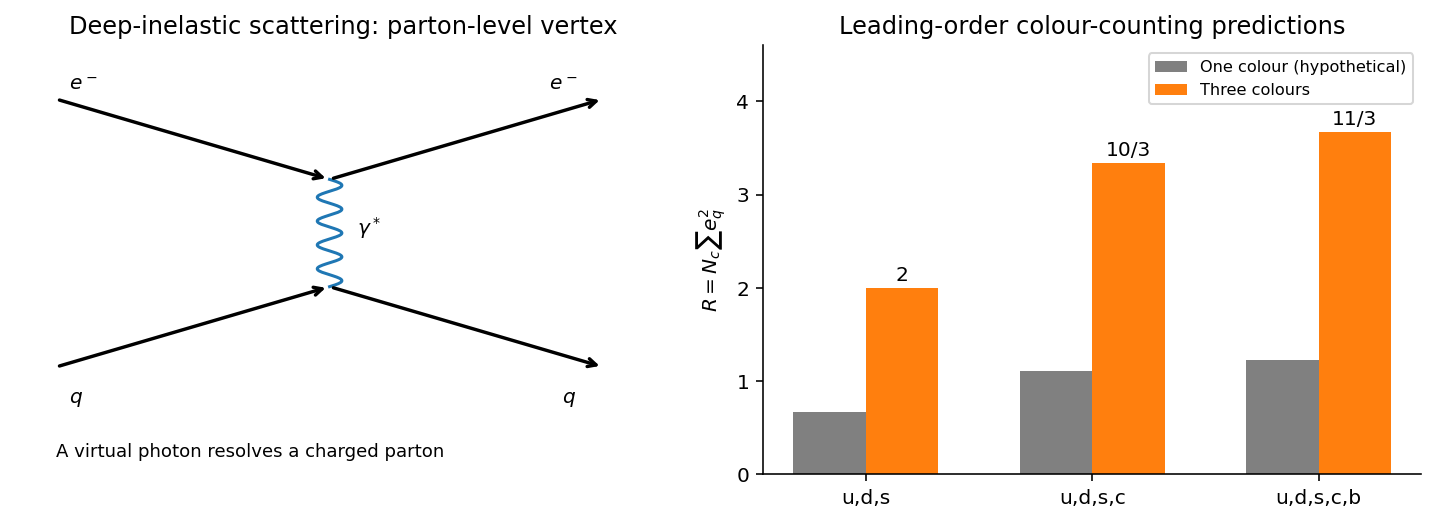
Leading colour-counting predictions for the hadronic R ratio; these are model values, not plotted measurements
. Details. Third, the neutral pion's two-photon amplitude contains a quark-loop colour sum, proportional to ; its rate and the other evidence are consistent with three colours. Quantum chromodynamics identifies this degree of freedom as a gauge charge, with eight gluons. Observed hadrons are colour singlets; the evidence for colour is its quantitative and symmetry consequences, not visible colours or isolated coloured quarks.
The common energetic principle behind nuclear fission and nuclear fusion is the nuclear binding energy. If the products are more tightly bound in total than the reactants, their smaller rest mass releasesThe two binding-energy expressions assume that the same numbers of protons and neutrons are counted on both sides; emitted free nucleons have zero nuclear binding. The energy appears mainly as product kinetic energy, with radiation and subsequent decays contributing according to the reaction.
The binding energy per nucleon rises rapidly through light nuclei, has a broad maximum in the iron/nickel region, and decreases more slowly for heavier nuclei. Combining suitable light nuclei can therefore increase their total binding, whereas splitting a sufficiently heavy nucleus into moderately heavy fragments can do the same. This is an energy comparison, not a rule that every fusion or fission channel is exothermic: the actual nuclear masses fix the sign of .
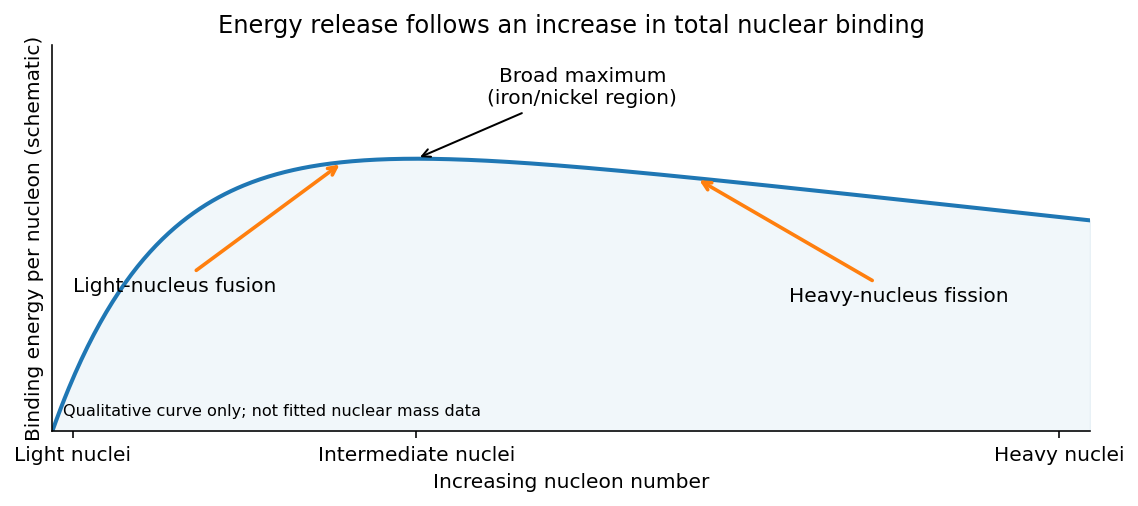
Schematic binding-energy trend explaining why light-nucleus fusion and heavy-nucleus fission can release energy
. Details. In nuclear fission, the liquid-drop model illustrates the competition between attractive short-range nuclear cohesion and long-range proton repulsive Coulomb interaction. Deformation increases surface area and costs surface energy, but separating the charge can reduce nuclear Coulomb energy. Their competition creates a fission barrier. An excited nucleus may pass over the barrier; spontaneous fission can occur through quantum tunnelling. The resulting fragments are often excited and neutron-rich, so they may emit prompt neutrons and photons and undergo later beta decay. The typical total energy released by a heavy-nucleus fission is of order a few hundred MeV, rather than an electronic-scale energy. Its size follows from an approximately MeV-per-nucleon binding gain summed over a heavy nucleus. A neutron from one fission can induce another; a nuclear chain reaction is the repeated physical process, distinct from the energy-release condition for one event.
In nuclear fusion, the initial charged nuclei repel one another. Exothermicity does not remove this entrance Coulomb barrier. A reaction requires sufficient overlap of their wavefunctions, achieved by energetic encounters and quantum tunnelling. For nonresonant low-energy charged-particle fusion, a useful separation isThe astrophysical S factor isolates the nuclear part from much of the rapidly varying Coulomb penetration probability. In a thermal population, the competition between the decreasing high-energy population and increasing penetration produces the Gamow peak. This explains how fusion can proceed below the classical barrier without requiring the mean thermal energy to equal its height.
Both processes conserve total energy, charge, baryon number and angular momentum. Their very different entrance barriers and mass ranges explain why a favorable value by itself does not specify a reaction rate. Short-range attraction gives approximately saturated nuclear binding, while surface, Coulomb, symmetry and pairing terms account for the broad trend and its isotope-dependent departures.
The deuteron is the bound proton–neutron system. Its ground state has and isospin , with binding energy approximately and no excited bound state. The small binding compared with characteristic nuclear energy scales produces an extended tail. With reduced mass , the asymptotic radial wavefunction decays as , whereThe decay length is not a sharp deuteron radius or the force range. It illustrates weak binding outside the region of strong attraction.
The observed total spin is consistent with aligned nucleon spins, , and a predominantly spatial state, . A central attraction identical in both spin–isospin channels would not distinguish this channel from a spin-singlet proton–neutron channel. In fact the triplet channel binds while the corresponding singlet channel does not. A realistic nuclear force must therefore distinguish these spin–isospin channels, for example through a term , whose eigenvalues are and in triplet and singlet states. The absence of a bound dineutron and diproton reinforces the need to distinguish channels; proton–proton Coulomb repulsion is an additional effect, not a complete explanation of the singlet nuclear interaction.
The clearest evidence against a purely central force is the nonzero electric quadrupole moment. A pure isotropic S-wave charge distribution would give zero. The deuteron quadrupole evidence for a tensor force instead points to a nuclear tensor force,It depends on how the spins point relative to the line joining the particles. It preserves total but couples orbital angular momenta differing by two, producingBoth terms have , and their interference permits a quadrupole moment. The 1939 theoretical analysis explicitly connected the measured quadrupole moment with such directional dependence.[ref]
The nuclear magnetic moment provides a second check. A pure aligned-spin S wave would give approximately , close to but larger than the observed deuteron value approximately . The discrepancy is consistent with non-S-wave structure and interaction-current corrections; it is not by itself a model-independent measurement of a D-state probability. The deuteron D-state admixture depends on the adopted Hamiltonian and electromagnetic current. The magnetic moments and mass differences used for these scales are tabulated physical constants.[ref]
A useful schematic interaction therefore contains central, spin-dependent and tensor terms, and possibly spin–orbit terms in other channels. Long-range one-pion exchange naturally supplies a tensor component, with its finite range set by the pion mass. The deuteron establishes an attractive triplet channel and a noncentral tensor interaction; a spin-independent central potential is insufficient.
In the Breit-Wigner resonance cross section, is the total centre-of-momentum energy, the resonance energy, and either incident particle's center-of-momentum momentum magnitude. The total decay width is , while and are partial widths into the entrance and specified exit channels. Their ratios to are the corresponding branching fractions. The factor averages over incident spin states and sums over the resonance's magnetic substates.
In natural units, , the resonant partial-wave cross-sectional scale is an area proportional to the squared reduced de Broglie wavelength, . Equivalently a partial-wave scattering amplitude carries one factor , and its squared modulus supplies . In SI area units the same scale is ; if is expressed in energy units, multiply the final inverse-energy-squared answer by .
For unpolarized spin-half incident muons, the unpolarized resonance spin factor isHence and . The outgoing tau spins do not supply another independent multiplicity here: their allowed final states are already included in .
Near a narrow resonance, treat the smooth prefactor and the partial widths as constant across the line. At the peak the denominator is . Half its height occurs when , namely at . Thus the full width at half maximum is within the Breit-Wigner narrow-line approximation. A varying prefactor or convolution with the beam-energy distribution can modify an observed line shape.
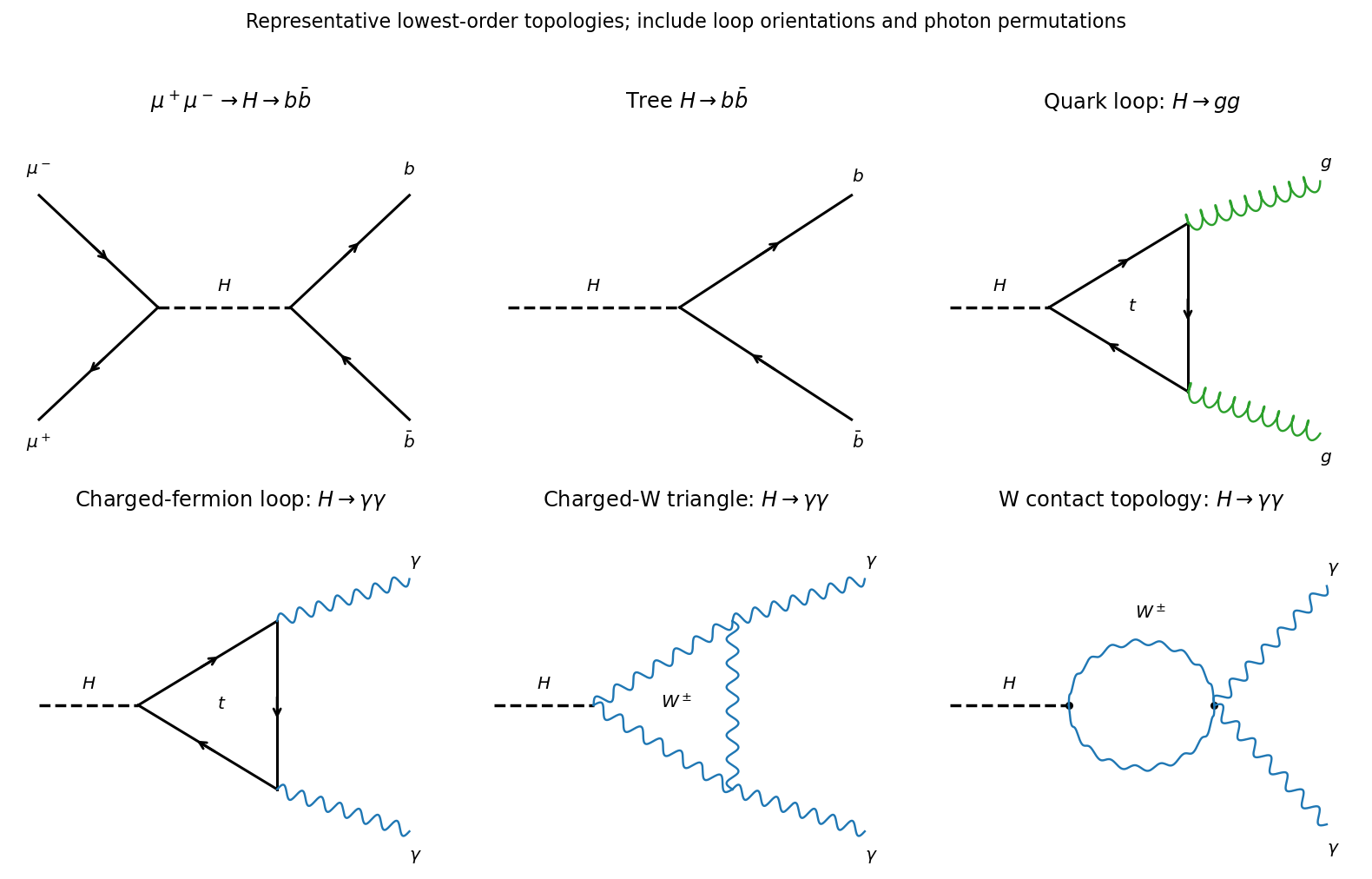


The production amplitude has a muon pair joined to a Higgs propagator through their Yukawa coupling, followed by the bottom-quark pair at a second Yukawa vertex. The separate graph is a tree-level Higgs–fermion vertex. There are no tree-level or vertices in the renormalizable Standard Model: their lowest nonzero graphs are loops. A quark triangle, dominated by the top contribution, produces two gluons. Charged-fermion triangles contribute to two photons; charged-W loops also contribute and are dominant in the Standard Model amplitude. Photon permutations and the W contact topology belong to the full amplitude; the diagram shows these topologies rather than claiming one triangle alone is the entire gauge-invariant W contribution.[ref]
At leading order the Higgs decay to a fermion pair hasEach quark contributes three distinguishable colour states, whereas a lepton has one. Neglecting the small phase-space factors for these masses, radiative corrections and the scale dependence of quark masses, the requested ratio isThe numerical masses here are those printed with question 3; the tau and electron approximations deliberately differ from those in question 1. Omitting the quark colour multiplicity would give the wrong relative rates.
Use the same leading-order assumptions as in part a. Let , so the partial widths are times their mass-squared and colour weights. The stated three-channel branching sum fixesThe Higgs branching-fraction normalization from mass-weighted channels therefore givesNo numerical value of is needed. At resonance, and , neglecting the incident muon mass in the kinematic factor. The peak resonance cross section and branching fractions relation givesUse the supplied rounded , rather than silently substituting a different conversion:This is the ideal unsmeared peak for the simplified inputs, not a beam-averaged collider event rate. Finite energy spread, radiation, polarization and radiative corrections require additional treatment.
The entrance Yukawa coupling is proportional to the incident lepton mass, so the partial Higgs width into that lepton pair is proportional to its mass squared. With the question's masses,The same factor enhances direct s-channel Higgs boson formation when all other factors are held fixed. The much larger muon Yukawa coupling motivates a muon-collider Higgs resonance. Heavier muons also radiate less strongly in a curved orbit, but their decay lifetime makes a collider technically demanding. The resonance remains narrow, so a sufficiently small beam-energy spread is essential to retain a large fraction of the ideal peak.
The inequality forbids two on-shell W bosons in a two-body final state. It does not forbid the four-fermion states reached through a virtual W propagator. The physical channel iswith at least one W off shell. The virtual particle need not satisfy ; the final stable particles still obey total four-momentum conservation. The W propagator and reduced phase space suppress the rate relative to an above-threshold two-on-shell-W decay, but do not make it zero. The label commonly includes this off-shell contribution to Higgs decay to two W bosons.
Beta decay converts a neutron to a proton or vice versa through the weak interaction, leaving the mass number fixed:Inside a nucleus the full initial and final nuclear masses determine whether either process is possible. Electron capture, , is the related bound-electron process. The emitted charged-lepton spectrum is continuous because energy is shared with the neutrino and nuclear recoil.
For allowed beta decay, the lepton wavefunctions' leading spatial terms are constant over the nucleus. A Fermi transition has and no parity change. A Gamow-Teller transition has and no parity change, excluding . Thus a same-parity transition with nonzero initial and final spins and can contain both contributions. First-forbidden transitions change parity and permit ; the case is unique forbidden beta decay. Higher forbiddenness requires higher powers of the small lepton momentum times nuclear size. “Forbidden” denotes suppression of the leading allowed operator, not an impossible decay.[ref]
Nuclear Data Sheets General Policies by National Nuclear Data Center. Physical PDF page 3, General Policies — Theory, Beta Transitions
Fermi's golden rule expresses a rate as a squared nuclear matrix element times leptonic phase space. Neglecting charged-lepton mass and Coulomb distortion, a constant allowed matrix element givesThis is the approximate Sargent rule, for comparable allowed strengths; it is not an exact law across arbitrary transitions. Finite electron mass, the Fermi function, forbidden shape factors and nuclear structure change the comparison. A microscopic first-forbidden unique operator introduces additional momentum factors.
Using bare nuclear masses , the kinetic-energy release isThe daughter is different in the two cases: its charge is for beta minus and for beta plus. The relevant mass difference must exceed one electron mass. For neutral atomic masses, to leading order in small electronic binding corrections, the corresponding expressions are and . Electron capture is energetically possible approximately when , with available shell binding energy and daughter excitation included. Nuclear masses and atomic masses must not be mixed.
The mirror nuclei have interchanged neutron and proton numbers. Neglect their strong-interaction binding difference and describe them with the same uniformly charged sharp sphere of radius . The nuclear Coulomb energy isChanging one neutron into a proton decreases the nucleon rest-mass sum by , but raises the Coulomb energy. The diagram gives for nuclear masses, soWith the standard electromagnetic conversion , the uniform-sphere Coulomb displacement energy estimate isThis is the uniform sphere's outer radius. If “charge radius” means the rms nuclear charge radius, the same distribution givesThe numerical result is an estimate within the charge-density model, not a model-independent radius measurement. A discrete-proton correction replaces by , giving and . The main answer above follows the literal continuum charged-sphere model. Strong isospin-breaking, nonuniform density and changes in the valence-nucleon distribution also limit the extraction.
Read the spin and parity from the actual diagram: N and Ne have ground states; O and F have ground states. The N→O beta-minus branch and Ne→F beta-plus branch therefore both have with a parity change: both are first-forbidden unique. The F→O beta-plus branch has : it is allowed and can contain both Fermi and Gamow-Teller contributions.
The Ne ground-state branch is , as explicitly printed on the diagram, not as a probability. The prose leaves off its percent sign. Interpret the supplied “lifetimes” as mean lifetimes , so each partial decay rate is , with no extra . ThenA decay width in energy units is , rather than a rate. Thus the corresponding partial energy widths, in the same order N, F, Ne, are , and . If a different convention used the supplied numbers as half-lives, all these rates and widths would acquire ; their ratios would be unchanged. The literal mean-lifetime convention is used throughout.
The bracketed diagram energies are nuclear, so subtract one electron rest energy from each parent-to-daughter energy difference. The three kinetic-energy endpoints areThe observed partial-rate ratios are and .
To obtain the simple Sargent-law estimates, define an effective strength by , using the same normalization . ThenThus the two forbidden branches have effective strengths of the same broad order, whereas the N ground-state branch is highly suppressed relative to the allowed F branch after this approximate fifth-power kinematic scaling. The first comparison involves mirror transitions with related nuclear configurations; order-of-magnitude similarity is reasonable, without expecting exact equality from this estimate.
These effective strengths must not be confused with precisely extracted microscopic reduced nuclear matrix elements. Both N and Ne ground-state branches are first-forbidden unique, for which the first-forbidden unique beta-decay phase space contains an additional factor proportional to . In the massless, no-Coulomb limit this gives , so using the same microscopic unique-forbidden normalization for those two branches instead yieldsComparing a unique-forbidden reduced operator directly with an allowed reduced operator also requires a convention for its powers of length and momentum. The number is consequently an effective Sargent-normalized suppression, not a universal dimensionless ratio between different operator ranks. Electron-mass and opposite-sign Coulomb corrections matter, particularly for the low-energy F branch. The data justify approximate strength comparisons; they do not fix precision nuclear matrix elements without these extra ingredients.
The state marked X in F is the analogue at excitation. Its absolute nuclear energy relative to O is . HenceIt is a same-spin, same-parity allowed beta decay between isobaric analog states. The large analogue Fermi overlap makes it a superallowed analogue transition, in the broad analogue-state terminology. Since rather than zero, this classification does not exclude a Gamow-Teller contribution.
For a transparent numerical estimate, take the Fermi part to dominate both this branch and the reference F-ground-state decay, neglect Coulomb and electron-mass corrections in their phase-space ratio, and use the Sargent rule. For , Ne has and goes from to in its analogue multiplet. The isospin ladder strength in analogue beta decay is therefore three. The F→O ground-state mirror transition in has Fermi strength one. Thus the analogue beta-decay branching estimate givesThis percent-level result is an estimate under the stated assumptions, not a unique consequence of the level diagram. More generally, if denotes an allowed phase-space integral and , thenThe diagram fixes the Fermi strengths but not both axial strengths. Including them and proper Positron phase-space functions changes the numerical result. Assuming equal total allowed strengths instead of the Fermi-only ratio three would give approximately ; that alternative makes a different nuclear-structure assumption. The rate enhancement from removing the forbiddenness explains why the X branch can be appreciable despite its much smaller endpoint than the Ne ground-state branch.
Articles by others on the same topic
There are currently no matching articles.