The primordial-element abundances from Big Bang nucleosynthesis, together with the cosmic microwave background, constrain the total baryonic density. massive compact halo objects such as ordinary faint stars, brown dwarfs and stellar remnants are baryonic whether or not they shine. With the stipulated density fractions, the entire baryonic budget is only one fifth of the required dark-matter density, and much of it is already accounted for by ordinary gas and stars.
A second test does not require a compact object to emit light: gravitational microlensing temporarily magnifies a background star as the object crosses the line of sight. Monitoring many Magellanic-Cloud stars constrains the microlensing optical depth and event-duration distribution. Surveys such as EROS-2 found too few suitable events for a standard halo predominantly composed of compact objects over their tested mass range.[ref]
Limits on the Macho Content of the Galactic Halo from the EROS-2 Survey of the Magellanic Clouds by the EROS-2 Collaboration. Abstract and halo-fraction limits; mass-dependent detection efficiency
Artificial-event injection, cadence and blending corrections are needed because very short or long events are easily missed; lensing by stars within the Clouds must also be separated from halo lensing. These are mass-range and halo-model constraints, not a proof excluding every compact-object mass. Primordial black holes are not limited by the ordinary-baryon budget in the same way as stellar remnants; their viability requires their own observational bounds.Standard Model active neutrinos decouple while relativistic and retain a thermal momentum distribution. They therefore constitute hot dark matter for the light masses compatible with the standard cosmological picture. Their collisionless free streaming erases linear cosmological density perturbations below a characteristic scale. Making them the dominant gravitating matter would delay small-scale structure formation and suppress the observed matter power spectrum.
For standard thermal abundances and nonrelativistic neutrinos today,Increasing the mass sum enough to provide all the stipulated dark matter conflicts with the successful cold dark matter description of cosmological structure. Independently, the Tremaine-Gunn bound on the fermionic phase-space occupation limits the density light neutrinos can supply in small galactic haloes.[ref]
Dynamical Role of Light Neutral Leptons in Cosmology by Scott Tremaine and James Edward Gunn. Pages 407–410, collisionless phase-space bound
Oscillations establish nonzero neutrino mass differences, but do not make the relic neutrinos cold. Active neutrinos can contribute some matter; they cannot supply the dominant cold component. A heavier sterile neutrino candidate would be a different hypothesis, not an ordinary Standard Model relic.Particle candidate. A stable, electrically neutral weakly interacting massive particle can become nonrelativistic before cosmological particle freeze-out. Its annihilation rate per particle eventually falls below the Hubble parameter; the surviving comoving number then remains approximately fixed. A weak-scale annihilation cross section can give a cosmologically significant thermal relic. This is a mechanism and a parameter-scale motivation, not a guarantee that every weakly interacting particle has the right abundance.
supersymmetry supplies neutralinos, mixtures of neutral electroweak gauginos and higgsinos. If a neutralino is the lightest supersymmetric particle and R-parity is conserved, it cannot decay solely into Standard Model particles and is stable. Its electroweak interactions can make it a WIMP. Conservation of R-parity and a neutral lightest state are additional assumptions; R-parity violation, coannihilation, composition and resonant annihilation can substantially change the conclusion.
An underground test. XENON100 at Gran Sasso used a liquid-xenon target in a two-phase time projection chamber. A WIMP scattering elastically from a xenon nucleus could produce a low-energy nuclear recoil. The interaction makes prompt particle scintillation, S1, and ionization electrons. An electric field drifts the electrons upward; their extraction into xenon gas produces delayed electroluminescence, S2. The delay measures depth, while the S2 light pattern determines the transverse position. An inner fiducial volume suppresses surface backgrounds through xenon self-shielding; underground overburden reduces cosmic-ray muons, and shielding and material selection reduce radioactivity.[ref]
The XENON100 Dark Matter Experiment by the XENON100 Collaboration. Detector design, signal formation and background-rejection principles
The S2/S1 ratio separates most electron recoils from nuclear recoils. Gamma-source calibration maps the electron-recoil leakage; an americium–beryllium neutron source calibrates nuclear-recoil response and cut acceptance. Purity and position corrections must be measured, and selection fixed before unblinding the search region. neutrons can themselves produce single nuclear recoils, so discrimination is not perfect; material assays and transport simulations constrain this background. In the 224.6-live-day, 34-kg analysis, two candidate events were compatible with the expected background events. The result constrained scattering cross sections rather than establishing a discovery.[ref]
Dark Matter Results from 225 Live Days of XENON100 Data by the XENON100 Collaboration. Pages 2–4, calibration, blinded selection, neutron background and candidate counts
A predicted count also depends on the local dark matter halo density, distribution of velocities, recoil threshold and nuclear response. Thus a null result constrains a particle model under stated astrophysical assumptions; it does not exclude all dark matter. A collider missing-momentum signal would likewise need independent evidence for a cosmological lifetime.
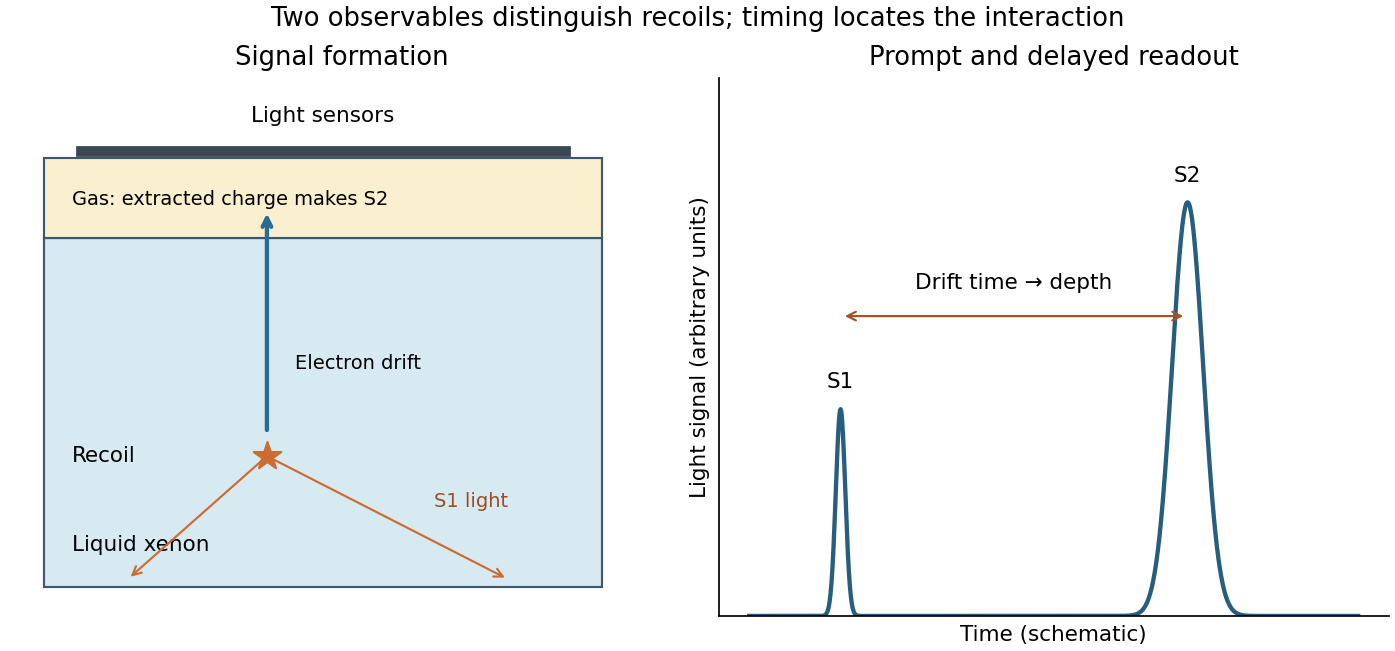
Original functional schematic of prompt light and delayed charge readout in a two-phase xenon detector
. Details. 
Relic energy density in the stipulated freeze-out approximation. Let and . Writing the given distribution in energy units givesBy sharp-freeze-out relic dilution, after cosmological particle freeze-out conserve particle number, . In the approximation for the background bath,Inserting the printed inputs yieldsand henceThis is approximately of the stipulated dark-matter energy density, , so the toy calculation gives the right order and is close to the target. At fixed the cancellation of in is exact for the given prefactor, while the present energy density remains proportional to .
The equilibrium exponential must be evaluated at freeze-out, not at today's temperature: equilibrium no longer maintains the particle number afterward. More accurately, comoving entropy conservation gives and multiplies the displayed by , when both counts use the same bath-temperature convention. Thus is the constant- estimate supported by the supplied toy model. A refined abundance would require additional entropy degrees of freedom and annihilation history: realistic entropy release, gradual freeze-out and the model's annihilation channels matter.
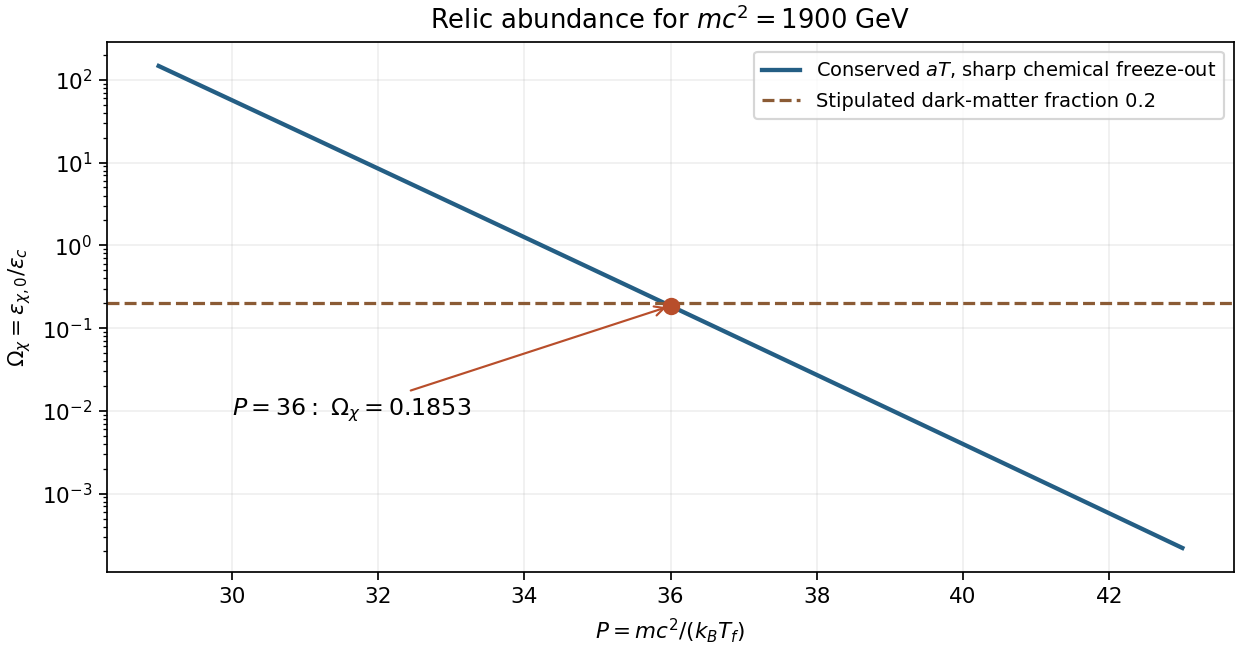
Original calculation of the relic-density sensitivity to freeze-out parameter, with the printed mass and constant-entropy-degrees approximation
. Details. 
Articles by others on the same topic
There are currently no matching articles.