Original solutions for the shared Physics and Astrophysics paper. [ref]
https://www.whatdotheyknow.com/request/natural_science_tripos_physics_e_2/response/2340776/attach/2/FOI%202023%20399%20Zahid%20materials.pdf?cookie_passthrough=1. Original examination PDF, physical pages 755–757
Cosmological variables and conventions. The scale factor describes the relative separation of comoving observers; dots denote derivatives with respect to cosmic time . The Hubble parameter is , usually time dependent; “Hubble constant” conventionally means its present value. Here is mass-equivalent density, so is energy density, while is isotropic pressure. is the gravitational constant and the speed of light. The constant specifies cosmological spatial curvature: with a length, and describe closed, flat and open spatial geometries. Alternative normalizations of move a constant factor into . In the printed equations has units : it is times a cosmological constant defined in inverse square metres. This time-unit convention for the cosmological constant prevents a missing factor of .
Continuity and the first law. Differentiating the first Friedmann equation with constant and , and then eliminating with the second, givesThus, on an expanding or contracting branch,The relation extends continuously to a regular turning point. For a physical volume bounded by fixed comoving coordinates, . Multiplication by givesThis adiabatic work in a comoving volume is the first law of thermodynamics for adiabatic evolution with fixed entropy and no additional chemical work. It expresses local energy conservation, including pressure work. It does not assert that is constant: radiation loses internal energy as it does work; negative pressure makes grow during expansion. A generic expanding spacetime has no global time-translation symmetry from which a conserved total energy follows.
Constant scalar-field energy density. Setting in the continuity equation, with , givesFor a homogeneous canonical scalar field, in units , and . A stationary potential-dominated field has precisely this equation of state. A general evolving scalar field need not have ; the constant-density assumption is essential.
Expansion at the stipulated Higgs energy density. With zero explicit and zero , constant givesThe plus sign selects the expanding branch; there is also a contracting solution. The scalar-field energy is already included in , so adding it again as an explicit cosmological constant would double count it. Using gives , and . ThereforeThis vacuum-dominated doubling time describes accelerated expansion in de Sitter spacetime, with . The stipulated energy density exceeds the critical density in energy units used in Question 2 by , so it cannot persist as the dominant component of the present universe. The calculation exhibits the cosmological constant problem: the absolute gravitational vacuum energy must be enormously smaller than such a particle-physics scale today. It does not establish that the Standard Model Higgs field actually remains constant or supplies a viable inflationary epoch.
The acoustic ruler and accelerated expansion. Before baryon drag becomes ineffective, pressure in the photon-baryon fluid drives acoustic waves around initial linear cosmological density perturbations. Their comoving sound horizon at the baryon drag epoch isAfter decoupling, this preferred separation survives in galaxy clustering as baryon acoustic oscillations: a peak in the two-point correlation function and oscillations in the matter power spectrum. Its value is calibrated by early-universe physics, commonly constrained by the cosmic microwave background. The SDSS luminous-red-galaxy measurement established a peak near ; its use as a distance indicator depends on the ruler calibration rather than the length of an individual galaxy.[ref]
Detection of the Baryon Acoustic Peak in the Large-Scale Correlation Function of SDSS Luminous Red Galaxies by Daniel Eisenstein and others. Abstract and Sections 2–5, correlation-function peak and distance-scale interpretation
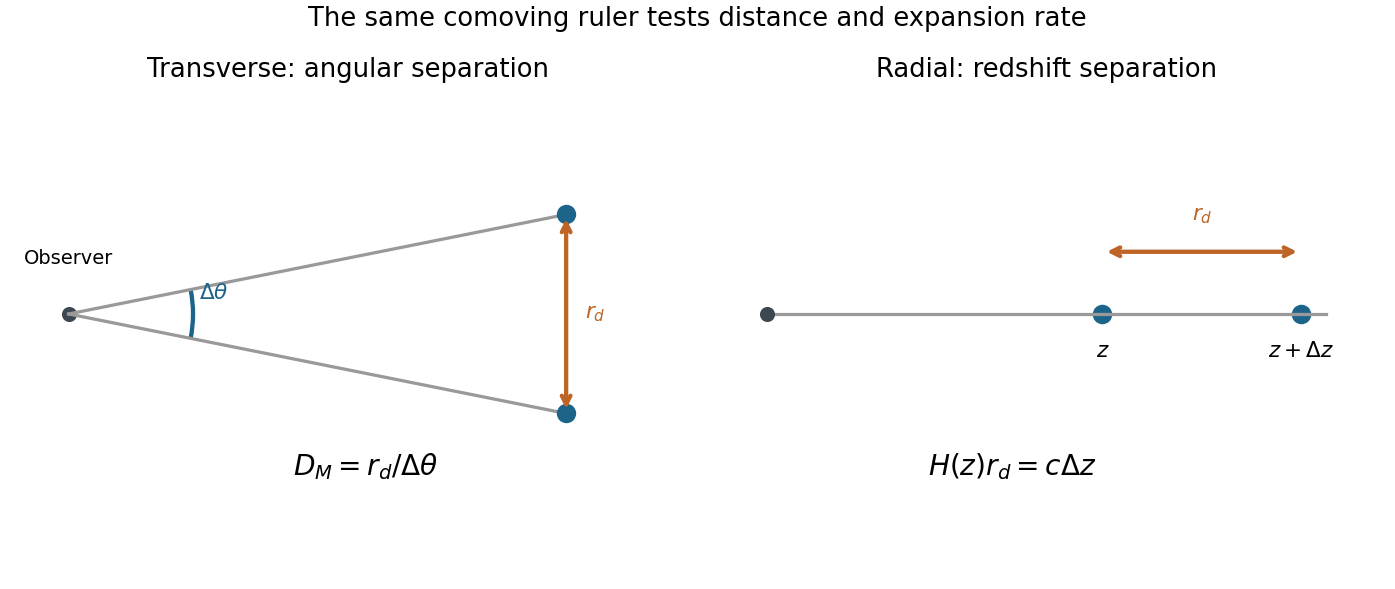
For a ruler perpendicular to the line of sight and one parallel to it,where is the transverse comoving distance and the angular diameter distance. These measure and , respectively. Comparing multiple redshifts tests the distance–redshift relation and expansion history. In particular,so sufficiently precise measurements of the shape of can test . In general relativity, accelerated expansion requires a sufficiently negative total ; a positive cosmological constant supplies it.
A single acoustic angular scale does not independently determine acceleration, cosmological spatial curvature, the absolute sound horizon and the dark-energy equation of state. One combines redshift coverage with early-universe calibration and independent matter-density or distance information, comparing accelerating and nonaccelerating models. The galaxy selection function and redshift completeness must be modeled with random catalogues, survey covariance estimated with mock catalogues, and redshift-space distortions, galaxy bias and nonlinear broadening controlled. These tests distinguish a cosmological feature from a survey artifact. The evidence is the measured expansion history within an explicit cosmological framework, rather than the existence of an acoustic peak alone.

The primordial-element abundances from Big Bang nucleosynthesis, together with the cosmic microwave background, constrain the total baryonic density. massive compact halo objects such as ordinary faint stars, brown dwarfs and stellar remnants are baryonic whether or not they shine. With the stipulated density fractions, the entire baryonic budget is only one fifth of the required dark-matter density, and much of it is already accounted for by ordinary gas and stars.
A second test does not require a compact object to emit light: gravitational microlensing temporarily magnifies a background star as the object crosses the line of sight. Monitoring many Magellanic-Cloud stars constrains the microlensing optical depth and event-duration distribution. Surveys such as EROS-2 found too few suitable events for a standard halo predominantly composed of compact objects over their tested mass range.[ref]
Limits on the Macho Content of the Galactic Halo from the EROS-2 Survey of the Magellanic Clouds by the EROS-2 Collaboration. Abstract and halo-fraction limits; mass-dependent detection efficiency
Artificial-event injection, cadence and blending corrections are needed because very short or long events are easily missed; lensing by stars within the Clouds must also be separated from halo lensing. These are mass-range and halo-model constraints, not a proof excluding every compact-object mass. Primordial black holes are not limited by the ordinary-baryon budget in the same way as stellar remnants; their viability requires their own observational bounds.Standard Model active neutrinos decouple while relativistic and retain a thermal momentum distribution. They therefore constitute hot dark matter for the light masses compatible with the standard cosmological picture. Their collisionless free streaming erases linear cosmological density perturbations below a characteristic scale. Making them the dominant gravitating matter would delay small-scale structure formation and suppress the observed matter power spectrum.
For standard thermal abundances and nonrelativistic neutrinos today,Increasing the mass sum enough to provide all the stipulated dark matter conflicts with the successful cold dark matter description of cosmological structure. Independently, the Tremaine-Gunn bound on the fermionic phase-space occupation limits the density light neutrinos can supply in small galactic haloes.[ref]
Dynamical Role of Light Neutral Leptons in Cosmology by Scott Tremaine and James Edward Gunn. Pages 407–410, collisionless phase-space bound
Oscillations establish nonzero neutrino mass differences, but do not make the relic neutrinos cold. Active neutrinos can contribute some matter; they cannot supply the dominant cold component. A heavier sterile neutrino candidate would be a different hypothesis, not an ordinary Standard Model relic.Particle candidate. A stable, electrically neutral weakly interacting massive particle can become nonrelativistic before cosmological particle freeze-out. Its annihilation rate per particle eventually falls below the Hubble parameter; the surviving comoving number then remains approximately fixed. A weak-scale annihilation cross section can give a cosmologically significant thermal relic. This is a mechanism and a parameter-scale motivation, not a guarantee that every weakly interacting particle has the right abundance.
supersymmetry supplies neutralinos, mixtures of neutral electroweak gauginos and higgsinos. If a neutralino is the lightest supersymmetric particle and R-parity is conserved, it cannot decay solely into Standard Model particles and is stable. Its electroweak interactions can make it a WIMP. Conservation of R-parity and a neutral lightest state are additional assumptions; R-parity violation, coannihilation, composition and resonant annihilation can substantially change the conclusion.
An underground test. XENON100 at Gran Sasso used a liquid-xenon target in a two-phase time projection chamber. A WIMP scattering elastically from a xenon nucleus could produce a low-energy nuclear recoil. The interaction makes prompt particle scintillation, S1, and ionization electrons. An electric field drifts the electrons upward; their extraction into xenon gas produces delayed electroluminescence, S2. The delay measures depth, while the S2 light pattern determines the transverse position. An inner fiducial volume suppresses surface backgrounds through xenon self-shielding; underground overburden reduces cosmic-ray muons, and shielding and material selection reduce radioactivity.[ref]
The XENON100 Dark Matter Experiment by the XENON100 Collaboration. Detector design, signal formation and background-rejection principles
The S2/S1 ratio separates most electron recoils from nuclear recoils. Gamma-source calibration maps the electron-recoil leakage; an americium–beryllium neutron source calibrates nuclear-recoil response and cut acceptance. Purity and position corrections must be measured, and selection fixed before unblinding the search region. neutrons can themselves produce single nuclear recoils, so discrimination is not perfect; material assays and transport simulations constrain this background. In the 224.6-live-day, 34-kg analysis, two candidate events were compatible with the expected background events. The result constrained scattering cross sections rather than establishing a discovery.[ref]
Dark Matter Results from 225 Live Days of XENON100 Data by the XENON100 Collaboration. Pages 2–4, calibration, blinded selection, neutron background and candidate counts
A predicted count also depends on the local dark matter halo density, distribution of velocities, recoil threshold and nuclear response. Thus a null result constrains a particle model under stated astrophysical assumptions; it does not exclude all dark matter. A collider missing-momentum signal would likewise need independent evidence for a cosmological lifetime.
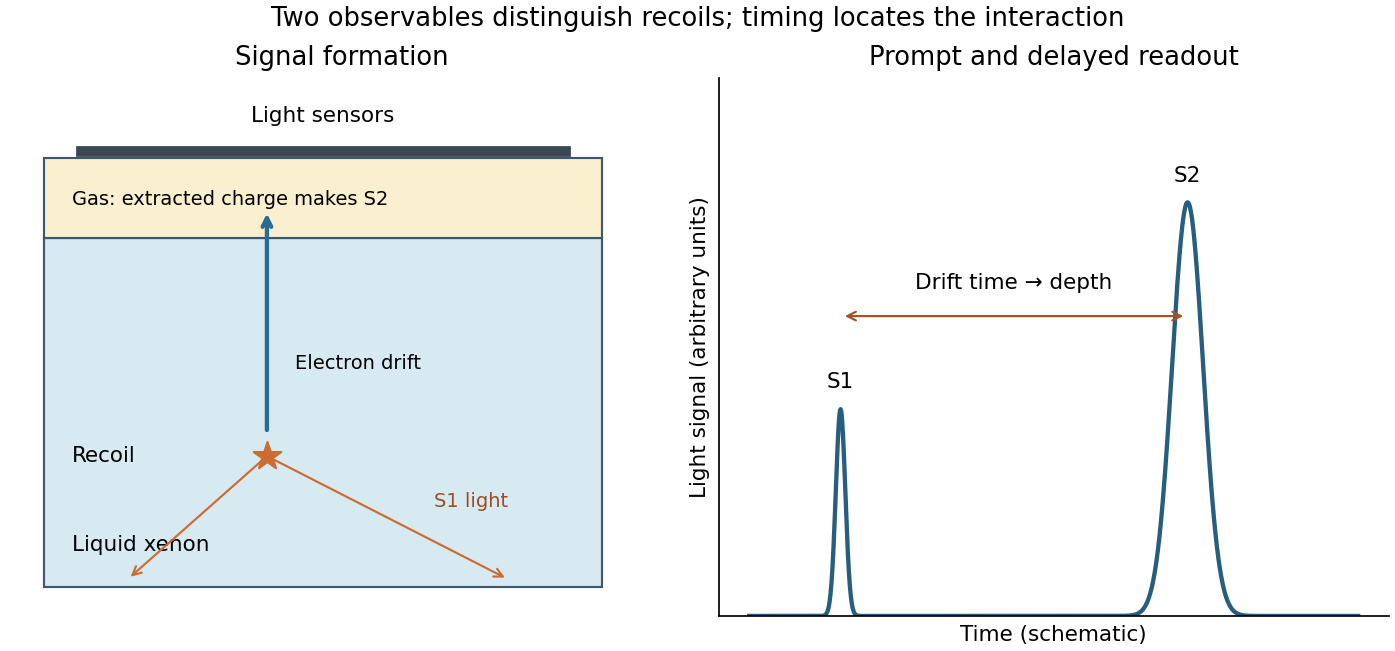
Original functional schematic of prompt light and delayed charge readout in a two-phase xenon detector
. Details. 
Relic energy density in the stipulated freeze-out approximation. Let and . Writing the given distribution in energy units givesBy sharp-freeze-out relic dilution, after cosmological particle freeze-out conserve particle number, . In the approximation for the background bath,Inserting the printed inputs yieldsand henceThis is approximately of the stipulated dark-matter energy density, , so the toy calculation gives the right order and is close to the target. At fixed the cancellation of in is exact for the given prefactor, while the present energy density remains proportional to .
The equilibrium exponential must be evaluated at freeze-out, not at today's temperature: equilibrium no longer maintains the particle number afterward. More accurately, comoving entropy conservation gives and multiplies the displayed by , when both counts use the same bath-temperature convention. Thus is the constant- estimate supported by the supplied toy model. A refined abundance would require additional entropy degrees of freedom and annihilation history: realistic entropy release, gradual freeze-out and the model's annihilation channels matter.
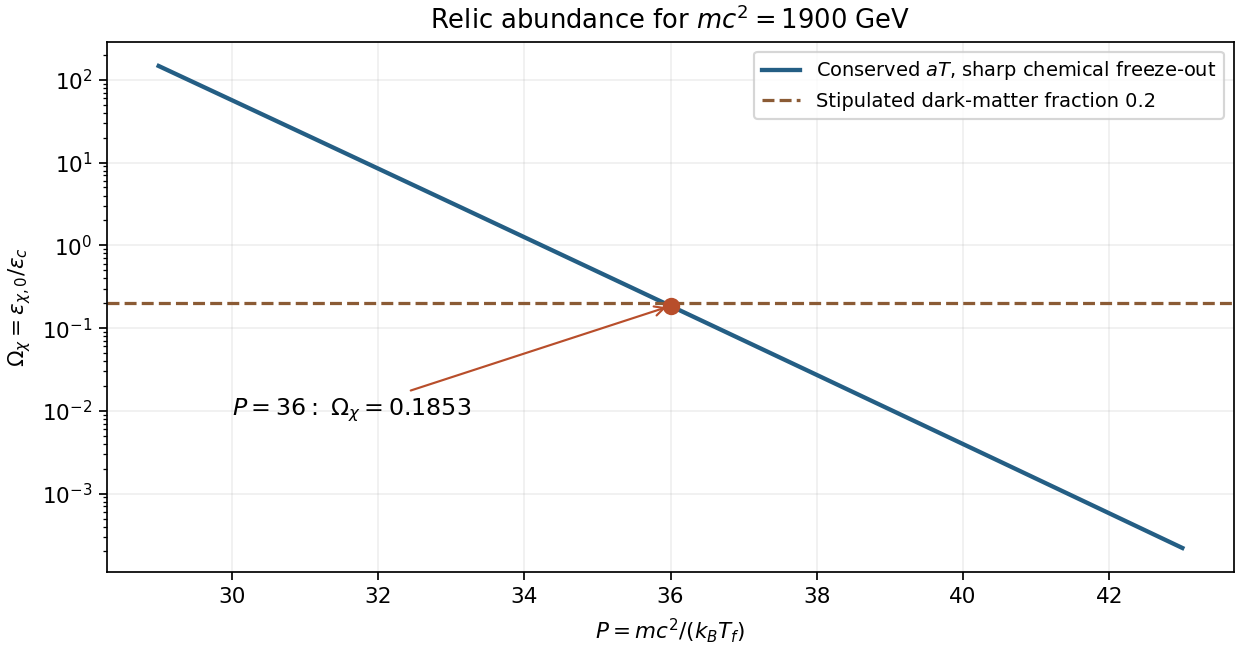
Original calculation of the relic-density sensitivity to freeze-out parameter, with the printed mass and constant-entropy-degrees approximation
. Details. 
When a cosmological phase transition breaks a symmetry to a subgroup , the degenerate vacuum configurations form a vacuum manifold . Causally separated regions need not choose the same vacuum orientation. The Kibble mechanism explains how joining those choices can leave a field configuration that cannot be continuously deformed to a uniform vacuum without leaving . The field then stores energy in a defect core, gradients or gauge fields.[ref]
Topology of cosmic domains and strings by Thomas Walter Bannerman Kibble. Sections on vacuum topology, domains and strings
The relevant homotopy classification of cosmological defects uses the vacuum map on a surface surrounding a proposed defect:A domain wall separates different disconnected vacua. A cosmic string has nonzero winding number on a loop around its core. A magnetic monopole has a nontrivial vacuum map on an enclosing sphere. Nontrivial can instead support cosmological texture configurations extending over a volume; cosmological textures can unwind dynamically by leaving the vacuum manifold and need not possess a permanently localized stable core. Nontrivial topology permits a defect; formation efficiency, interactions and the cosmological history still determine its abundance.
For example, a complex scalar with a circular set of minima can wind by around a cosmic string. Continuity forces the field away from its vacuum value near the core. A local gauge symmetry allows gauge fields to screen much of the exterior gradient and trap flux, whereas a global symmetry leaves long-range Goldstone-field gradients. Thus local and global cosmic strings have different energy-loss channels; they should not be treated as identical networks.
Relic defects can be tightly constrained because their energy dilutes differently from radiation. Nonrelativistic magnetic monopoles approximately dilute as , so excessive production causes the cosmological monopole problem. A roughly frozen wall network has energy density proportional to , even slower dilution. An evolving cosmic string network can approach a scaling regime with characteristic separation proportional to cosmic time and density of order in units, losing energy into loops and radiation. That is a dynamical network statement, not the dilution law of a fixed collection of cosmic strings.
cosmic inflation can dilute defects made before it; reheating and later symmetry breaking must not regenerate an unacceptable abundance. Observational tests include microwave-background anisotropy, gravitational lensing by cosmic strings, gravitational radiation from string loops, and searches for magnetic monopoles. Each is sensitive to model-dependent tensions, couplings and evolution. Defects are possible relics of symmetry breaking, not an inevitable dominant dark-matter population. Their absence constrains a transition and its subsequent history rather than every theory possessing a nontrivial vacuum topology.
supersymmetry predicts partners with spins differing by one half. At a proton collider, strongly interacting squarks and gluinos can be pair produced if kinematically accessible. With conserved R-parity, their cascade decays end in a stable lightest supersymmetric particle, often a neutralino. The generic signature is energetic particle jets, possibly leptons or heavy-flavour jets, together with missing transverse momentum from invisible particles. Longitudinal missing momentum is not an equally clean observable because the initial parton momentum fractions are unknown.
A practical inclusive search defines collider signal regions using jet multiplicity, transverse momenta, missing transverse momentum and an event scale such asLeptonic and heavy-flavour selections probe other decay chains. For a compressed supersymmetric spectrum, the daughter particles can be soft, making a hard initial-state radiation jet useful for triggering and recoil. Direct chargino or neutralino production instead motivates multilepton searches. Decays with R-parity violation can yield high jet or lepton multiplicities with little missing momentum, and long-lived particles motivate displaced vertices, disappearing tracks or anomalous ionization. No single selection covers all these cases.
The difficult issue is background inference. Invisible decay with jets is a real missing-momentum background: a photon-plus-jets sample or reconstructed decays to charged leptons constrains its normalization and recoil shape through modeled transfer factors. A single-lepton collider control region constrains and top backgrounds whose charged lepton is missed in the collider signal region. Jet mismeasurement in ordinary multijet events gives instrumental missing momentum; angular cuts, detector-quality checks and control samples test that tail. Validation regions check these extrapolations without tuning on the final signal count.
detector acceptance, trigger efficiency, jet calibration, collider luminosity, theoretical production rates and transfer factors enter a likelihood as nuisance parameters. One compares the observed signal-region distribution with background-only and signal-plus-background hypotheses, using a profile likelihood and reporting exclusions for specified masses, branching fractions and spectra. As a pre-examination example, the 2014 ATLAS zero-lepton jets-plus-missing-momentum search used at and found no significant excess. Its interpretation depended on R-parity conservation and a neutralino lightest state; different simplified models gave different mass exclusions.[ref]
A null search excludes the tested parameter region, not supersymmetry as a whole. Conversely, a missing-momentum excess alone would not establish supersymmetry: one would need consistent masses, decay chains, couplings and eventually spin information. A stable particle on detector flight-time scales is not thereby proved stable for the age of the universe.
The inference of dark matter uses a gravitational law to turn observed motions and lensing into a mass distribution. modified gravity asks whether some discrepancies instead reveal a breakdown of that law. The strongest motivation at galactic scales is the regular relation between baryonic structure and galaxy rotation curves, including approximately flat outer rotation speeds and the baryonic Tully-Fisher relation.
In modified Newtonian dynamics, the low-acceleration spherical relation is , with at high acceleration and at low acceleration. For an isolated baryonic mass in the latter regime,Thus an asymptotically flat rotation curve and a fourth-power mass–speed relation arise from a common acceleration scale, without assigning an independent halo profile to every galaxy. This is a substantive phenomenological motivation. Distances, stellar mass-to-light ratios, gas distributions and the external gravitational environment must still be controlled.[ref]
A modification of the Newtonian dynamics as a possible alternative to the hidden mass hypothesis by Mordehai Milgrom. Astrophysical Journal 270, pp. 365–370, low-acceleration law and asymptotic rotation-speed prediction
A nonrelativistic acceleration prescription does not itself specify light bending or cosmology. A relativistic completion must determine the metric followed by photons and matter. tensor-vector-scalar gravity illustrates the need for additional dynamical fields and a specified physical metric; lensing predictions then have to be calculated within that theory rather than imported unchanged from general relativity.[ref]
Relativistic gravitation theory for the MOND paradigm by Jacob Bekenstein. Abstract and relativistic field construction, physical metric and lensing
Several observations challenge a simple replacement of dark matter by a single galactic acceleration law. galaxy clusters retain substantial mass discrepancies even after such a modification. In the bullet Cluster dark-matter separation, the dominant X-ray-emitting baryonic gas is displaced from the galaxies, whereas weak-lensing mass concentrations lie nearer the galaxies. Collisionless dark matter accompanying the galaxies provides a natural account of this separation. The inference uses a lensing model and does not constitute a theorem excluding every conceivable modified-gravity theory, but a successful alternative must reproduce the displaced lensing signal quantitatively.[ref]
The cosmic microwave background, acoustic structure, expansion history and growth of cosmic structure provide additional simultaneous tests. A theory that fits galaxy rotation curves must also supply the appropriate cosmological perturbation evolution and lensing. Adding extra clustering fields can help, but may reintroduce an effective unseen gravitating component. Solar-system and binary-pulsar agreement with general relativity constrain alternatives in their tested regimes, although a modification designed to act only at very low acceleration is not automatically ruled out by a high-acceleration test.
A discriminating programme compares dynamics, which probes the potential accelerating nonrelativistic matter, with lensing, which probes the sum of the two scalar metric potentials. Scale-dependent discrepancies, gravitational slip and environmental screening can then be tested with controlled galaxy bias and selection effects. Galaxy-scale tensions in a dark-matter model must likewise be separated from uncertain baryonic astrophysics. Regular galactic scaling relations motivate modified gravity; clusters and the combined cosmological evidence strongly challenge its simplest dark-matter-free forms. Failure to detect a particular WIMP is not positive evidence for a particular modified-gravity theory.
Articles by others on the same topic
There are currently no matching articles.