Cherenkov radiation is coherent electromagnetic emission by a charged particle moving through a dielectric faster than the phase velocity of light in that medium. The particle polarizes the material along its path. Wavelets interfere constructively on a cone whenA simple wavefront construction compares a particle displacement with the light-wave displacement , giving the cone relation. The particle still travels slower than the vacuum speed of light; no violation of special relativity occurs. Dispersion makes the angle and threshold wavelength-dependent. The radiation has a continuous spectrum rather than the discrete line spectrum of an atomic transition.
At , the velocities are , giving approximately , and for electrons, muons and protons. The glass threshold is . Thus the first two produce Cherenkov radiation, with internal angleswhereas a primary proton at this momentum is below threshold.
If an optical arrangement transports those cone angles without changing them, a plane downstream would intersect rings of radiusThese are conditional geometric estimates, not the ray trace for a flat slab in air. The emission depth alone spreads the radius by order , already larger than the approximately separation. The slab is one radiation length: electrons lose appreciable energy by bremsstrahlung and begin an electromagnetic shower, producing a broader and less clean pattern. Muons mainly ionize and retain a comparatively clean cone, with some Multiple Coulomb scattering. A below-threshold primary proton gives no direct cone, although energetic delta electrons and other secondary interactions can produce light.
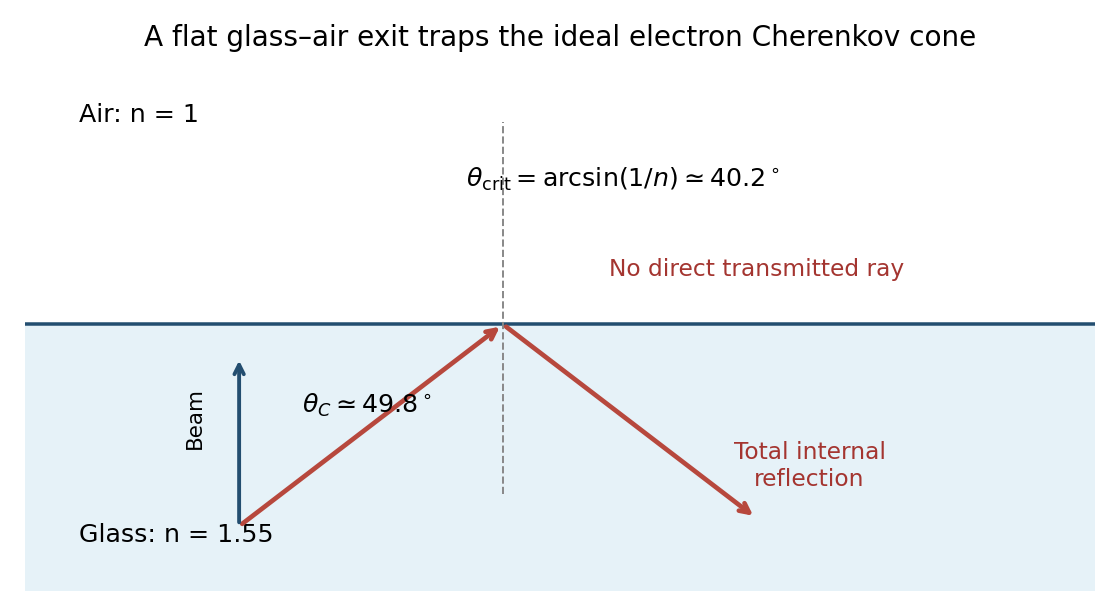
There is an essential optical qualification. For a normal beam through a parallel-faced glass slab followed by air, the internal critical angle is . Both emission angles exceed it. Snell's law would require , so the ideal photons undergo total internal reflection at the downstream face and do not form those direct downstream rings. Optical coupling, a prism or different surface geometry must be specified to extract them. The stated material parameters alone do not define a unique detected pattern; this flat-slab geometry is a concrete counterexample to silently assuming straight transmitted rays.
For protons, exposure and efficiency , the expected count in this channel is . A partial decay rate at the quoted upper bound gives one event per year whenMore generally, at the limiting rate. This is an estimate of the required proton inventory, not necessarily the whole detector mass. For water, each molecule contains ten protons and has mass approximately atomic mass units; the corresponding ideal inventory is about of water. Finite efficiency and a useful sample larger than one event increase the required exposure.
An upper limit is not a measured nonzero rate. The true rate could be much smaller, including zero, so no finite target guarantees a measurable signal. The estimate describes sensitivity to a rate near the existing limit.
A large, optically clean water Cherenkov detector provides many protons, a transparent radiator and a relatively inexpensive homogeneous target. A surrounding array of inward-facing photomultipliers records hit times and charge. Reconstructing the vertex and cone intersections identifies track directions and visible energies; an outer active veto rejects entering particles. Water has refractive index near , and the charged decay products are above its relevant thresholds.
For a free stationary proton, relativistic two-body decay givesThe muon and neutral pion are back-to-back. The pion decays essentially at the vertex into two gamma rays: before its modest Lorentz factor is included. Each gamma ray converts and initiates an electromagnetic shower, producing a diffuse ring. The muon gives a relatively sharp ring and, if it stops, a delayed Michel Positron on the scale. The ideal topology therefore has one muon-like and two electron-like rings, although overlaps or a weak photon may merge or hide a ring.
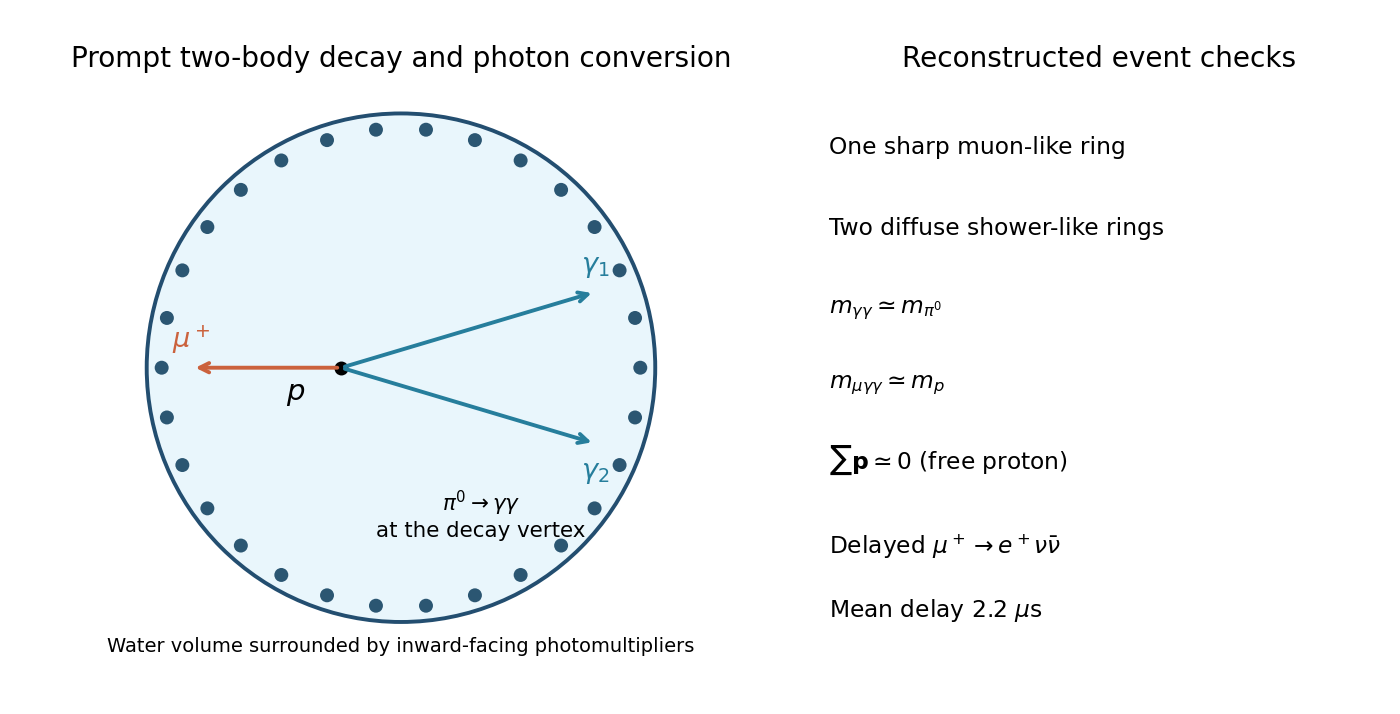


Require the two-photon invariant mass to match , the total reconstructed mass to match , and small total momentum. Bound oxygen protons have Fermi motion and their hadronic products can rescatter, so those cuts need realistic nuclear corrections; the water target also contains free hydrogen protons. Install the detector deep underground to suppress cosmic-ray muons, with shielding and an active veto. Important irreducible backgrounds are atmospheric-neutrino interactions producing a muon and neutral pion, potentially with an undetected recoil nucleon.
Articles by others on the same topic
There are currently no matching articles.