The Delta baryon has electric charge and valence quark content . In its ground state the spatial wavefunction has orbital angular momentum and is symmetric. Its spin is ; the maximal projection state is symmetric in spin, and its quark flavour wavefunction is symmetric as well. Three identical fermions require an antisymmetric total wavefunction by the Pauli exclusion principle. A further internal degree of freedom must therefore supply the antisymmetry.
With three color charges, that factor is the normalized colour singletIt changes sign under exchange of any two quarks. The remaining symmetric factors then give the required antisymmetric total state. This argument motivates color charge independently of the already present quark flavour and spin labels.
For quarks in an -dimensional internal space , complete antisymmetrization of three labels corresponds to a Young diagram with one column of three boxes, the partition . Its representation is the exterior power and has dimensionFor , the column is too tall: . With only two labels at least two of the three coincide, and the Young tableau column antisymmetrizer annihilates the state. For , the filled column spans a one-dimensional determinant representation. It is a colour singlet of SU(3) because every group element has determinant one.
Equivalently, the tensor product of group representations decomposes asThe two mixed-symmetry terms account for dimensions, so the total is . Antisymmetry alone establishes at least three internal states. Exactly three follows in the usual special unitary group model when the observed three-quark baryon must be a colour singlet: for the antisymmetric third exterior power has dimension greater than one and is not a singlet. This extra assumption should be made explicit.
Away from narrow resonances and quark thresholds, the QED annihilation cross section into each accessible quark flavour is its squared fractional electric charge times the muon-pair cross section, multiplied by the number of distinguishable color charges. Thus the inclusive hadronic ratio isWith , the continuum predictions are , and as successive charm quark and bottom quark channels become accessible. The measured normalization and steps support three color charges. At leading order these hadronic events form two back-to-back jets from the quark and antiquark; quantitative comparisons include QCD corrections and avoid the nonperturbative threshold region.
The extra resolved jet is explained by , with gluon radiation from either the quark or antiquark. One possible color charge routing is initial followed by ; the final , and combine to a net colour singlet.
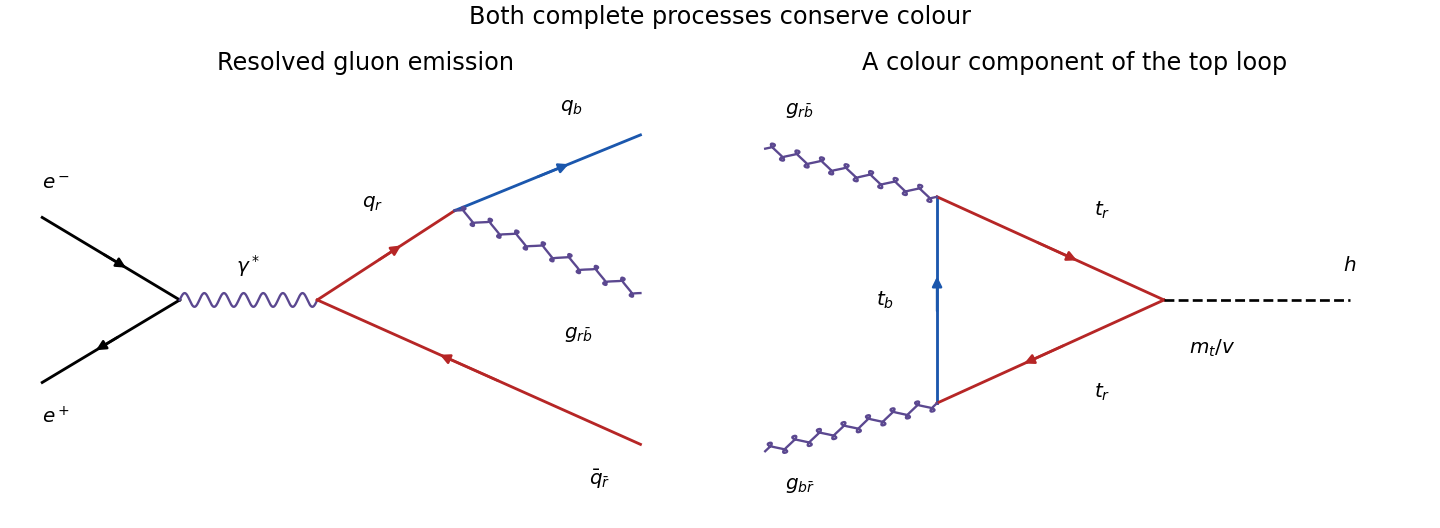

The three-jet cross section contains one additional strong interaction vertex in the amplitude, so its ratio to the two-jet rate is of order times a resolution-dependent kinematic coefficient. A resolved fraction of order is consistent with perturbative QCD and a strong coupling constant much larger than the fine-structure constant. It is not an equality : the jet definition and cuts are needed. Photon radiation has a much smaller electromagnetic rate. The large hadronic third-jet rate supports gluon radiation; identifying the radiated object specifically as a colour-octet gluon also uses the QCD vertex and colour-flow description, not merely the existence of three visible jets.
Represent the color charges by , and . The Gell-Mann matrices satisfyThe physical quark-gluon Feynman vertex contains with ; the off-diagonal combination therefore allows . Color charge conservation assigns the emitted gluon the colour-flow label .
The claimed impossibility of is false. A direct counterexample from the printed matrices isThus both diagonal gluons have nonzero vertex elements, and . They correspond to the traceless combinationsA Gell-Mann matrix is a generator rather than a finite rotation, but exponentiating a diagonal generator also leaves the red basis direction fixed up to a phase. The actual excluded object is the identity generator, proportional to the colour singlet . Adding it would extend SU(3) to unitary group and introduce a ninth singlet vector boson. A colour-preserving vertex among the existing eight gluons does not require that extra boson and does not make the ordinary diagonal gluons colour singlets.
In gluon-fusion Higgs production, two gluons couple to a closed top quark loop, and the Higgs boson couples to that massive quark through its Yukawa interaction. The right panel of the diagram in c shows one explicit colour-flow component: internal at one gluon insertion, then at the other; the colour-neutral Higgs boson insertion preserves the internal color charge. Include both loop orderings. The color charge factor isso the two incoming gluons are projected onto a colour singlet. The Yukawa coupling is , and the vertex has strength . No direct tree-level mass coupling is needed. Integrating out a sufficiently heavy top quark generates an effective interaction proportional to , which is allowed by gauge invariance even though the gluon is massless.
There is also no kinematic obstacle: two massless particles with nonparallel momenta can have nonzero total invariant mass. In particular, head-on gluons have , providing the energy needed for the Higgs boson at the LHC.
Articles by others on the same topic
There are currently no matching articles.