Choose positive x along the rocket's motion. If its instantaneous total mass is and it ejects a positive amount , the exhaust velocity in the original inertial frame is to first order. Conservation of momentum over that increment givesIntegrating the rocket equation from to givesThe constant exhaust speed is relative to the rocket, not the initial frame. Kinetic energy of rocket plus exhaust is not conserved because stored fuel energy is released. The calculation is Newtonian and requires resulting speeds small compared with the speed of light.
Let be the transferred fuel mass. Before any engine reversal, rocket A has mass and velocityFor exhaust collection by a second rocket, under the stipulated eventual capture of all exhaust, final conservation of momentum for the complete initially stationary system gives . ThusCapture is inelastic: no kinetic energy conservation for B is assumed. Finite exhaust flight time changes the intermediate sharing of momentum but not this endpoint balance if the stated complete capture actually occurs.
The ballistic exhaust interception condition is a physical restriction on that idealization. For purely ballistic exhaust to reach a receding collector to the rear, its laboratory velocity must be more negative than B's while interception occurs. In the negligible-flight-time approximation this requires . Very large fuel ratios need not meet that condition throughout a complete burn; the boxed endpoint formula is conditional on the prompt's complete-collection stipulation, not an unconditional prediction for every ballistic two-rocket geometry.
Neglecting exhaust flight time, no momentum is stored in transit andSince the velocities have opposite signs, equal nonzero speeds imply equality of the instantaneous masses. For and , this occurs at , or . ThereforeThe common-speed event occurs after of A's original fuel has been transferred, rather than when either rocket has its final mass. At this event the rearward exhaust still overtakes B: . Thus the interception restriction in b does not invalidate this event even though extending complete ballistic capture over the much later burn would need separate checking.
Put and . At reversal the transferred mass is , leaving A with and, after capture of that exhaust, B with . The first burn givesAfter reversal A emits its remaining exhaust away from B, so B receives no further fuel and eventually coasts at this velocity. Applying the rocket equation with reversed thrust to A givesBoth now move toward negative x, but A moves faster in that direction. The asymptotic closing speed isThis conclusion does not require a burn rate or an initial separation: after a finite burn, the positive eventual closing speed closes any finite remaining gap. Those additional inputs would be required to calculate the meeting time. Any pre-reversal exhaust still in transit affects the timing, not B's eventual momentum after collecting that fixed amount.
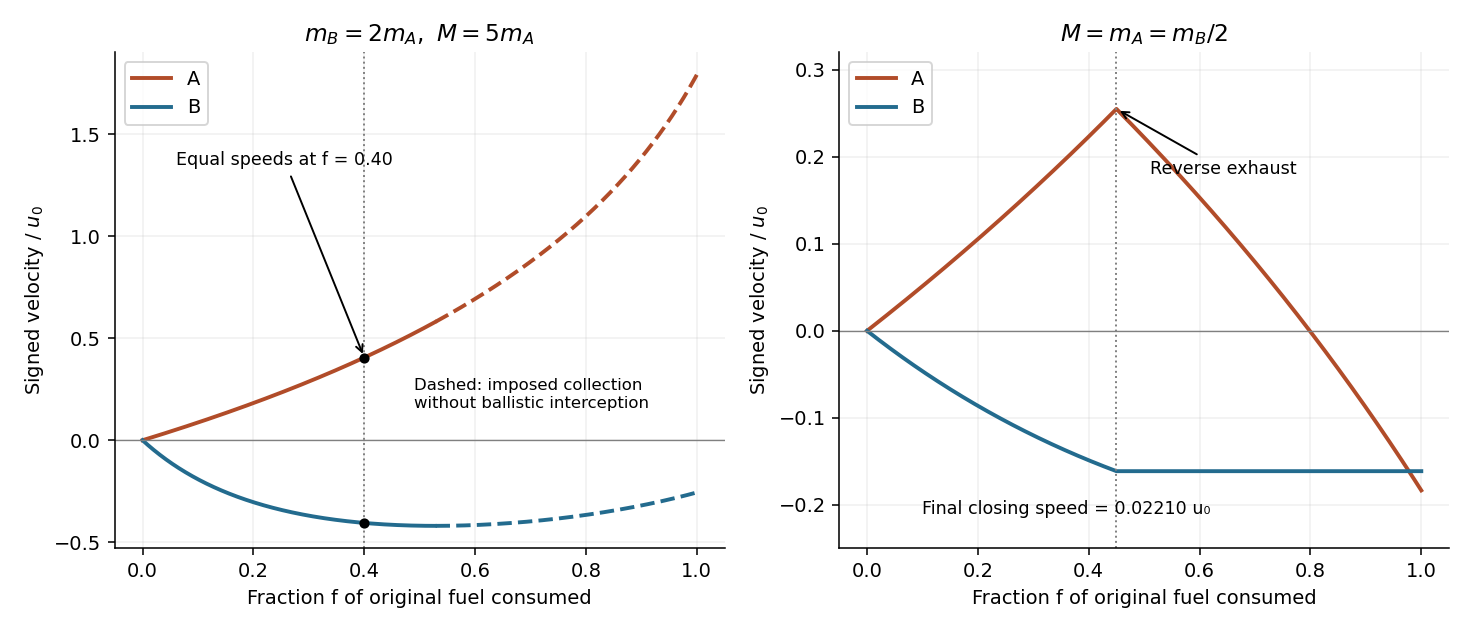
Signed velocities during exhaust collection and thrust reversal
. Original Newtonian calculations versus the fraction of original fuel consumed. Left: the equal-speed event in the ideal negligible-flight-time collection model; the later dashed extension is conditional on collection and can violate ballistic interception. Right: reversing thrust at 45 percent produces a small positive eventual closing speed. Details.
Articles by others on the same topic
There are currently no matching articles.