Put . Balancing Newton's law of universal gravitation with the required centripetal force gives , henceThe circular Kepler orbit is stable against small radial perturbations: its effective radial potential is , and at the circular value , . Here is the conserved angular momentum.
The assumed orbital energy is . At a point a distance from the planet,This is the vis-viva equation. The semi-major axis and radius are measured from the gravitational focus where the planet lies.
For the Hohmann transfer orbit, the inner and outer circular radii are the ellipse's pericentre and apocentre distances, so . The vis-viva equation gives the transfer speed at the inner tangent point,Both old and new velocities are tangential there, so the required first impulse is prograde, with
At the outer tangent point, the vis-viva equation gives . This is below the outer circular Kepler orbit's speed . The second impulse is therefore also prograde:It raises the pericentre to the outer radius, completing the circularization.
In a quasi-circular spiral transfer, a small tangential thrust supplies power while the orbit stays approximately circular. Differentiating and using givesThis is the integrated thrust magnitude per unit constant mass, not the net vector change of orbital velocity.
For comparison, write . Adding the two Hohmann transfer impulses and subtracting the slow-transfer result yieldsThe bracket is negative because for . Thus the Hohmann transfer uses less total impulse than the slow circular spiral for these ideal coplanar transfers. The Hohmann transfer compared with a slow spiral does not establish a global optimum over every possible transfer family or propulsion constraint.
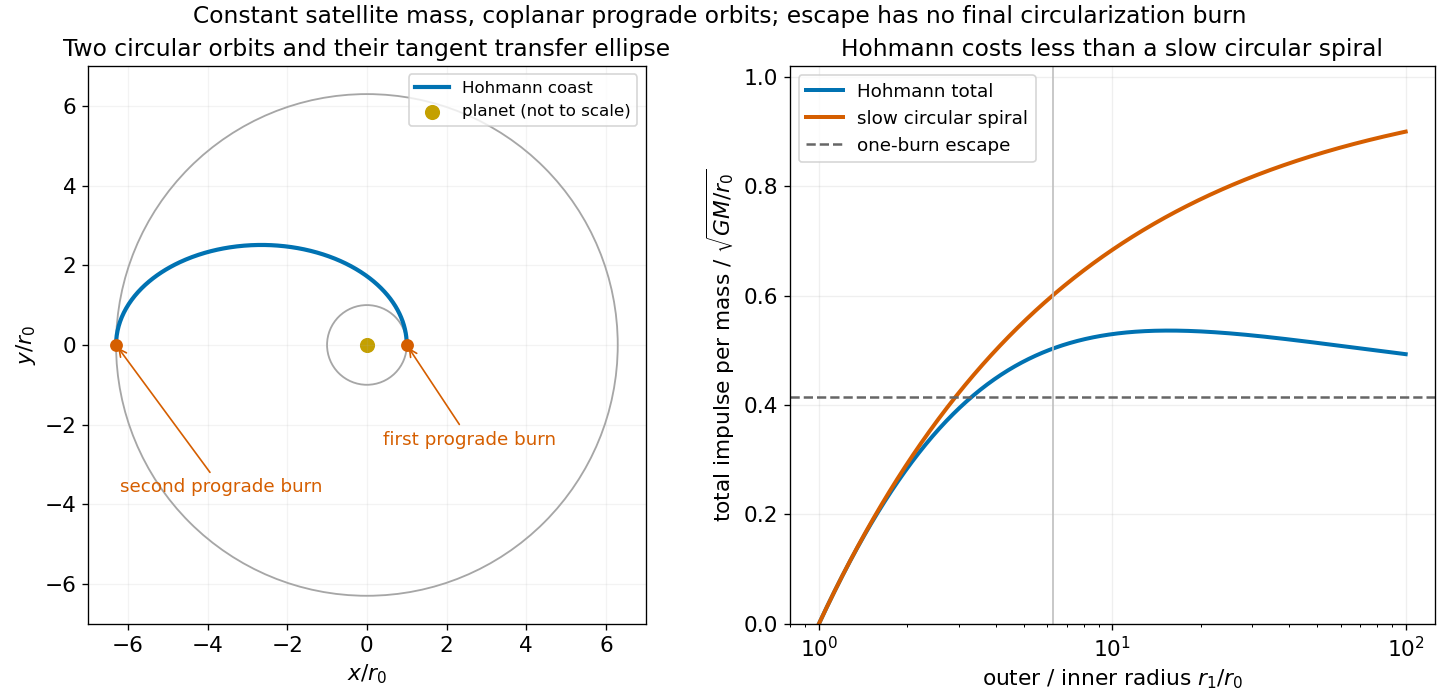
Two tangential Hohmann burns versus an adiabatically slow circular spiral; total impulse is lower for the Hohmann transfer
. Details. 
Use the supplied planet mass , , and adopt mean Earth radius . For a geostationary orbit, use one sidereal day, . The adopted radius and rotation period follow NASA's fact sheet.[ref]
Earth Fact Sheet by National Aeronautics and Space Administration. Bulk parameters: volumetric mean radius6371.000km; orbital parameters: sidereal rotation period23.9345hours
The slightly smaller radius than the usual terrestrial value follows from using the question's smaller Earth mass. For coplanar prograde orbits, the preceding formulas giveThe escape transfer has , so its first tangential burn reaches the local escape speed . No final circularization at infinity is needed:Thus the geostationary transfer requires about more total impulse, or about 22 percent more, despite leaving the spacecraft gravitationally bound. Reaching the outer radius and circularizing there are separate requirements. Changing the starting orbit's inclination would add a plane-change cost absent from this calculation. Articles by others on the same topic
There are currently no matching articles.