For a uniform thin disc, the surface mass density is . An annulus of radius and thickness has mass , all at distance from the normal central axis. Its contribution to the moment of inertia is , soThis establishes the moment of inertia of a uniform disc; the normal axis and uniform surface mass density are part of the result.
Take the rotation axis as . A slice of the uniform sphere at coordinate is a disc of radius and mass , where is its mass density. Applying a to the slice givesThe slices' axes coincide, so no displaced-axis correction is needed. Integrating,Thus the moment of inertia of a uniform solid sphere isThe sphere's rotational symmetry makes this valid about every central axis. A thin spherical shell would have a different mass distribution and a different moment of inertia.
Choose positive horizontal velocity to the right and positive spin angular velocity anticlockwise, as in the source drawing. At the bottom of the sphere, the rotational velocity is then to the right: the initial tangential contact-point velocity isFor the illustrated positive , the contact slips to the right, so the tangential contact force acts leftward. The upward normal force acts through the sphere centre and produces no spin torque. The tangential contact force acts at lever arm and produces a clockwise torque, reducing the positive spin. The weight acts vertically downward through the centre of mass.
During the short impact the contact impulses dominate the weight's impulse. In an ideal elastic rough contact, the tangential deformation can store and return energy; its contact force need not be a dissipative sliding-friction law throughout the collision. For other signed incoming states, reverse the initial tangential force if ; if , no tangential impulse is required.
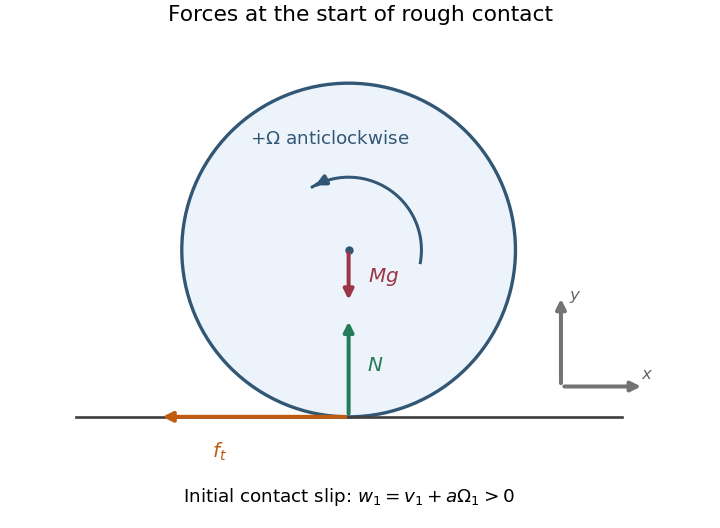

Write the sphere's mass as and use from b. Let and be the upward and rightward contact impulses. The initial vertical velocity is and the outgoing vertical velocity is . Perfect normal elasticity givesThe tangential and angular impulse equations areFor the ideal elastic rough-sphere bounce, the tangential translational plus rotational kinetic energy is restored on separation. Substituting these two equations into that requirement givesThe interacting rough-contact branch, rather than the smooth branch , therefore hasConsequently, with all tangential quantities signed in the convention of c,In particular, : the tangential contact-point velocity reverses. The outgoing may be negative; the sphere rebounds backward when . Substitution also checks both total kinetic energy and angular momentum about the contact point, .
This result uses the conventional perfectly elastic, fully rough contact idealization. The word rough alone, with an unspecified finite coefficient of friction, would not determine the outgoing tangential state. For example, imposing sticking at separation would instead give and dissipate , contradicting total elasticity unless . The displayed elastic branch requires enough tangential impulse; a Coulomb bound would at least require .
Articles by others on the same topic
There are currently no matching articles.