A central force exerts zero torque about its centre, so angular momentum is conserved and the motion is planar. In plane polar coordinates, andUse and either the radial Euler-Lagrange equation or differentiation of the energy away from turning points to getThe radial acceleration is , so this is exactly , not an additional physical outward force in an inertial frame. The variational derivation remains valid at turning points where dividing an energy derivative by would be illegitimate.
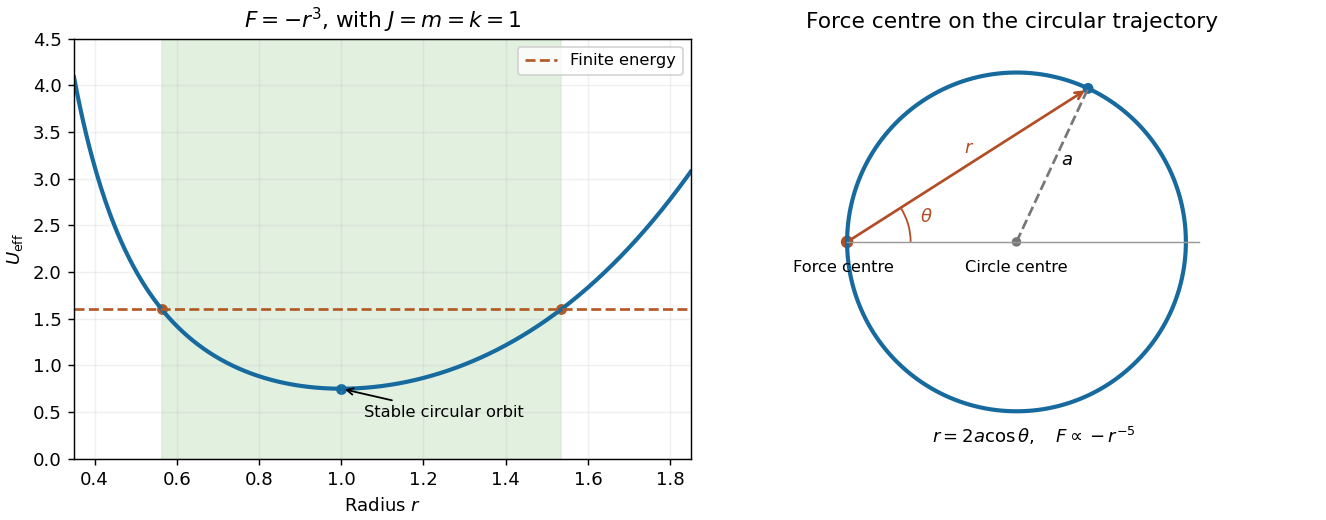
The effective potential includes the angular part of the kinetic energy. Taking gives , henceFor , this diverges at both zero and infinity and has a unique minimum. Finite-energy motion therefore remains between two radial turning points, or at the minimum itself. For , the centrifugal barrier is absent, but still bounds every finite-energy trajectory; radial motion can pass through the force centre.
A circular orbit requires , soIt is stable because . These are nonzero-radius orbits for ; also permits the stationary particle at the origin. Boundedness does not mean that every noncircular orbit is closed.
The diagram places the force centre on the circumference, not at the centre of the circle. Choose the polar axis through the circle's geometric centre. Its equation is , so andSubstitute into Binet's equation:Consequently a circular orbit through the force centre is generated byThe result applies to the regular arc where and . The force is singular at the point where the geometrical circle meets the origin, so the curve is not a regular periodic orbit continued through that point. Indeed, and this trajectory has zero total energy, with kinetic and negative potential terms diverging as the centre is approached.

Articles by others on the same topic
There are currently no matching articles.