Follow the branch of a light ray that undergoes one internal specular reflection in the spherical drop. At entry, refraction turns its direction by . The internal specular reflection turns it by , because the radius is the normal vector and the incidence and reflection angles are both . At exit the second refraction contributes another . Thus the total deviation angle isSnell's law at entry gives , taking the surrounding air's refractive index as one. The same internal angle at successive encounters follows from the isosceles triangles formed by each chord and the two radii. Internal specular reflection here need not be total internal reflection; the transmitted branch at that encounter does not belong to the one-reflection trajectory.
Regard the refraction angle as a function of the angle of incidence, . Implicit differentiation of Snell's law gives . Differentiating the deviation angle gives . An interior stationary point therefore satisfiesThe stationary deviation of a primary rainbow ray is a minimum: differentiating again and using Snell's law gives . At the stationary point, , and hence for a positive interior refraction angle. This minimum is responsible for the concentration of emerging light rays near the primary rainbow direction.
Square the stationary condition and eliminate the angle of incidence using Snell's law:Rearranging yields . Taking the positive root for a physical incident light ray,An interior minimum exists for , which includes water at visible wavelengths. For illustration, gives , and . The corresponding angle from the antisolar direction is . At the stationary solution reaches the endpoint, and for the displayed square root is not real; the water result is not a formula for every possible refractive index.
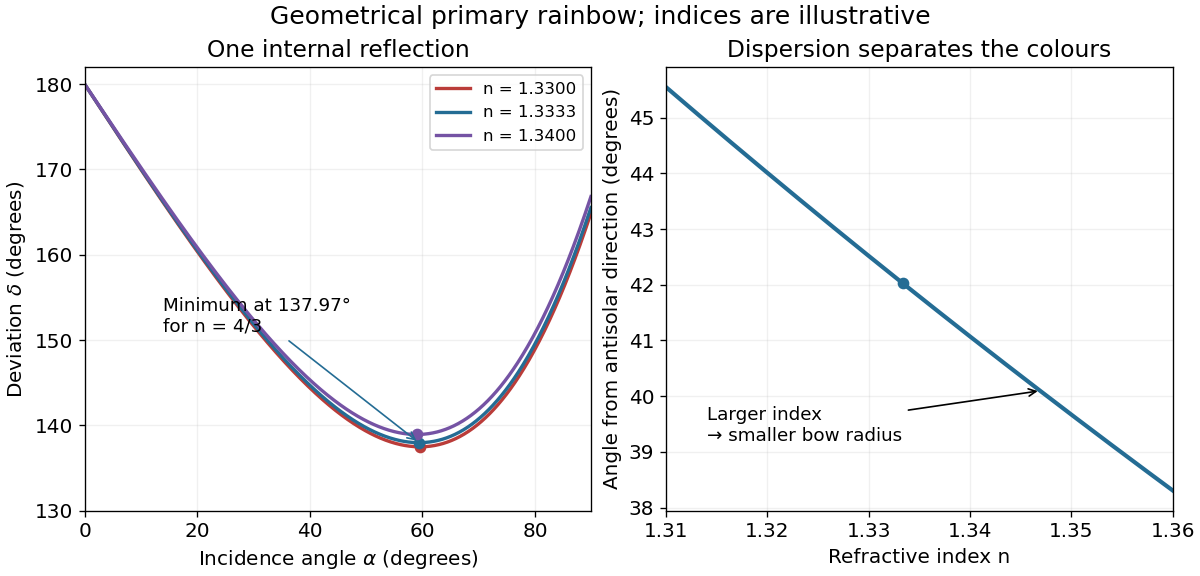

With the Sun behind the observer and raindrops ahead, the one-reflection branch sends many light rays toward directions close to the minimum deviation angle. Nearby values of the angle of incidence produce nearly the same outgoing direction there, forming a wave caustic. For water the resulting cone is approximately from the antisolar direction. The observer sees the intersecting drops as a circular rainbow, or the part of that circle visible above the ground.
Normal dispersion makes the refractive index larger for violet than for red light. At the minimum, increasing the refractive index increases the deviation angle, and therefore decreases the viewing angle . Red is on the outer edge of the primary rainbow, violet on the inner edge. The internal specular reflection is partial: with , the relevant is below the critical angle . Diffraction and the finite angular size of the Sun smooth the geometrical concentration; the physical intensity does not actually become infinite.
Articles by others on the same topic
There are currently no matching articles.