Let denote the capacitor voltage with the same polarity as the applied voltage. By Kirchhoff's voltage law, Ohm's law and ,Solving this first-order differential equation gives the RC low-pass step responseThe capacitor voltage is continuous at switching because an instantaneous finite jump would require an impulsive electric current.
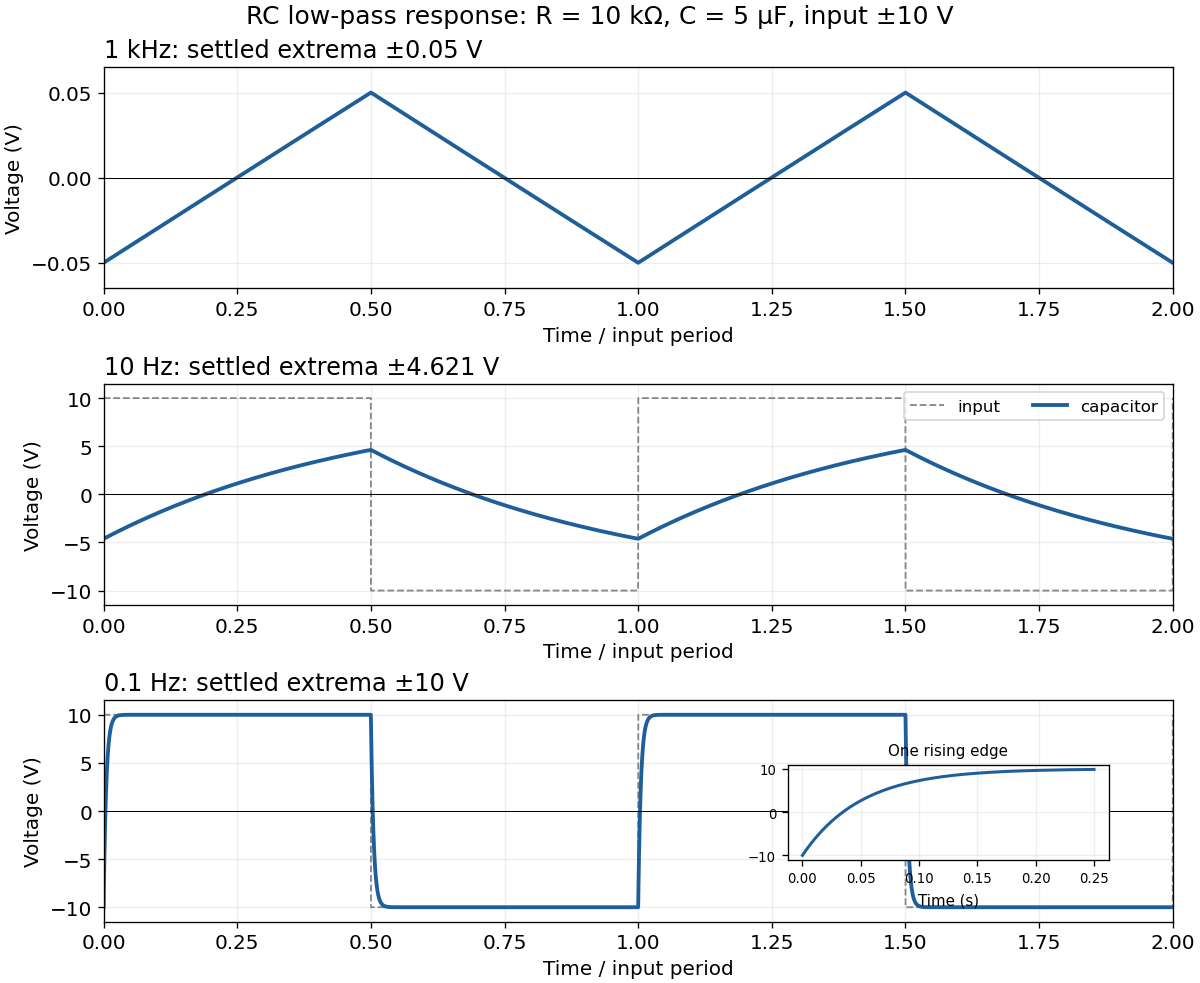
For the square-wave response of an RC low-pass filter, take equal positive and negative half-periods. Let , , and . After the transient, symmetry makes the capacitor voltage alternate between and . Over the positive half-period,Requiring givesThe next half-period is the sign-reversed copy. These exact expressions explain the requested sketches:
- At , . The voltage barely changes in each half-period, so the output is nearly triangular about zero, with extrema about . Its small-signal slope is approximately .
- At , . Clearly curved exponential rises and falls reach only ; the output never settles to either input level.
- At , . The output closely follows the input plateaux at , joined by continuous exponential transitions with time constant .

Articles by others on the same topic
There are currently no matching articles.