Source paper: Oxford public response bundle, pages 200–204. The cover identifies CP2, 3 September 2019, and bears a Draft Only watermark. The recovered source lacks the diagram for 7; that solution records the remaining limitation.
For one wire, Ampère's circuital law on a concentric circle of radius givesThe other wire experiences the Lorentz force on its electric current, . Its direction is perpendicular to this magnetic field, so the force per unit length isThe right-hand rule gives attraction for parallel electric currents in the same direction and repulsion for opposite directions.
For the upper wire, the upward magnetic force per unit length balances its weight per unit length, , where is the gravitational acceleration. ThereforeThis assumes the lower wire is held fixed and both wires remain straight. Within the vertical-motion model, increasing the separation weakens the upward magnetic force, so this equilibrium is vertically restoring.
Interpret the coordinates as a plane in ordinary three-dimensional electrostatics. Set , where is the vacuum permittivity. The work required to bring the second point charge in quasistatically is its electric charge times the first charge's electric potential:The individual point-charge self-energies are excluded; this is the electrostatic potential energy of point charges relative to infinite separation.
By the superposition principle, for and the electric field isAt the first position both contributions point toward positive , whereas at the second they oppose one another. ThusAt the two distances are . The vertical electric field components cancel and the horizontal components add:Dimensional convention. The source's description of space as two-dimensional cannot literally mean two-dimensional electrostatics with the same inverse-square formula. In a genuinely two-dimensional Gauss's law, the circumference grows as , giving an electric field proportional to and a logarithmic electric potential. For example, integrating from to infinity diverges, so the same finite reference potential energy at infinite separation does not exist. The displayed results use the conventional three-dimensional Coulomb's law restricted to the stated plane.
Assemble the spherically symmetric charge distribution by adding thin concentric shells, with the final charge density kept uniform. When the assembled radius is , the enclosed electric charge and the next increment areThe electric potential of the already assembled material at that shell is . Consequently its assembly work is , and the electrostatic energy of a uniformly charged solid sphere isThere is no extra factor of one half in this assembly integral: each pair of charge elements has already been counted exactly once, when the later element was brought in. A solid uniformly charged insulator has this value; a conducting sphere has its electric charge on the surface and instead has electrostatic energy .
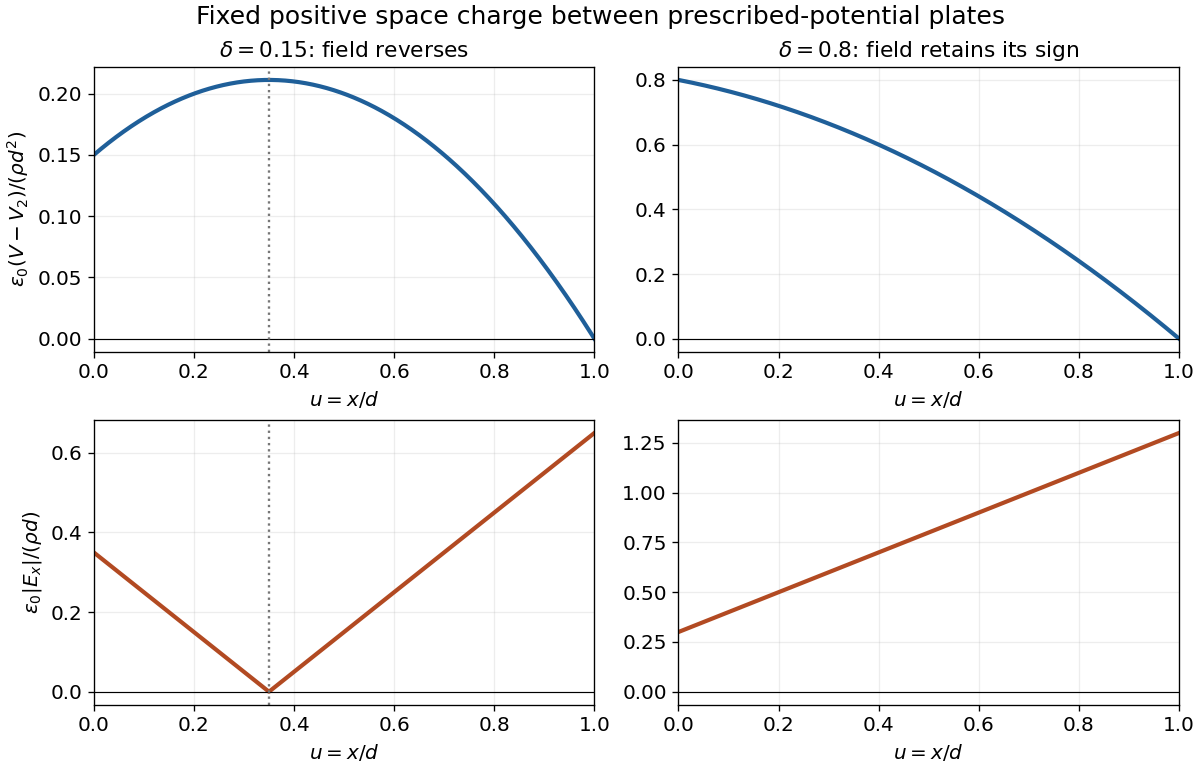
For this space-charge-filled parallel-plate capacitor, place the first plate at and the second at , ignoring fringing field of a capacitor. With vacuum permittivity between the plates and fixed charge density , Poisson's equation and the prescribed boundary electric potentials giveIntegrating twice and imposing both values yieldsThe electric field is minus the gradient of the electric potential, henceThus the electric potential is a parabola, concave downward for and upward for . The signed electric field is a straight line. Its magnitude has a V-shaped corner if its zerolies inside the gap; otherwise its magnitude is a single straight segment. An interior zero requires . At that point the electric potential has its interior extremum. For , these reduce to a linear electric potential and a uniform electric field.

Let denote the capacitor voltage with the same polarity as the applied voltage. By Kirchhoff's voltage law, Ohm's law and ,Solving this first-order differential equation gives the RC low-pass step responseThe capacitor voltage is continuous at switching because an instantaneous finite jump would require an impulsive electric current.
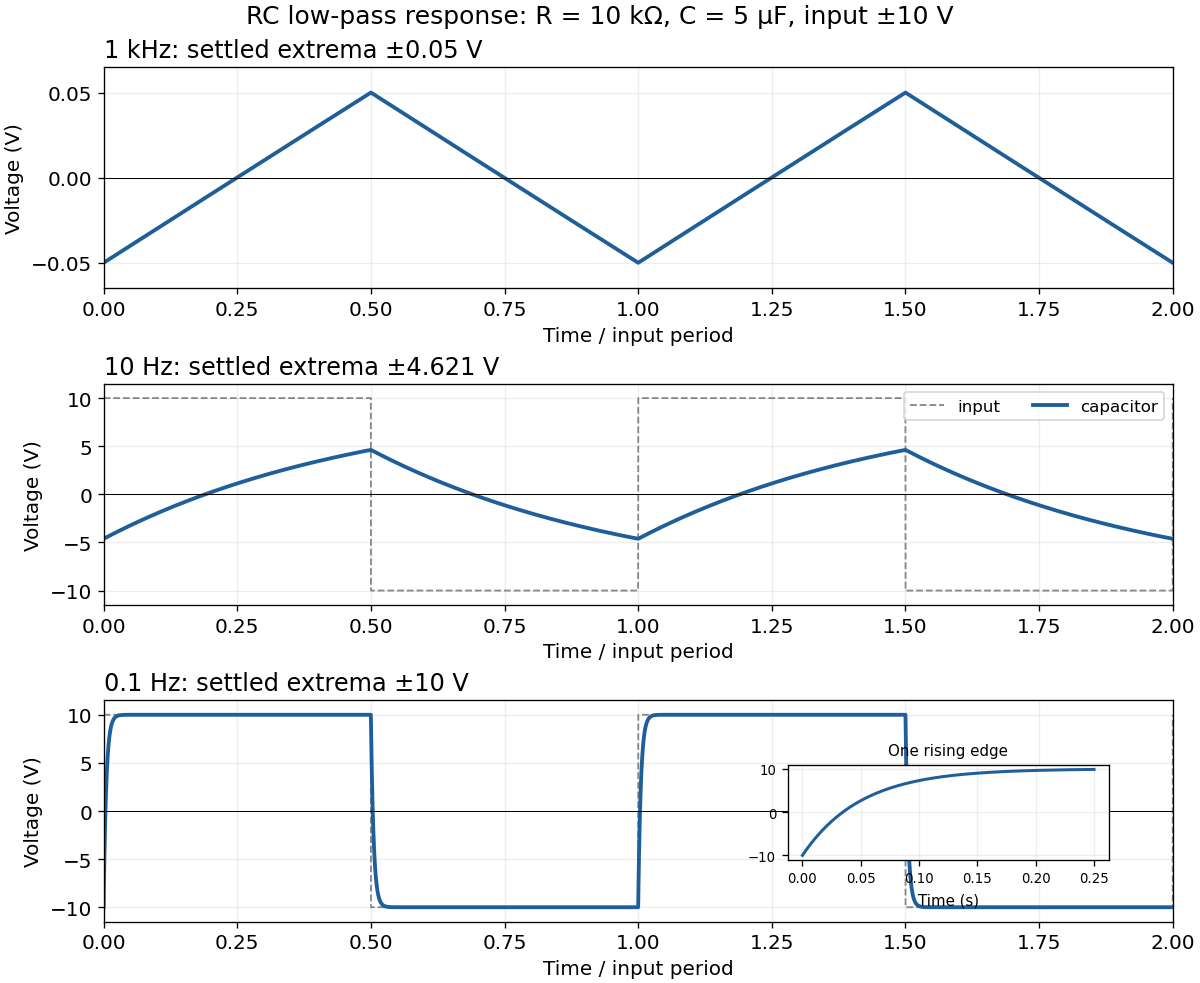
For the square-wave response of an RC low-pass filter, take equal positive and negative half-periods. Let , , and . After the transient, symmetry makes the capacitor voltage alternate between and . Over the positive half-period,Requiring givesThe next half-period is the sign-reversed copy. These exact expressions explain the requested sketches:
- At , . The voltage barely changes in each half-period, so the output is nearly triangular about zero, with extrema about . Its small-signal slope is approximately .
- At , . Clearly curved exponential rises and falls reach only ; the output never settles to either input level.
- At , . The output closely follows the input plateaux at , joined by continuous exponential transitions with time constant .

Treat the given orbital separation as the projected separation on the sky. The small angular separation isFor an ideal circular telescope aperture of diameter , the Rayleigh criterion requires . ThereforeThis is the diffraction limit, assuming comparable image brightness and adequate sampling. Atmospheric image blurring can require correction or space-based observing. A smaller actual projected separation of the binary star would require a larger aperture.
TODO: the source glass-rod diagram is unavailable. The recovered prose gives a surface curvature and object distance, but the diagram's orientation, labels and any further optical surfaces cannot be verified. The following solves the surviving request for a single convex entrance surface; it is conditional on that interpretation and does not reconstruct the missing diagram or supply a rod length.
For refraction at a spherical surface, take incident light travelling rightwards from refractive index to , object distance to the left of the vertex, image distance positive to the right, and signed curvature positive when the centre is inside the rod. In the paraxial approximation, applying Snell's law to a light ray at height givesAfter cancelling , the image position and transverse magnification areThe magnification follows by considering a paraxial light ray through the vertex: Snell's law there gives .
For a convex entrance, and . In air, the denominator is , givingThis is a real, inverted image within a sufficiently long glass rod, before any subsequent surface.
For water with refractive index , the denominator is , andThe emerging light rays diverge as though from an upright virtual image on the object side. The change of sign is consistent with diverging when . A reversed curvature or a second exit surface changes these answers; the unavailable diagram prevents a definitive answer for the full illustrated arrangement.
Faraday's law of induction states that the oriented electromotive force around a closed material circuit is minus the rate of change of its linked magnetic flux:The surface orientation and circuit direction obey the right-hand rule. The minus sign expresses Lenz's law: the induced electric current, when allowed to flow, produces a magnetic field opposing the change of linked magnetic flux. For a stationary circuit this reduces to .
The source's “Lorenz force” is the Lorentz force, . A wire element of cross-section contains carriers of charge with drift velocity . Adding their magnetic forces and using givesfor a straight wire in a uniform magnetic field. The length vector follows conventional electric current, irrespective of the carrier sign.
For the unlabelled upward-motion request, define down the slope, across the rails and out of their plane. Choose the vertical magnetic field as . An electric current across the bar in direction gives a horizontal magnetic force . The other forces are weight and the rail normal force . Uniform upward velocity requiresConsequentlyEach symmetric rail supplies half of . The electric current must make point horizontally toward the uphill side; for the coordinates just defined it flows along . Reversing the vertical magnetic field reverses this current direction. The external supply must maintain that electric current against the motional electromotive force during ascent. For , no finite horizontal magnetic force can support uniform motion along the vertical rails.
Use the coordinates in 8. At downhill speed , the moving bar has . The electromotive force and induced electric current are thereforeHere is positive along across the sliding bar, then returns through the rails and resistor. This direction makes the magnetic force oppose downhill motion, as required by Lenz's law. The factor is essential: only the component of magnetic field normal to the rail plane threads the circuit. Rail and bar electrical resistances and circuit self-inductance are neglected relative to the stated large model.
The component of magnetic force along the slope has magnitude . The rate at which the sliding bar does work against this magnetic braking isBy Ohm's law, , soThis exactly equals the Joule heating in the resistor in the negligible-self-inductance approximation. The normal force does no work because it is perpendicular to the velocity.
The gravitational power is instead . By the work-energy theorem,It equals the Joule heating only at constant speed. For a concrete counterexample, during the initial acceleration the kinetic energy increases, so some gravitational power remains mechanical.
Project Newton's second law down the slope. The normal reaction has no component along the rails, while the magnetic term opposes motion:This first-order linear differential equation has the release-from-rest solutionThe electrical self-inductance has been neglected; retaining it introduces a coupled electric current equation rather than this instantaneous resistive response.
At the terminal velocity, the acceleration in iii vanishes. ThusFor and nonzero , the magnetic drag increases linearly with speed and this terminal state is stable. Horizontal rails have no gravitational drive. Vertical rails have no linked vertical magnetic flux change, so the model gives free fall rather than a finite terminal velocity.
In SI units, Maxwell's equations in vacuum, allowing charge density and electric current density , areThe source-free specialization sets and ; it cannot describe the charged objects at their locations. Applying the divergence theorem to the first equation gives Gauss's law:For an isolated point charge , spherical symmetry makes the electric field radial and constant in magnitude on a concentric sphere. Therefore . Multiplying by a second point charge gives Coulomb's law,The force points away from the first charge for like signs and toward it for opposite signs.
For the spherical capacitor, a Gaussian sphere between the shells encloses , so for . Integrating the electric field inward from the outer shell yieldsAn arbitrary constant remains unless a reference is specified. The capacitance is determined by the potential difference:For the subsequent charging operation, take the initial outer shell to be earthed, or interpret the stated as the inner-to-outer voltage with the outer reference zero. Isolating the inner shell fixes its electric charge at . Removing the outer shell leaves an isolated conducting sphere. Its electric field and electric potential, now with zero at infinity, areConsequentlyThese changes of electric potential are compatible with constant electric charge. Without the initial reference convention the absolute stated does not determine : for example, if the outer shell were initially isolated and neutral, the absolute inner electric potential would instead be .
Finally take the connected spheres to be sufficiently far apart that the long wire's capacitance and their mutual influence can be neglected. Their common electric potential requiresso and . The magnitudes of the surface electric fields areThis is the usual widely separated-sphere approximation. A wire enforces an equipotential, but alone does not make this ratio exact for arbitrary arrangements. As a concrete counterexample, if the second shell enclosed the first concentrically and they were connected, all net electric charge would reside on the exterior and the inner sphere's surface electric field would be zero.
In the Huygens-Fresnel principle construction, after a time the incident disturbance advances while the secondary disturbance in the second medium advances . The two right triangles share the segment along the interface. HenceHere both angles are measured from the normal vector, and are phase velocities. This is Snell's law. For , no real transmitted angle exists whenThis is total internal reflection; equality is the limiting grazing geometry. The statement concerns an ideal transparent interface, not material absorption or losses at a nearby second boundary.
Let be the internal angle to the optical axis in the straight step-index optical fiber. At its flat entrance, Snell's law gives . At the side wall a meridional ray has angle of incidence . The limiting total internal reflection condition is . Thus the optical fiber acceptance angle satisfiesThe numerical aperture expression assumes the square root is at most one for air; otherwise all forward launch angles are admitted by this ideal ray test. Strictly confined meridional rays lie inside the limiting cone.
For and , and . A light ray at internal angle travels distance along a guide of axial length . In the nondispersive approximation its travel time is . ThereforeHere and ; using gives and . The halving applies to the external launch angle, not to . For actual short pulses the group refractive index replaces the prefactor in ; the source supplies no optical dispersion data. The difference calculated here is geometrical intermodal dispersion in a nondispersive geometrical optics model.
Bending lowers the outer-wall angle of incidence, allowing a previously guided light ray to escape into the cladding. To calculate a definite meridional ray bend threshold, continue the on-axis launch assumption and take a meridional ray in the plane of the circular bend. Its initial internal angle to the centreline tangent obeys . Its straight path has distance from the bend centre. At the outer wall of radius , elementary right-triangle geometry givesAt the loss threshold, this equals . Solving for the centreline radius givesFor this launch, violates the total internal reflection condition at the outer wall; is the limiting case. A real optical fiber has gradual bend loss governed by its electromagnetic wave modes, rather than a universal abrupt cutoff.
Launch dependence. The final sentence does not separately specify the entry position or orientation of the bend relative to the incident light ray. For a planar launch displaced by from the centreline toward the outer wall, replace the numerator of by . For example, a launch at the inner edge, , instead givesThus is the result for the stated on-axis continuation; it is not an entry-independent threshold. No missing figure is needed for these explicitly specified ray models.
Use phasors with time dependence and electrical impedance . The element laws , and giveA complex number records both amplitude and phase, turning the linear differential equations of a sinusoidally driven electrical circuit into algebraic equations. A resistor has in-phase voltage and electric current and dissipates average power. For an ideal capacitor, the electric current leads the voltage by ; for an ideal inductor, it lags by . Their imaginary electrical impedances express reversible energy storage and return, with zero net average power over a period. Using would conjugate the displayed reactive signs without changing predictions.
In the illustrated Maxwell bridge, the left and right vertices are the supply terminals and the upper and lower vertices are detector terminals. Insert a sensitive AC null detector between the latter and drive the former with a sinusoidal source. The upper-left arm is , the upper-right arm is , the lower-left arm is , and the lower-right arm is the parallel combinationAt a null no detector electric current flows, so the two voltage dividers giveMultiplying by the parallel-arm electrical admittance yieldsEquating real and imaginary parts therefore givesTwo independent adjustments are needed to annul the in-phase and quadrature detector signals. For example, change to set and to set , iterating until the detector reads zero. Alternatively, with fixed , independently vary and .
The Maxwell bridge compares an unknown lossy inductor with a stable standard capacitor, avoiding the need for an accurately known reference inductor. The ideal balance equations contain no frequency, and a null measurement need not rely on absolute detector calibration. In practice choose a suitable frequency below the coil's self-resonance, where the series model and the standard capacitor remain accurate.
If the initial setting is far from balance, the bridge as drawn needs adjustable components and a detector, not merely a more precise readout. Fit resistance boxes or switched ranges for and a ratio arm, and a selectable standard . Choose ranges aroundThen approach the null with coarse adjustments followed by finer ones. A large required can be brought into range by increasing and decreasing proportionally. Start with reduced excitation or reduced detector sensitivity to avoid overload, then increase sensitivity near the null. Changing frequency alone cannot repair an impossible component range, since the ideal balance conditions are frequency-independent. Stray capacitance and lead electrical resistance set practical accuracy limits and may require shielding and short connections.
Articles by others on the same topic
There are currently no matching articles.