In a periodic crystal potential, atomic levels broaden into bands of allowed bloch states. Coupling between states of the same symmetry opens avoided crossings, including Bragg-coupled states in the nearly free-electron picture. Bonding and antibonding combinations provide a complementary tight-binding picture. A semiconductor has a filled valence band and an empty conduction band at zero temperature separated by a forbidden energy interval; thermal excitation, light and doping provide mobile electrons and holes. The gap depends on the crystal's periodic potential, bonding and symmetry, not on a classical collision barrier. In a direct gap, the relevant extrema coincide in wavevector.
For the stated parabolic edges, take and . Negligible photon momentum and no phonon make the transition nearly vertical in versus . parabolic-band optical energy sharing divides the excess photon energy in inverse proportion to the effective masses:Thus the initial and final electron energies, relative to the valence-band maximum, areTheir difference is . The selected is about ; either sign gives the same energy in this symmetric approximation.
A shallow donor supplies an electron in a screened impurity potential, so its localized level lies just below the conduction edge. A shallow acceptor binds a hole and has an electron-occupation level just above the valence edge; thermal ionization supplies mobile holes. The level positions are measured relative to the relevant band edge, and deep impurities need not obey this hydrogenic approximation.
For the supplied bound-carrier mass and unit effective ionic charge, dielectric screening and effective mass change the hydrogen binding energy toThis corresponds to and an effective Bohr radius about . The binding is shallow compared with the band gap and typical atomic binding. Trivalent denotes chemical valence, not an unscreened hydrogenic charge of three. An acceptor physically binds a hole; the question's stated is used as its stipulated bound-carrier mass rather than silently replacing it by the separate band-edge .
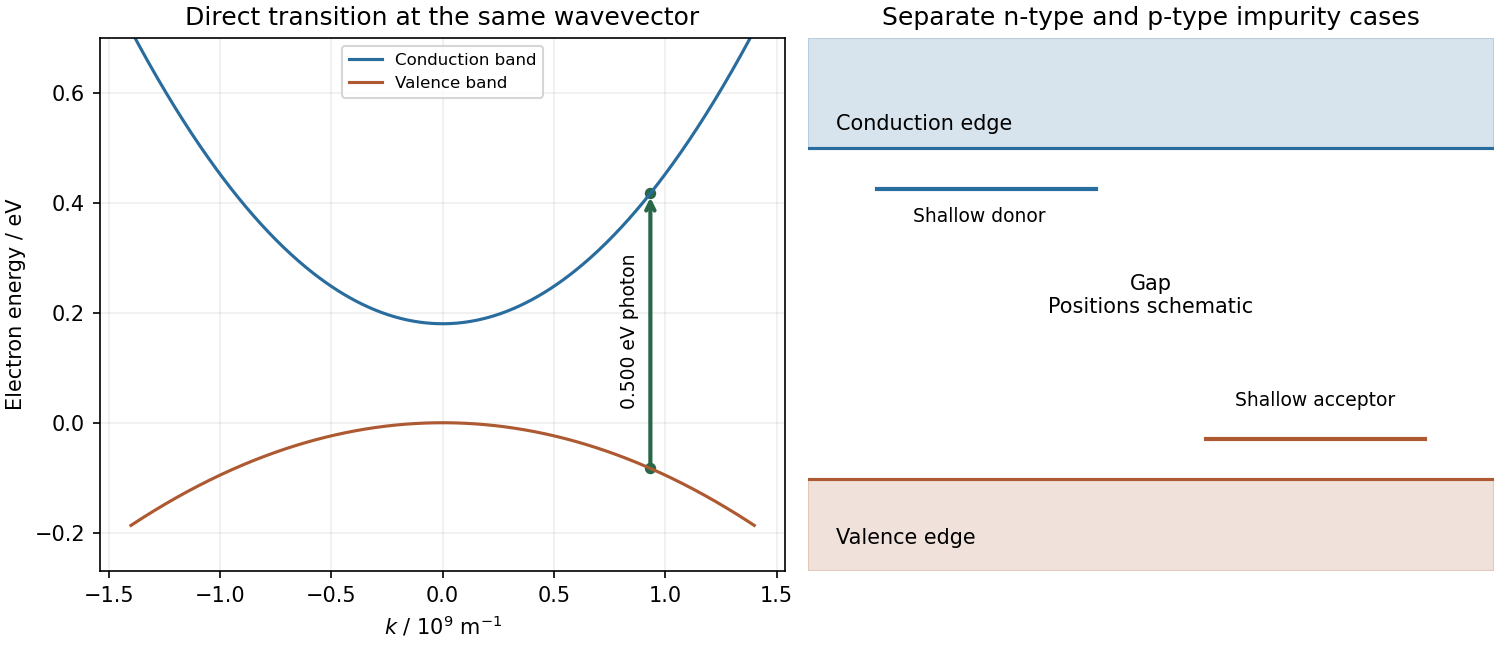
Original direct-gap vertical transition with mass-dependent energy sharing, and separate schematic shallow donor and acceptor levels
. Details. 
Articles by others on the same topic
There are currently no matching articles.