In the small-angle approximation the physical pendulum is a harmonic oscillator with . Its classical energy is . Equating this to givesAn oscillating bob is not a single stationary energy eigenstate. An ideal coherent state has a Poisson distribution of oscillator occupations centred on this mean, with relative spread , exceptionally small here. This quantum occupation scale of a classical oscillator fixes the excitation scale without requiring the real, damped clock to be a pure coherent state.
The free particle dispersion relation is . HenceThe phase velocity follows constant-phase surfaces of a plane wave. The group velocity follows the envelope of a narrow-band wave packet and equals its classical velocity . Dispersion can spread the packet; the phase speed is not the particle's transport velocity. In three dimensions and the phase speed quoted is along .
The mass dependence of fixed-barrier tunnelling follows by holding energy and the potential-energy barrier fixed: quantum tunnelling has the leading WKB approximationThe alpha-particle mass is about electron masses, so its decay exponent is about 85 times larger for the same profile. Exponential suppression therefore makes transmission much smaller. This comparison holds the potential energy and incident energy fixed: the same electrostatic potential is not the same potential-energy barrier for charges of different magnitude and sign.
For the squared discrepancy of a digit frequency, write . The plotted ordinates are , , , , and in increasing . Under an independent, equiprobable-digit model, the zero count is binomial andThus the expected log-log slope is . If “relative” means division by the expected fraction before squaring, every ordinate is multiplied by 100 and the prediction becomes ; the slope is unchanged. These are nested prefixes of one digit sequence, so the points are correlated, rounded observations, not independent variance estimates. Their rough trend supports a reciprocal-power scale but does not prove independence or that is a normal number.
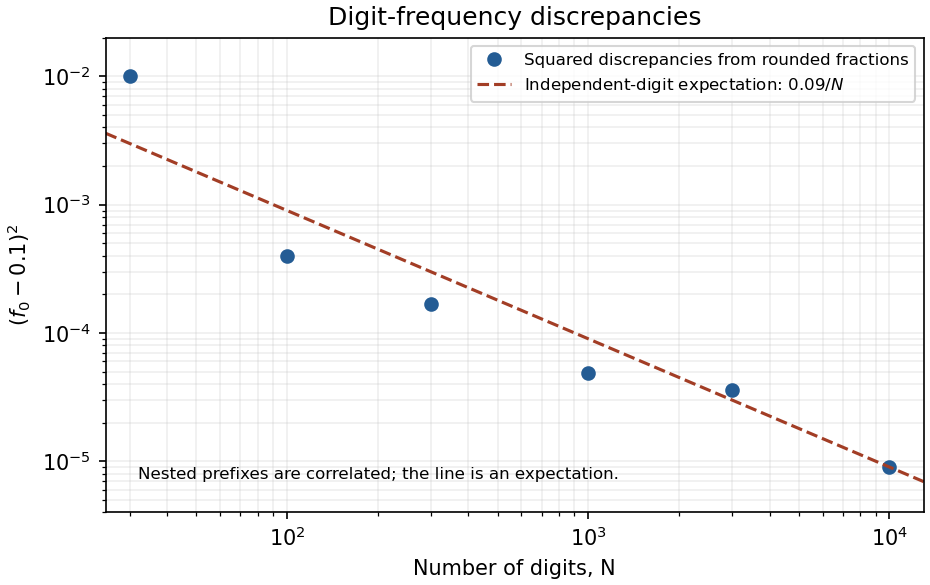
Original log-log plot of squared digit-frequency discrepancies with the independent-digit expectation
. Details. 
From Snell's law, . Treating the quoted angle errors as independent one-standard-deviation uncertainties and using radians in derivatives,This refractive-index uncertainty from Snell's law is first-order propagation of uncertainty, with air's index approximated by one. Correlated angular calibration errors add . If the quoted errors are hard bounds instead, their conservative first-order sum gives about , rather than the statistical quadrature value.
Articles by others on the same topic
There are currently no matching articles.