The photon relation gives . The diffraction-limited angular scale of an aperture of diameter is thereforeFor a uniformly illuminated circular aperture, the Rayleigh criterion instead gives . Both express the same requested estimate. This is an ideal diffraction limit, conditional on the effective diameter behaving as a coherent imaging aperture; photon energy and diameter alone do not specify the performance of a practical gamma-ray telescope.
At distance , the small-angle approximation gives . Thus the transverse resolution is approximately , or with the circular-aperture Rayleigh criterion. This is a transverse separation at the source, rather than a determination of its distance along the line of sight.
Let be the common tension and the linear mass densities. The characteristic impedance of a stretched string is . Continuity of displacement and transverse force at a massless junction gives and . ConsequentlyThe reflected power is . The minus sign of represents a phase reversal, not negative power. Both incident and reflected waves travel in the first string, so their power ratio is simply the squared displacement-amplitude ratio. As a check, and .
Compare a directly transmitted ray emerging at with a ray that makes one extra round trip inside the Fabry–Pérot interferometer and emerges at . Both emerge parallel at angle to the plate normal. The extra internal distance is , and their emergence points differ laterally by . The first ray has already travelled towards a common outgoing wavefront when the second reaches . The air-gap optical path difference in a Fabry–Pérot interferometer follows because optical path length equals geometric path length in the air-gap approximation:The subtraction is essential: comparing distances only inside the plates would compare different outgoing wavefronts. The corresponding propagation phase difference is . Coating reflection phases can add a separate phase offset; they do not change this geometric optical path difference.
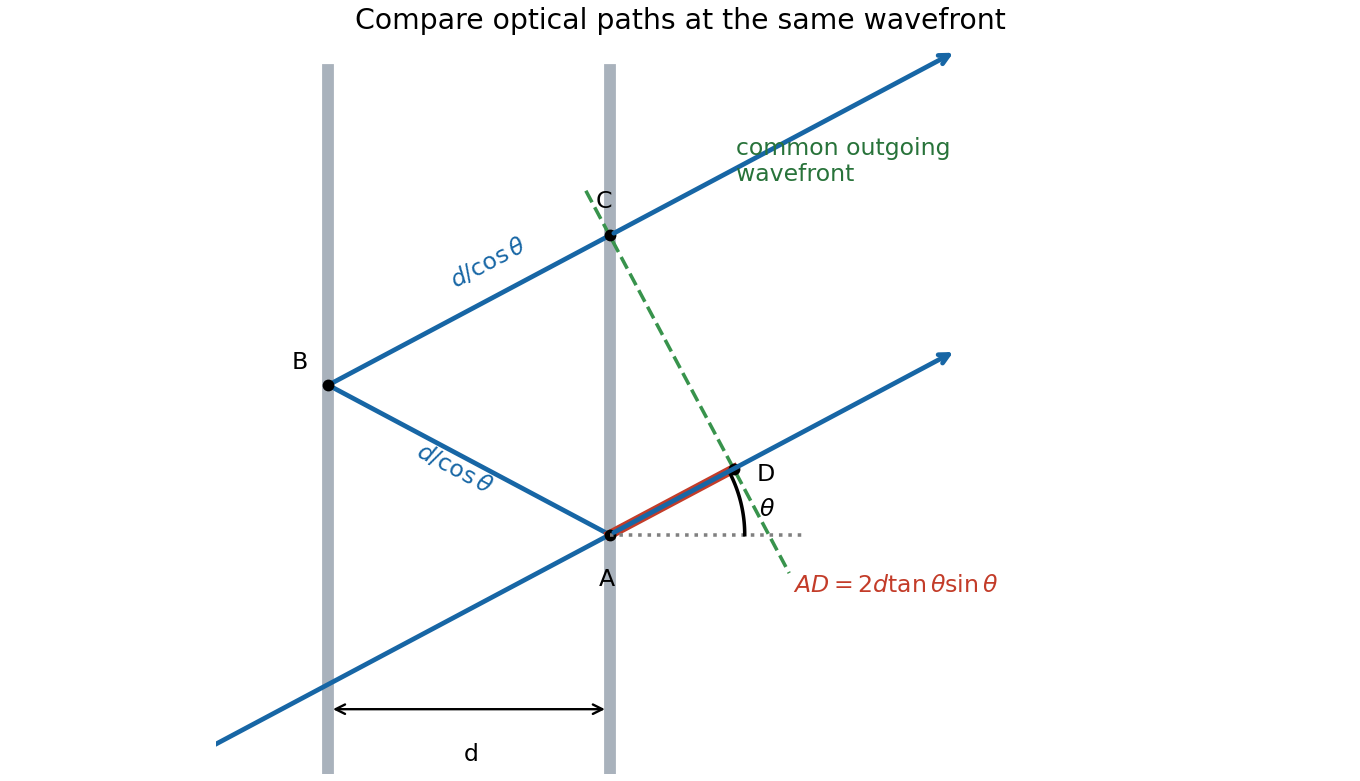
One extra round trip and the common outgoing wavefront in an air-spaced Fabry–Pérot interferometer
. Details. 
Count two electron spin states in each reciprocal-space cell of volume . Filling a Fermi sphere at zero temperature givesThe free electron model then givesThe energy zero is the bottom of the model's conduction band. The supplied carrier density already incorporates the one-electron-per-atom assumption; it must not be multiplied by another atomic count.
Write for the primitive cubic lattice spacing. With wavevector convention , reciprocal-lattice primitive vectors have length . The first Brillouin zone is the cube , henceIt has the same volume as any primitive reciprocal unit cell. A reciprocal coordinate defined in cycles per metre would instead give ; that is a different convention from this -space convention.
Articles by others on the same topic
There are currently no matching articles.