Let two weakly coupled bodies exchange energy while their total energy is fixed. If body1 has , the number of compatible states is . Its most probable equilibrium division maximizes the logarithm, givingThis equal intensive quantity labels thermal equilibrium. With and thermodynamic ,Ordinary positive heat capacities make the entropy maximum locally stable. Particle numbers and volumes are held fixed during the exchange.
For a subsystem coupled to a large heat bath, the exact level weight is proportional to . Expanding the bath entropy gives . Normalization therefore givesThe Boltzmann form uses the reservoir limit; an arbitrary small isolated pair instead retains its exact bath state count. The degeneracy counts distinct subsystem microstates at the same energy, rather than adding another Boltzmann factor for the whole level.
In the two-level donor occupancy model, set the single bound-state energy to zero and the conduction representative to with degeneracy . Ignoring spin, its bound probability isThe measured model occupancy gives , sousing . The supplied occupancy and energy are rounded, so there is no reason to demand an exact nonrounded integer from that inference.
For , the excited-to-bound weight must be . Eliminate using the first point:The probability decreases monotonically from1 as toward as . The nonzero high-temperature limit follows from the stipulated finite effective degeneracy, not from a full continuum conduction-band calculation. A realistic band with energy-dependent density of states need not retain this two-level limit.
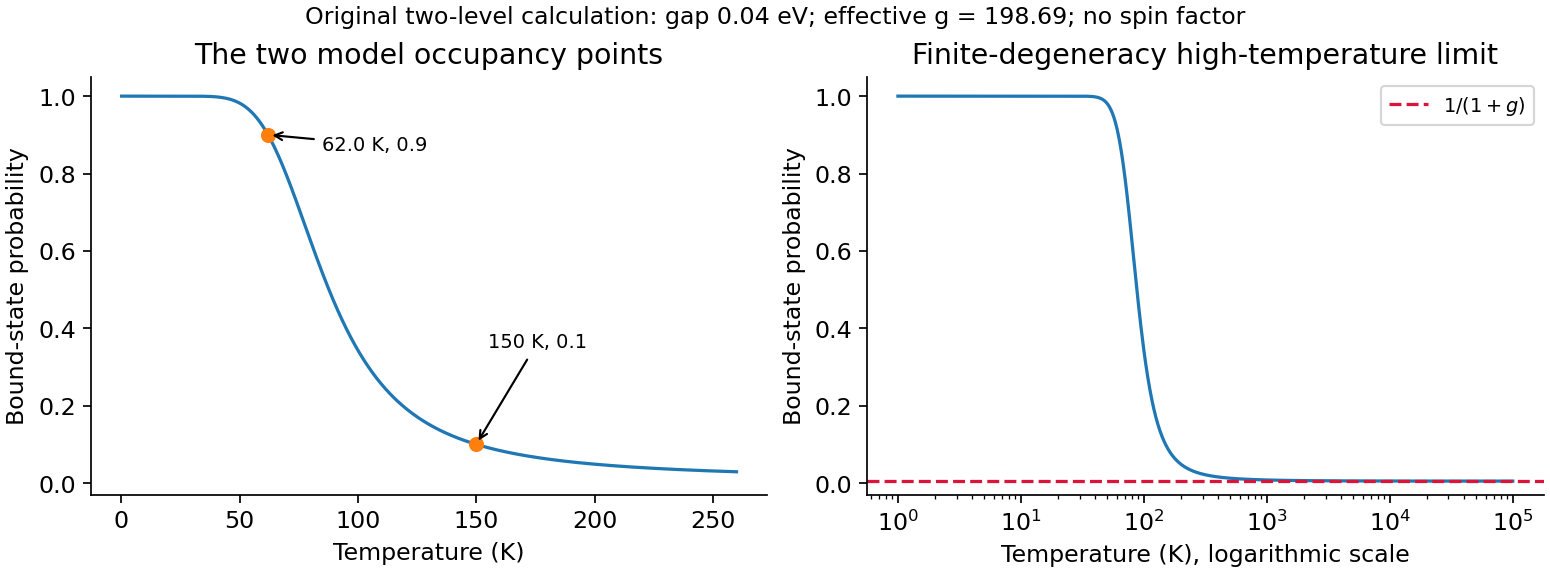
Donor occupancy
. Two-level model with both inferred temperature points. Details.
Articles by others on the same topic
There are currently no matching articles.