For a fixed-composition simple compressible system, gives and . Equality of mixed derivatives yields . ThereforeFor one mole of ideal gas, , so . Reversible heat at fixed pressure gives , and consequentlyWith constant positive molar heat capacity, integrate from a reference state :If heat capacity varies, the last term must instead be . The reference ratios make the logarithms dimensionless. The following classical ideal-gas entropy limits test where the constant-heat-capacity expression remains applicable.
At fixed positive pressure, the extrapolated term tends to as . That prediction is not physically realistic for an equilibrium sample. The classical ideal-gas description with constant heat capacity cannot extend unchanged to absolute zero. A real substance generally undergoes phase changes, and quantum statistics and thermal freeze-out change its heat capacity and entropy. For a nondegenerate equilibrium ground state, the third law gives entropy approaching zero; residual ground-state degeneracy can give a finite residual value rather than this negative divergence. This is a breakdown of the extrapolation, not a violation of the third law by a real gas.
At fixed positive temperature, tends to as . This is a physically meaningful unbounded-volume limit for a fixed mole number: , so the number of accessible translational configurations grows without bound. For an ideal gas the entropy difference is at fixed temperature. No finite vessel reaches an infinite entropy, and at finite temperature is not a finite-volume one-mole state. The divergence is approached by dilution; it does not conflict with the third law, which concerns a different temperature limit.
Let two weakly coupled bodies exchange energy while their total energy is fixed. If body1 has , the number of compatible states is . Its most probable equilibrium division maximizes the logarithm, givingThis equal intensive quantity labels thermal equilibrium. With and thermodynamic ,Ordinary positive heat capacities make the entropy maximum locally stable. Particle numbers and volumes are held fixed during the exchange.
For a subsystem coupled to a large heat bath, the exact level weight is proportional to . Expanding the bath entropy gives . Normalization therefore givesThe Boltzmann form uses the reservoir limit; an arbitrary small isolated pair instead retains its exact bath state count. The degeneracy counts distinct subsystem microstates at the same energy, rather than adding another Boltzmann factor for the whole level.
In the two-level donor occupancy model, set the single bound-state energy to zero and the conduction representative to with degeneracy . Ignoring spin, its bound probability isThe measured model occupancy gives , sousing . The supplied occupancy and energy are rounded, so there is no reason to demand an exact nonrounded integer from that inference.
For , the excited-to-bound weight must be . Eliminate using the first point:The probability decreases monotonically from1 as toward as . The nonzero high-temperature limit follows from the stipulated finite effective degeneracy, not from a full continuum conduction-band calculation. A realistic band with energy-dependent density of states need not retain this two-level limit.
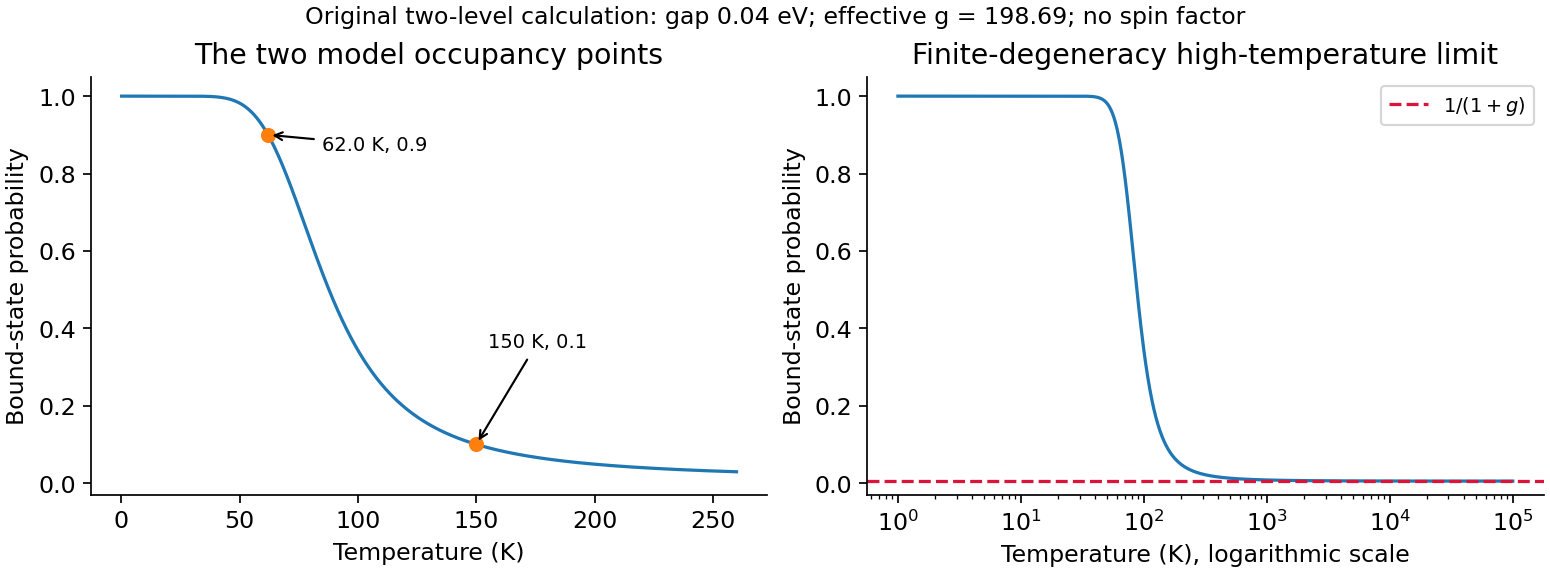
Donor occupancy
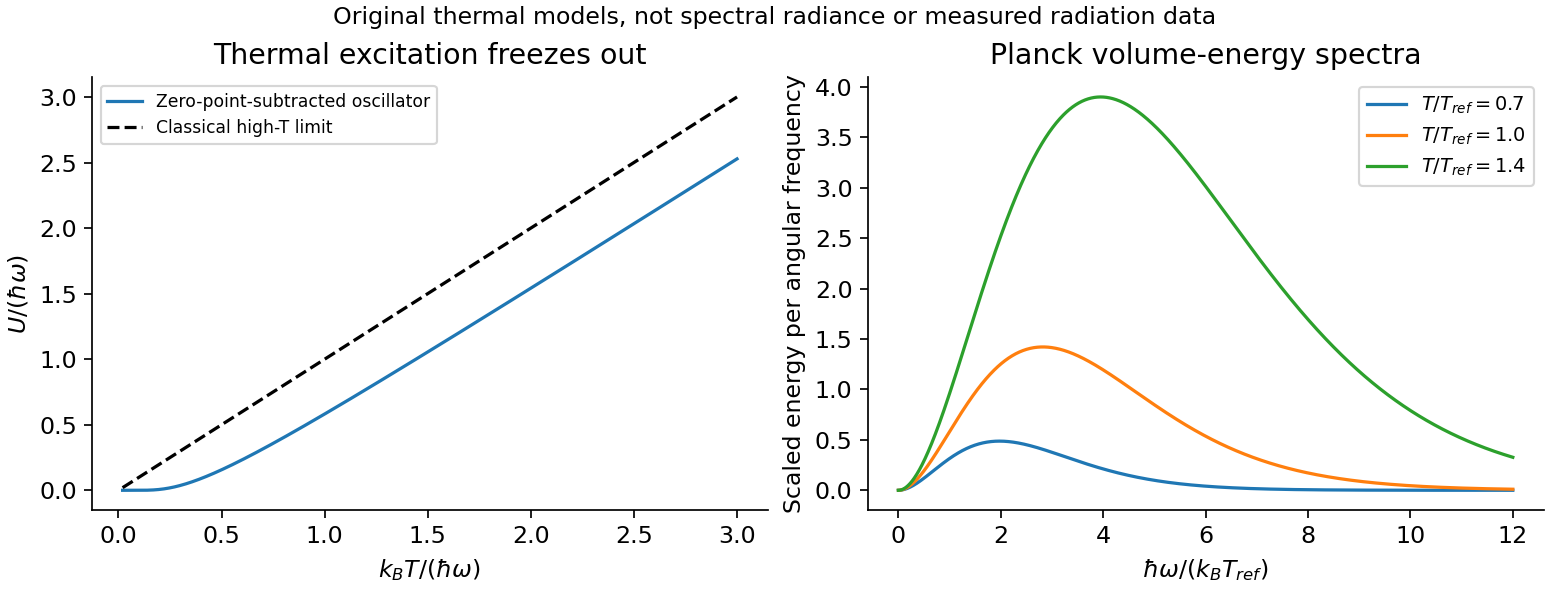
. Two-level model with both inferred temperature points. Details.For excitation energy , the geometric series gives the thermal partition function of a quantum harmonic oscillator with its zero-point energy subtracted:Thus at low temperature and approaches at high temperature. Restoring the zero-point term multiplies by and adds to , without changing the thermal occupation probabilities.
To count electromagnetic modes, put a large cavity in a periodic box of volume . One transverse polarization has wavevector-state density ; there are two independent polarizations. In the shell ,With , the electromagnetic mode density in a box becomesThe continuum expression is the large-cavity leading term; using standing-wave boundary conditions gives the same bulk count. Both photon polarizations must be included. This is density per angular frequency, not per ordinary frequency.
Each mode is an oscillator with zero photon chemical potential in thermal equilibrium. Multiplying its mean thermal energy by the mode density per volume gives the angular-frequency Planck energy densityAt small it reduces to the Rayleigh–Jeans result ; exponential suppression at high frequency prevents a divergent thermal energy. With ,The integral is the stipulated . This is a volume energy density, ; for isotropic cavity radiation the outward black-surface flux is , with . Distinguishing flux, spectral density and total volume energy avoids extra factors of , or .


The zeroth law of thermodynamics states the transitivity of thermal equilibrium: if two systems each equilibrate thermally with a third, they equilibrate with one another. A reproducible thermometric property can therefore label their temperature. Its empirical numerical scale is not itself the complete thermodynamic content; reversible heat-engine relations establish an absolute temperature scale.
The first law of thermodynamics expresses energy conservation. For a closed system, when is work done by the system. internal energy is a state function, while heat and work depend on the path. In reversible simple compressible motion, and ; an open system additionally needs the energies carried by transferred matter. An ideal gas can expand freely with and unchanged internal energy. The first law alone does not decide whether the reverse spontaneous process occurs.
The Second law of thermodynamics introduces entropy and restricts direction. For a reversible path, ; for an irreversible process the entropy balance includes nonnegative production. The entropy of an isolated system cannot decrease. In a cycle, the Clausius inequality is , using the appropriate boundary/reservoir temperatures. The Kelvin–Planck statement forbids a cyclic device whose sole effect is extracting heat from one reservoir and turning all of it into work; the Clausius statement forbids moving heat from cold to hot with no compensating effect. A refrigerator is allowed because it consumes work. A two-reservoir engine has , with equality in the reversible limit. Work may be fully dissipated as heat without contradicting this one-way restriction.
The third law of thermodynamics constrains low-temperature entropy. An equilibrium perfect crystal with a nondegenerate ground state approaches zero entropy as , fixing the conventional absolute entropy reference. Degenerate ground states or frozen nonequilibrium disorder require care when discussing residual entropy. Under regular equilibrium conditions the heat capacity must decrease sufficiently for to remain finite; a constant positive classical heat capacity cannot be extrapolated to zero temperature. The unattainability formulation states that absolute zero cannot be reached by a finite sequence of admissible cooling operations. These statements concern the limiting thermodynamic regime, rather than predicting that every substance stays in one classical phase during cooling.
The laws work together: conservation sets a device's energy budget, entropy production restricts the attainable budget, and constitutive equations give the properties of its working material. For fixed temperature and volume, Helmholtz free energy decreases toward equilibrium; at fixed temperature and pressure the corresponding potential is Gibbs free energy. Stable equilibrium, phase coexistence and Maxwell relations follow from these potentials with appropriate constraints. Calorimetry, mechanical-work measurements, thermometry and reversible-path comparisons test different parts of this framework. None of the laws by itself supplies a particular gas equation of state or microscopic heat capacity.
Articles by others on the same topic
There are currently no matching articles.