A fictitious force accounts for acceleration of the chosen reference frame rather than an additional interaction. For axes rotating at constant , differentiating a vector uses . Twice applying this givesso moving the last two terms to the force side produces the Coriolis and centrifugal forces. Here is measured in rotating axes.
The rotating saddle trap has potential force . ThereforeThe trial solution givesBoth modes are bounded for arbitrary sufficiently small initial displacements and velocities precisely when . At equality there is a zero-frequency secular mode; the exactly stationary solution does not establish stability.
For rapidly rotating saddle confinement with , real mode ellipses can be writtenThey are nearly circular clockwise motions at rates . Rotating these axes back to the laboratory cancels the large angular rate: the leading laboratory motion is a slow approximately harmonic ellipse with frequency , plus small rapid micromotion. It results from the changing saddle force, not a static potential minimum. At next order the ellipse precesses prograde at . The rotating-potential model and this guiding-centre distinction are analysed in the primary work cited here.[ref]
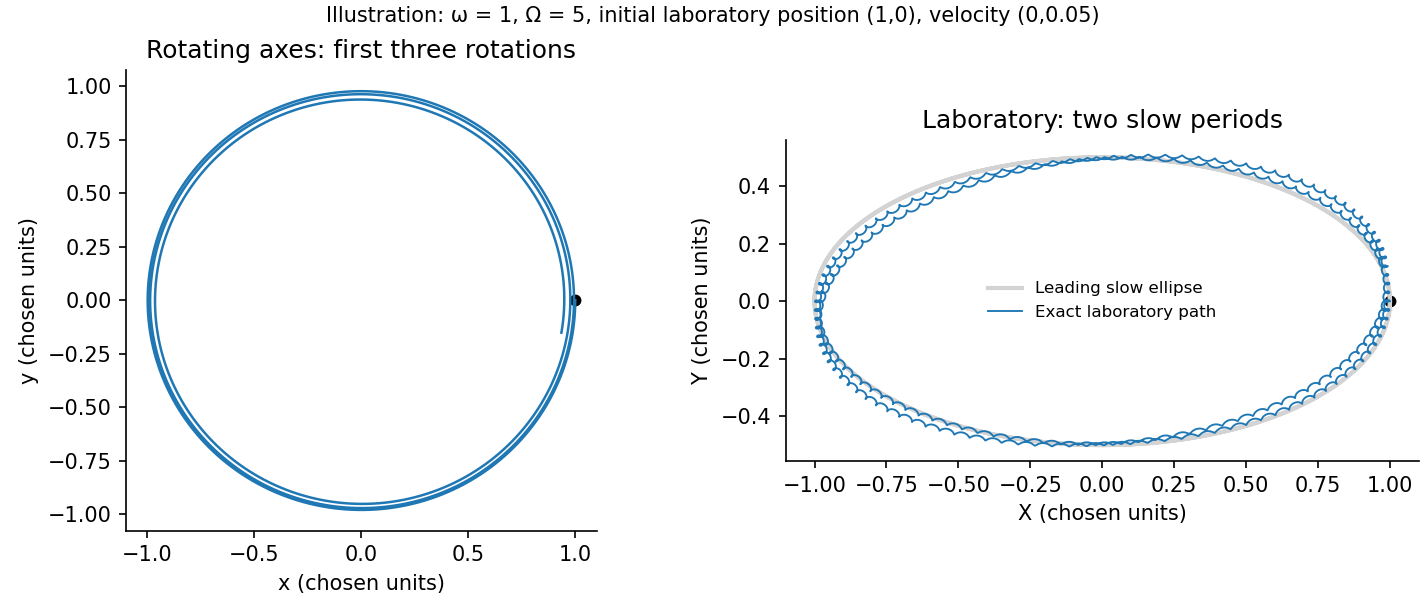
Original exact trajectories in rotating and laboratory coordinates for a chosen rapid saddle rotation
. Details. 
Articles by others on the same topic
There are currently no matching articles.