A fictitious force accounts for acceleration of the chosen reference frame rather than an additional interaction. For axes rotating at constant , differentiating a vector uses . Twice applying this givesso moving the last two terms to the force side produces the Coriolis and centrifugal forces. Here is measured in rotating axes.
The rotating saddle trap has potential force . ThereforeThe trial solution givesBoth modes are bounded for arbitrary sufficiently small initial displacements and velocities precisely when . At equality there is a zero-frequency secular mode; the exactly stationary solution does not establish stability.
For rapidly rotating saddle confinement with , real mode ellipses can be writtenThey are nearly circular clockwise motions at rates . Rotating these axes back to the laboratory cancels the large angular rate: the leading laboratory motion is a slow approximately harmonic ellipse with frequency , plus small rapid micromotion. It results from the changing saddle force, not a static potential minimum. At next order the ellipse precesses prograde at . The rotating-potential model and this guiding-centre distinction are analysed in the primary work cited here.[ref]
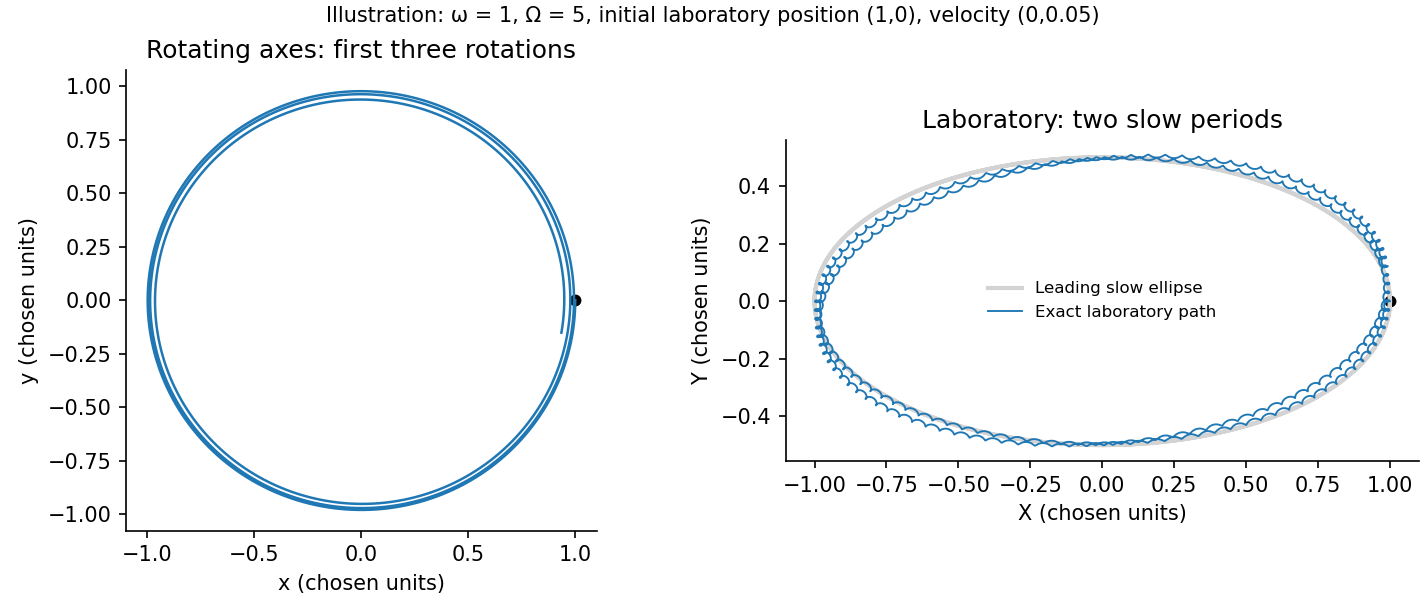
Original exact trajectories in rotating and laboratory coordinates for a chosen rapid saddle rotation
. Details. A normal mode is a small oscillation with fixed relative displacement amplitudes, all coordinates oscillating at one frequency. linearization gives , so mode shapes solve .
Write . force balance on an outer ion gives , henceA pair separated by has quadratic energy , equivalent to spring constant . The adjacent-pair constants are , and the outer-pair constant is . Adding the trap stiffness givesIn the three-ion axial normal modes, the translation mode leaves every separation unchanged. The antisymmetric breathing mode leaves the central ion fixed; the remaining vector is orthogonal to both. Direct multiplication yieldsFor breathing excitation after a trap-frequency quench, put and . The displacement from the new equilibrium is solely along the breathing vector and the initial velocity is zero. To first order in the fractional quench,The frequency shown is the linearized frequency about the new equilibrium. Nonlinear amplitude corrections are beyond this small-quench result.
At distance from the neutral axis, bending strain has magnitude and the corresponding stress is . Its moment is thereforeThe second moment of area is about the neutral bending axis and has units of length to the fourth power. This assumes a slender linear-elastic beam, small strains and plane sections remaining plane, not necessarily small deflections.
For horizontal compression , moment balance across a short arc gives . Since , the exact-angle Euler elastica equation and its first integral areThe first integral follows by multiplying by and integrating; no small-angle replacement has been made.
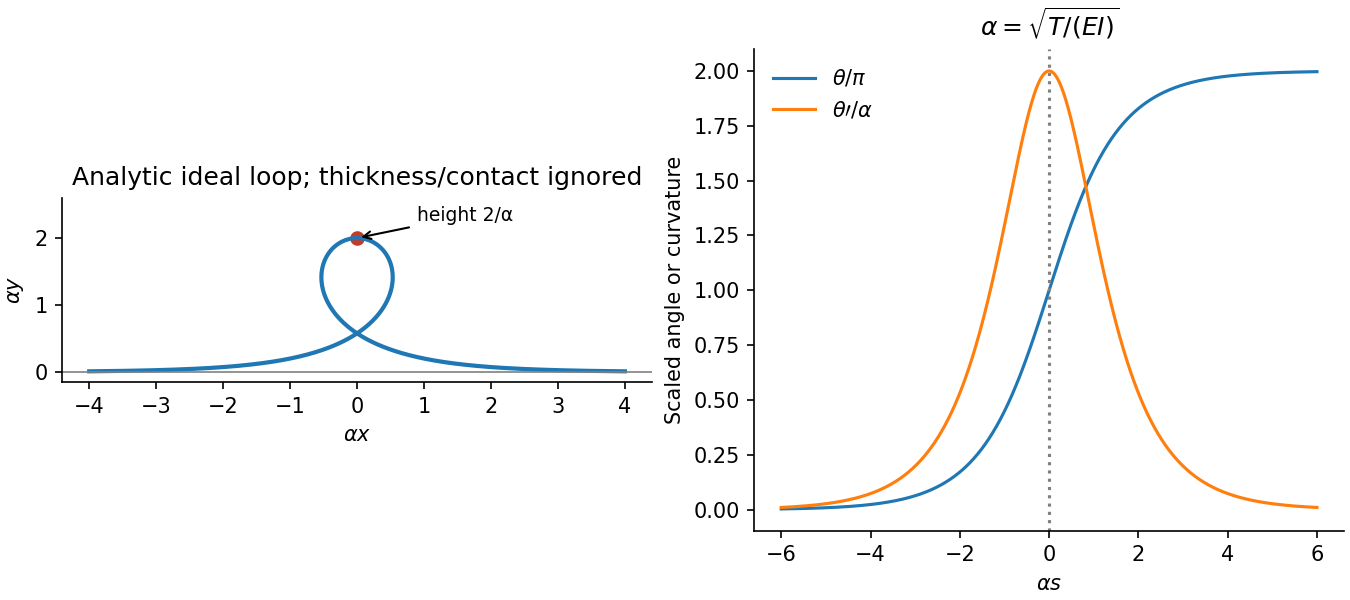
For tension set . The straight far-field ends give , so on the increasing-angle tensile elastica loop branchChoosing at givesThe terminal angles are and , the same physical tangent direction. At the top, and the bending moment is . The horizontal tensile force has lever arm , soIntegrating independently gives , , confirming the height. This ideal loop neglects self-contact and thickness at its crossing.


In irrotational flow, the velocity has a velocity potential locally, and globally in a simply connected flow domain. incompressibility then gives . For a sphere moving at speed along through fluid at rest far away, the potential of a translating sphere is a decaying axisymmetric dipole. Its solution and its impermeability condition giveThese are laboratory fluid velocities expressed relative to a moving origin. A velocity field measured in the sphere-rest frame instead requires adding to the potential.
The vector identity printed in the PDF has its signs reversed. The product rule gives the consistent identity . With outward normal of the exterior fluid equal to at the sphere, the divergence theorem yieldsThe integral at infinity vanishes. HenceThis added mass of a sphere is half the displaced fluid mass. For a spring of unchanged stiffness, buoyancy only shifts the static equilibrium. Its oscillation frequency with fluid added mass isFor a small-angle simple pendulum, buoyancy also reduces restoring torque from to , while the inertia is . ThusThe downward equilibrium is stable only for . The ideal results assume unbounded fluid, negligible viscosity, small excursions, and no important free-surface or container corrections.
Articles by others on the same topic
There are currently no matching articles.