Faraday's law for the moving loop is , equivalently for its moving circuit. Lenz's law fixes its orientation: the induced current opposes the change in linked magnetic flux. The minus sign represents this opposition, not opposition to the existing field in every phase of motion.
Unroll the small loop's motion locally into translation to the right at speed , where is the radius marked in the source figure. Take the imposed field into the page. On entry the linked into-page flux increases, so the current is counterclockwise. The leading vertical side carries current upward and feels a leftward magnetic force . The in-field parts of the horizontal sides feel equal opposite vertical forces; the trailing side is outside the field. On exit the current is clockwise. The trailing vertical side is now the one in the field and again carries upward current, producing leftward drag; the horizontal forces reverse and still cancel. When the entire loop is within the uniform region, its flux is constant, so and every side force is zero under the stated negligible-self-inductance approximation.
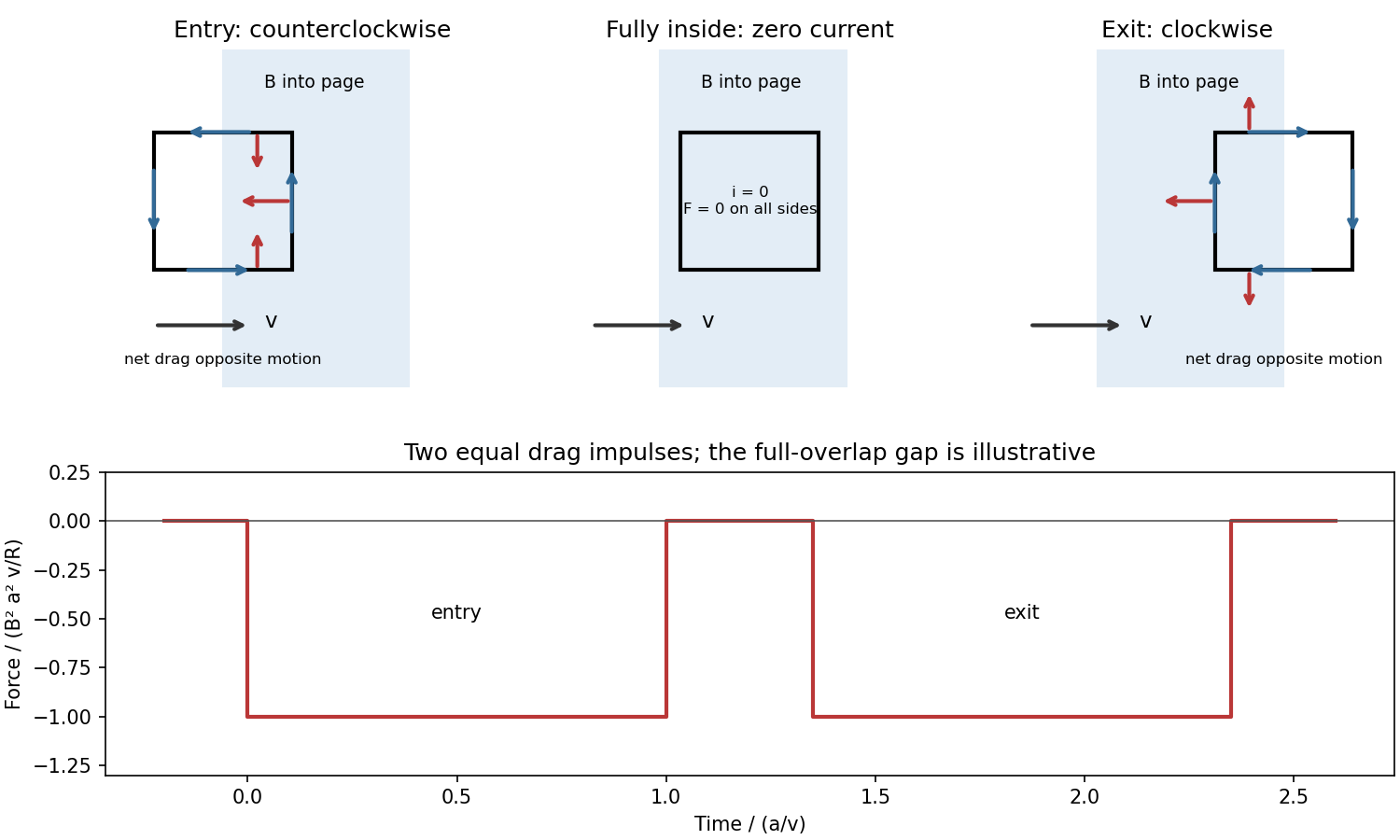

For a loop crossing a magnetic field boundary, overlap changes at rate , henceFor approximately constant speed this gives two negative rectangular force pulses of duration , separated by a short zero-force interval while the loop is fully inside. Their time integral isThe quoted impulse is its magnitude; this impulse of magnetic braking opposes the motion. In fact its independence of speed remains exact within this locally translational sharp-boundary model even if speed changes: each crossing contributes over distance .
Write the system's moment of inertia as . Since , the local energy balance during overlap isThus rotational energy lost is exactly resistive heat in this model. At nearly constant , each pass givesFor a finite speed reduction the exact relation is the integral of , rather than initial speed times impulse; the equality of work and heating still holds. Fringing fields, loop curvature and finite self-inductance smooth the ideal pulses. A practical user control is to vary the electromagnet current, hence : braking scales as .
Articles by others on the same topic
There are currently no matching articles.