Coupled oscillators have more than one collective pattern of motion. For two equal masses , each attached to a fixed support by a spring of stiffness and linked to each other by stiffness , small displacements obeyHere equal linear damping is included to make finite steady-state responses at resonance. The normal mode coordinates and diagonalize these equations. Their natural angular frequencies areThe symmetric normal mode leaves the coupling spring unextended; the antisymmetric normal mode stretches it and therefore has the higher frequency. With , their complex steady-state responses areThus the drive's spatial pattern matters as well as its frequency. Equal in-phase forces drive only the symmetric normal mode; opposite forces drive only the antisymmetric one; driving a single mass generally excites both. Finite damping broadens the resonance peaks and produces a phase lag. In the ideal undamped system, a resonant drive with nonzero projection onto a normal mode produces secular growth rather than a bounded resonant steady state.
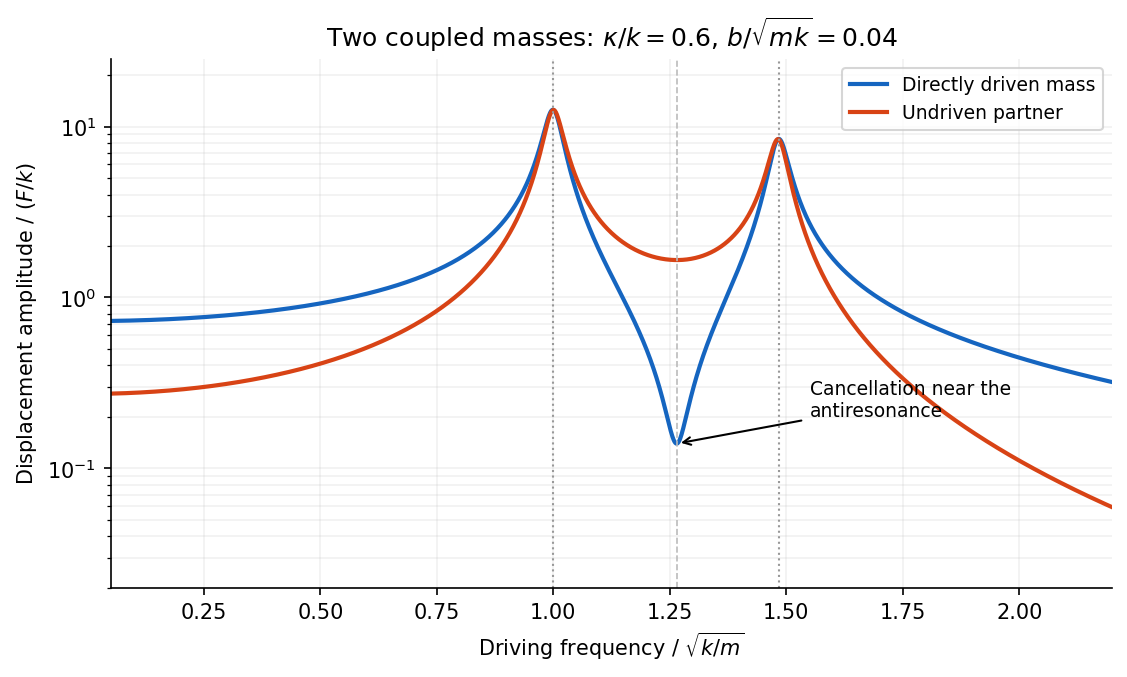

The displacement of a particular mass adds contributions from both normal modes. They can cancel at an antiresonance. For and no damping, vanishes at , while the partner still moves. This differs from the two nearby resonances, where a mode responds strongly; a small measured response need not mean that no motion or stored energy exists elsewhere.
Articles by others on the same topic
There are currently no matching articles.