A horizontal pressure gradient force accelerates air from higher toward lower pressure. In a rotating frame the Coriolis force deflects the flow. Away from strong friction, at large spatial scales and small Rossby number, a slowly changing flow can reach geostrophic balance:where is the Coriolis parameter. The geostrophic wind runs along atmospheric isobars, with speed . Closely spaced atmospheric isobars therefore indicate stronger geostrophic wind when density and latitude are comparable. In the northern hemisphere lower pressure lies to the left of this wind, producing counterclockwise circulation around a low; the sense reverses in the southern hemisphere.
A curved flow also has centripetal acceleration. For cyclonic circular flow in the northern hemisphere, the gradient wind relation isNear the ground, friction reduces wind speed and weakens its Coriolis contribution, so air crosses atmospheric isobars toward lower pressure. The simple geostrophic formula fails near the equator, where becomes small, and where rapid changes or tight curvature make neglected acceleration important. Vertically, large-scale motion is often approximated by hydrostatic balance, .
Bernoulli's principle can relate speed changes to pressure changes along an appropriate inviscid streamline, but its simple dynamic-pressure relation is not a replacement for the rotating force balance governing a broad atmospheric pressure map.
Coupled oscillators have more than one collective pattern of motion. For two equal masses , each attached to a fixed support by a spring of stiffness and linked to each other by stiffness , small displacements obeyHere equal linear damping is included to make finite steady-state responses at resonance. The normal mode coordinates and diagonalize these equations. Their natural angular frequencies areThe symmetric normal mode leaves the coupling spring unextended; the antisymmetric normal mode stretches it and therefore has the higher frequency. With , their complex steady-state responses areThus the drive's spatial pattern matters as well as its frequency. Equal in-phase forces drive only the symmetric normal mode; opposite forces drive only the antisymmetric one; driving a single mass generally excites both. Finite damping broadens the resonance peaks and produces a phase lag. In the ideal undamped system, a resonant drive with nonzero projection onto a normal mode produces secular growth rather than a bounded resonant steady state.
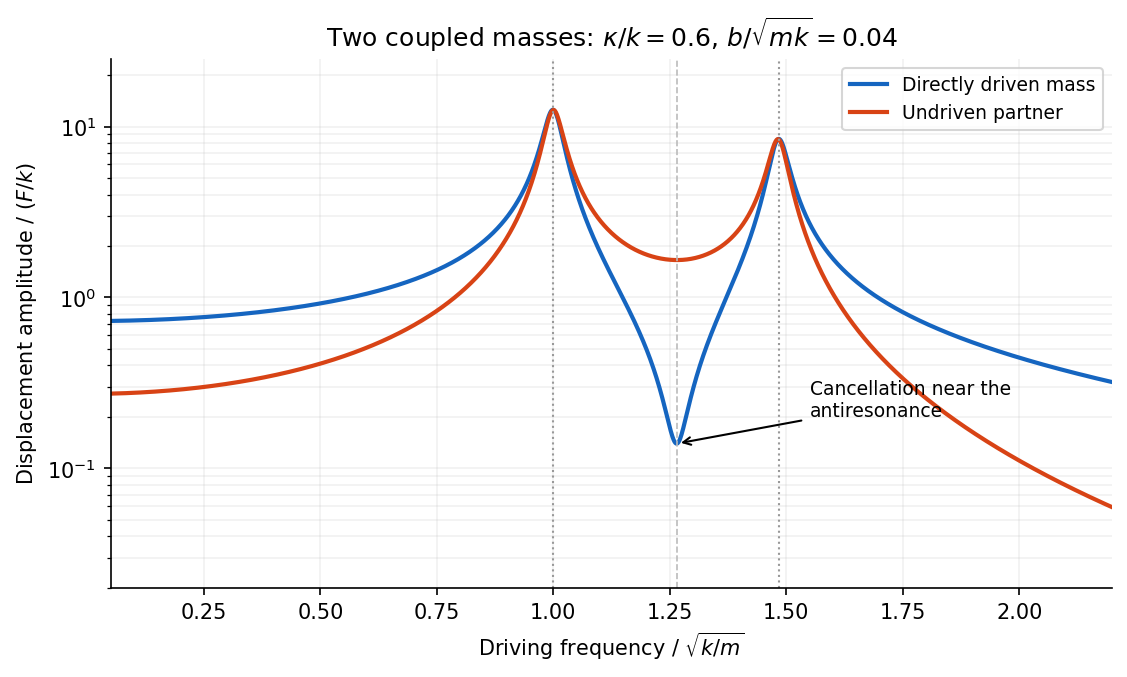

The displacement of a particular mass adds contributions from both normal modes. They can cancel at an antiresonance. For and no damping, vanishes at , while the partner still moves. This differs from the two nearby resonances, where a mode responds strongly; a small measured response need not mean that no motion or stored energy exists elsewhere.
A Newtonian fluid exerts viscous shear stress proportional to the rate of strain. For an incompressible fluid of constant dynamic viscosity ,The local momentum balance is the Navier-Stokes equation:The left side is density times material acceleration. A steady velocity field can still have convective acceleration when a moving parcel changes speed or direction; setting does not eliminate it.
The Reynolds number compares inertia with viscous effects. At low Reynolds number, the fluid's own inertia can often be neglected, giving Stokes flow. This does not say that every immersed body has zero acceleration: its mass and the net pressure, viscous and body forces still enter its own equation of motion.
For a small rigid sphere moving through a slowly varying viscous background, Stokes drag is . In still fluid, a simple settling model includes weight, buoyancy and drag:Ignoring fluid added mass and unsteady history forces, this gives relaxation time and terminal velocityAt the terminal velocity the net force and acceleration vanish, while viscous drag and gravity remain individually nonzero. The dissipated power is supplied by the loss of gravitational potential energy relative to buoyant support. The creeping-flow and quasisteady-drag assumptions must be checked before applying this expression at large speed or immediately after a rapid start.
For two bodies interacting through a potential energy that depends only on their separation, introduce the centre of mass coordinate and the two-particle relative coordinate:Their kinetic energy separates exactly:The centre of mass moves uniformly if there is no external force, while the internal two-body problem reduces to one effective particle of reduced mass :The original trajectories follow from and .
For Newtonian gravity, , so the relative acceleration is . Conserved relative angular momentum and energy then give the usual conic sections. For a bound orbit of relative semimajor axis ,The two bodies share this orbital period and orbit their common centre of mass with semimajor axes in inverse proportion to their masses. If , then , recovering the fixed-heavy-centre approximation. Using as the internal inertial mass would confuse centre-of-mass translation with relative motion.
Articles by others on the same topic
There are currently no matching articles.