Images and uniqueness. The method of images replaces a conducting boundary by fictitious charges outside the physical field region. Choose them so that the resulting electric potential satisfies the required conductor potentials. The Uniqueness of the Dirichlet problem then guarantees the same physical exterior field. For example, a point charge at height above a grounded plane has an image at height : the plane is an equipotential at zero, and the charge is attracted toward it by . The image is a computational device; the physical conductor carries a continuous induced surface charge density.
Potential of a line. Surround an infinite line charge by a coaxial Gaussian cylinder of radius and length . Gauss's law gives , hence . Integrating givesWriting an additive constant instead is equivalent. The reference length makes the logarithm dimensionless; an isolated infinite line cannot be assigned a finite zero potential at infinity.
Locating the two lines. Put the grounded plane at and the physical cylinder at , with axis along and radius . Set , and place line charges and at and . If and are their distances from an observation point, the cylinder-plane image charges giveOn , , so . To check the cylinder, define . The level set is a circle: completing the square givesSince , its centre is and radius is . The positive line lies inside the cylinder; the negative line lies behind the plane. There is consequently no fictitious charge in the exterior physical region. A Gaussian contour around the cylinder encloses only, so the required physical charge per unit length is also correct. These boundary conditions and the far-field behaviour determine the physical solution by Uniqueness of the Dirichlet problem.
Cylinder voltage. The constant distance ratio on the cylinder immediately givesIts capacitance per unit length is . In the thin-cable limit, .
Cable attraction. Because the cable is idealized as infinite, the meaningful answer is force per unit length. For , centre height and ,The electrostatic attraction per unit length of a cylinder above a plane isFor example, this follows without any ambiguity about moving image positions from at fixed voltage, including the work of the voltage source. Its sign is negative because capacitance decreases with height. A cable length experiences approximately downward when end effects are negligible. This is the electrostatic contribution only.
Inductance and interface conditions. For a linear coil, self-inductance is the ratio of its own magnetic flux linkage to current. Its induced electromotive force is for fixed . Across an interface with unit normal from medium 1 to 2,These electromagnetic boundary conditions follow from Gauss's law for magnetism and Ampère's law. Here is free surface current. At the iron–air faces there is no free surface current, so normal magnetic flux density and tangential magnetic field intensity are continuous. In each isotropic linear medium, .
Complete core. A slender toroid has approximately uniform along mean path length . Ampère's law gives , so . The flux per turn is , yielding the inductance of a toroidal winding,This uses constant relative magnetic permeability and neglects leakage, fringing and saturation.
Why the gap lowers inductance. The gap replaces an easy magnetic path in iron with air. Maintaining the same flux now requires a much larger magnetic field intensity in part of the path and therefore more ampere-turns. Equivalently, magnetic reluctance increases, so the flux linkage for a fixed current and hence self-inductance decrease. A narrow gap can matter greatly because its permeability is smaller by the factor .
Oblique-gap calculation. In the original diagram is the perpendicular separation of the cut faces. Let point along the core, and let be normal and tangential to the gap faces. With the face at angle to the core direction, . Write the core flux density as . The boundary conditions givesoThe gap area normal to its nearly normal field is , not . Its leading reluctance is consequently . Adding the core reluctance gives the inductance of a toroid with an oblique narrow air gap,Thus at ,The approximation retains the possibly order-one ratio while neglecting , fringing and the small tangential gap contribution. More precisely, a local uniform-field path along the core, with missing iron length subtracted, gives denominator . Its correction is beyond the stipulated large-, narrow-gap accuracy; simply neglecting would not be justified.
Field in the slot. The component expression above givesFor the gap and ,Its units are . The field is almost perpendicular to the cut faces, rather than following the iron direction straight across the cut. Its small angle away from the face normal satisfies at ; the sense reverses if the current reverses.
Field law and centre value. The Biot-Savart law for a steady thin wire isHere follows the conventional electric current and the displacement points from source to observation point. For a circular loop of radius , every element at the centre has distance and contributes in the same axial direction. Choose by the right-hand rule. Then
On-axis integration. At axial distance , every wire element has distance . Azimuthal symmetry cancels transverse components. Parameterizing gives axial cross-product element , so the on-axis magnetic field of a circular current loop isIt points the same way on the two halves of the axis; its strength is even in .
Directions near the axial point. At a point on the positive axis the field is axial, but nearby lines spread outward because decreases as increases. On the negative-axis side they converge toward the axis while still progressing in the positive axial direction. There is no azimuthal field. The near-axis sketch shows this local spreading; the complete magnetic field lines return around the outside of the loop and form closed curves.
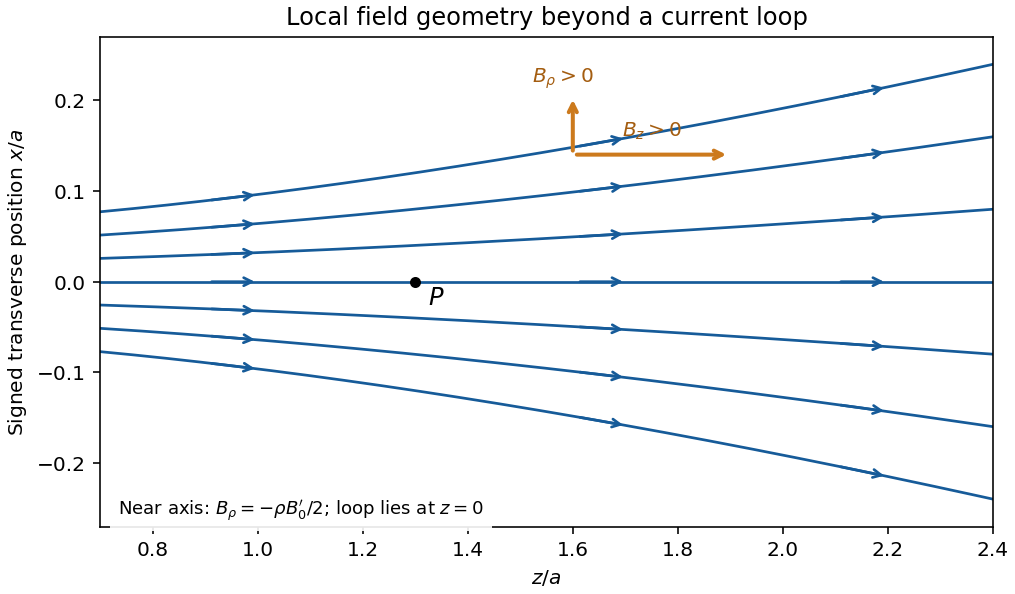
Original calculated leading near-axis field-line geometry on the positive side of a circular current loop; the lines spread as the axial field weakens
. Details. 
Radial component from zero divergence. Smooth axial symmetry gives and . By Gauss's law for magnetism,Integrate radially from zero, excluding a singular term, to obtain the near-axis radial magnetic field, . Differentiating the axial field therefore givesFor it is outward; for it is inward. This supplies the direction reasoning used in the sketch.
Force on the second loop. Put the second loop at and radius . For , the radial field due to the first loop is . The element experiences Lorentz forceThe radial contributions cancel as vectors around the loop. The axial contributions add, giving the force between distant coaxial current loops,The sign follows . Both the small radial coordinate relative to and the dipole approximation are justified by .
Force direction. The second loop is pulled back toward the first: the force is attractive for the same current sense. Reversing one current reverses the force. The much larger axial field chiefly produces radial element forces; retaining the smaller radial field is essential for the net axial attraction.
Field equations. In a homogeneous source-free nonmagnetic medium, and . Maxwell's equations becomeThe first equation follows from for spatially constant nonzero . When the effective relative permittivity is negative below, its charge response is already included in ; it must not also be counted as an extra free source.
Amplitude relations and bulk dispersion. Work with complex phasors proportional to . For , the Ampere-Maxwell law givesso the amplitudes must obeyThey are not arbitrary independent constants: the dispersion relation alone would not make arbitrary amplitudes satisfy the equations. These relations give , so the electric divergence vanishes; the magnetic divergence vanishes because there is no dependence. The only nonzero component of Faraday's law of induction isSubstitution then givesThis proves that all four field equations hold for the specified transverse magnetic polarization when both the amplitude relations and the dispersion relation are imposed.
Interface matching. Let region 1 be vacuum above the interface, with , ; region 2 has , . These signs make the evanescent fields decay as . In the absence of free surface current, tangential is continuous, giving a common interface amplitude. Tangential is also continuous, henceNormal is continuous as well: both sides have . This does not require itself to be continuous; the material can have polarization surface charge. The normal magnetic field is zero on both sides.
Existence and surface dispersion. The opposite signs of and require . The two bulk equations areUse to eliminate the decay constants. For the nontrivial interface branch,A positive together with real propagating gives . A negative permittivity between and zero is insufficient. This lossless planar surface-plasmon dispersion describes a surface plasmon polariton; would instead be identical media and supplies no decaying bound mode.
Frequency range and long wavelengths. With , the existence condition becomesThe upper value is a limiting frequency approached as , not an attained maximum at finite . Substitution into the dispersion relation givesFor , choosing propagation in the positive direction,It approaches the vacuum light line from larger . The vacuum decay constant is then , so confinement becomes weak at low frequency. This calculation assumes the stated real, lossless effective permittivity; dissipation would require complex propagation and decay constants.
Articles by others on the same topic
There are currently no matching articles.