An infinite sheet of surface charge density gives an electric field of magnitude on either side, normal to the sheet and directed away from positive charge. Use the superposition principle for the two sheets. Choose normals for and for . Away from the charged planes,The minus sign on the second contribution makes its field point toward the negatively charged sheet. Each sector has a uniform electric field; its direction changes on crossing a sheet.
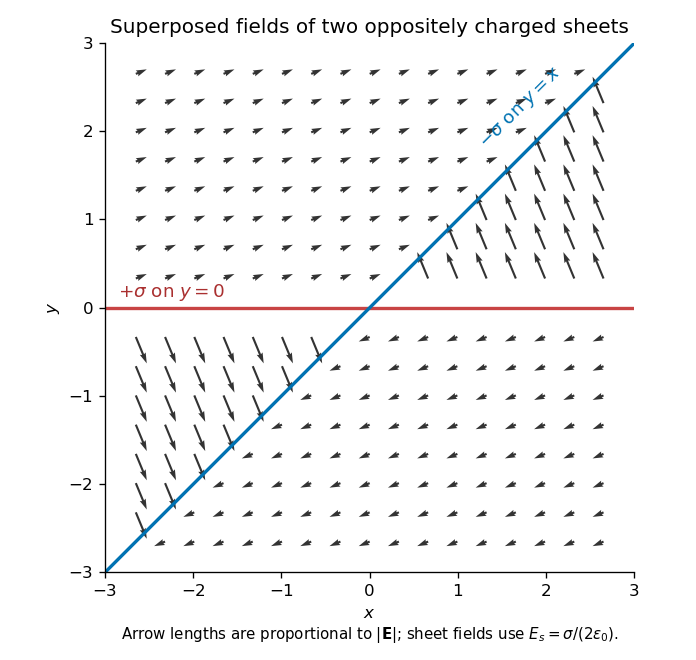
Original calculated electric-field directions for the intersecting positive and negative charge sheets; arrows retain the relative field magnitudes in the four sectors
. Details. 
For example, above both sheets the field points right and slightly upward, whereas in the sector but it points left and steeply upward. The other two sectors follow by inversion through the origin. The normal field jumps by the appropriate surface charge divided by ; a single field value on an ideal zero-thickness charged sheet is not required.
Let the signed axial velocity on the axis be . Smooth axisymmetric flow has and regular radial velocity at . The incompressible flow condition in cylindrical coordinates isTo leading order near the axis, integrate from zero to . The integration constant vanishes by regularity, giving the near-axis radial velocity in incompressible axisymmetric flow,With the usual signed interpretation ,For this is outward: the outward axial flow slows as its distance from the origin grows, and incompressibility requires radial spreading. Here has units , so the answer is a speed.
The source specifies a magnitude rather than an unambiguous signed component. On , reversing the axial flow while keeping its magnitude would reverse the radial answer. The general relation makes that dependence explicit; the boxed expression adopts , outward on both halves of the axis.
A large gas volume can reduce the effective mass density of the water surrounding the hull. In the simple quasihydrostatic model for the buoyancy of an aerated liquid, gas void fraction givesBy Archimedes' principle, a boat displacing volume then has buoyant force . To support the same boat mass , it needs a larger displaced volume , so its draft increases. If that exceeds the available watertight displacement, it can lose flotation or become swamped:Uneven aeration and strong plume motion can also disturb stability. This explains a possible hazard, not a claim that any bubble plume must sink a boat: upward water flow, turbulence and the distribution of bubbles can exert substantial additional forces.
The conventional electron plasma frequency isUse , , and . ThenThe equal proton density ensures charge neutrality; it does not double the electron density in this formula. Protons have their own plasma frequency,If both cold species are allowed to move in the relative charge-separation oscillation, its squared frequency is . This gives , only about above the electron-only answer, because .
Apply equal compressive pressure in all directions; here denotes Poisson's ratio. The three principal normal stresses are . For an isotropic linearly elastic material, Hooke's law givesand similarly for . At small strain, the fractional volume change is the sum of these normal strains:The bulk modulus is , giving the isotropic elastic modulus relation,The result assumes linear elasticity and fixed isotropic moduli. In the incompressible limit with finite Young's modulus, the bulk modulus tends to infinity.
Articles by others on the same topic
There are currently no matching articles.