In a linear isotropic dielectric of relative permittivity , the electric displacement field and electric field satisfyHere denotes the free charge density called in the question. For spatially constant , these also give . Equivalently, and . The electric displacement field has units and the electric field has units .
The local equations determine the fields once their geometry and boundary conditions are specified; a density value alone does not determine a unique vector field without that information.
Let point from medium 1 to medium 2. Integrate over a thin Gaussian pillbox crossing the interface. As its thickness tends to zero, the side contribution vanishes and any free surface charge density givesApply to a thin rectangular loop spanning the same interface. Its short sides vanish in the limit, so the tangential electric field is continuous:For a clean dielectric interface with no free surface charge density, these electrostatic interface boundary conditions reduce to and . In particular ; the normal electric field itself need not be continuous. Bound polarization charge is already incorporated into .
Consider a long uniform length of a coaxial cylindrical capacitor, with permittivity and inner-cylinder charge per unit length . A cylindrical Gaussian surface givesThe electric potential difference isThus its capacitance per unit length is .
In the partially filled coaxial capacitor, the vacuum section of length and the dielectric section of length share the same two conductors and hence the same electric potential difference. They are electrically in parallel, not in series. The radial electric field is tangent to the axial dielectric interface, consistent with the boundary condition in part (b). Adding their charges givesThis is the leading long-capacitor expression, neglecting end and interface-fringing corrections. The stated supports a long filled section; treating the other section as uniform also requires it to be well away from the end regions when those corrections matter.
Let increasing overlap mean that the dielectric moves farther into the capacitor. Its capacitance derivative isAt fixed electric potential difference , the capacitor energy rises by , but the voltage source supplies electrical work . The difference is available as mechanical work :The dielectric insertion force at fixed voltage is thereforeFor the usual , it pulls the dielectric inward, increasing ; its magnitude is constant within the long-overlap approximation. In the original longitudinal diagram this is to the left. The units are newtons, since is energy per length. Differentiating the field energy alone with a minus sign at fixed would miss the source contribution; the correct fixed-voltage capacitor energy balance is essential.
Use for the magnitude of charge on either plate. The fully filled capacitance is , while the initial value is given in part (c). At the same fixed electric potential difference,For and positive , this is an increase in the positive plate's electric charge magnitude, supplied by the voltage source; the negative plate acquires an equal opposite change. The net free charge of the two-plate capacitor remains zero. Thus “charge on the capacitor” has its usual circuit meaning, not the algebraic sum over both plates.
The electric field is approximately radial in the long interior, but near an electrode end its lines spread into a fringing field of a capacitor. The electric field magnitude falls on moving outward through that end region. The dielectric's induced electric dipoles experience a net force toward the stronger field, pulling the material into the capacitor. For a weakly perturbing polarizable element this is expressed by , with positive electric polarizability .
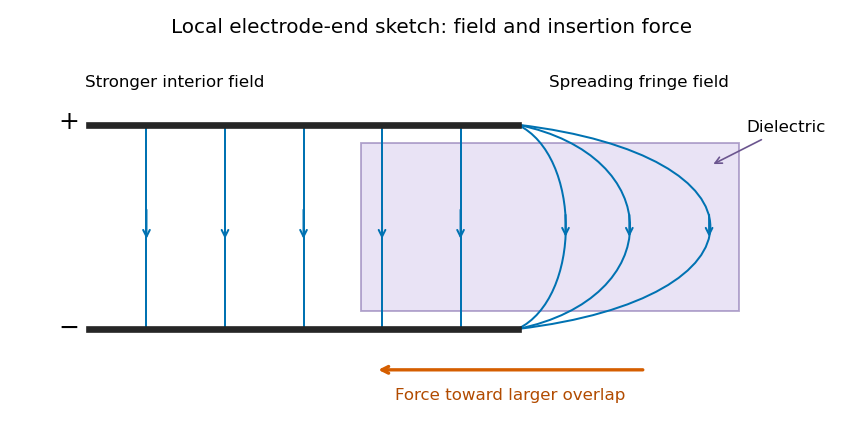
Local schematic of field lines at an electrode end and dielectric insertion; this illustrates the fringe rather than the full coaxial geometry
. Details. 
In the sketch the field lines run from the positive electrode to the negative one, curving outward near their ends. The material is attracted toward the interior where the field is stronger. A perfectly uniform interior field by itself would not give a longitudinal dipole-gradient force; the end region is essential to the local explanation. Neglecting its small contribution to the total capacitance does not justify omitting the finite insertion force that it transmits. The energy argument of part (d) gives that force without needing the detailed fringe solution.
Articles by others on the same topic
There are currently no matching articles.