The Third law of thermodynamics, in its perfect-crystal form, states that the entropy of a pure, perfectly ordered crystal with a unique ground state tends to zero as . Its more general entropy-difference formulation says that the entropy difference between equilibrium states related by a finite change of a regular external control parameter tends to zero at absolute zero:The common limiting entropy is independent of . Ground-state degeneracy or frozen disorder can produce residual entropy, so zero entropy is not an unconditional assertion about every sample.
In the usual regular thermodynamic setting, absolute zero cannot be attained from positive temperature by a finite sequence of cooling operations with finite resources. An entropy-temperature plot shows why a finite reversible adiabatic step cannot reach the common zero-temperature endpoint from a state with positive entropy above that endpoint: an isentropic process follows a horizontal line, while all the regular entropy curves meet only at .
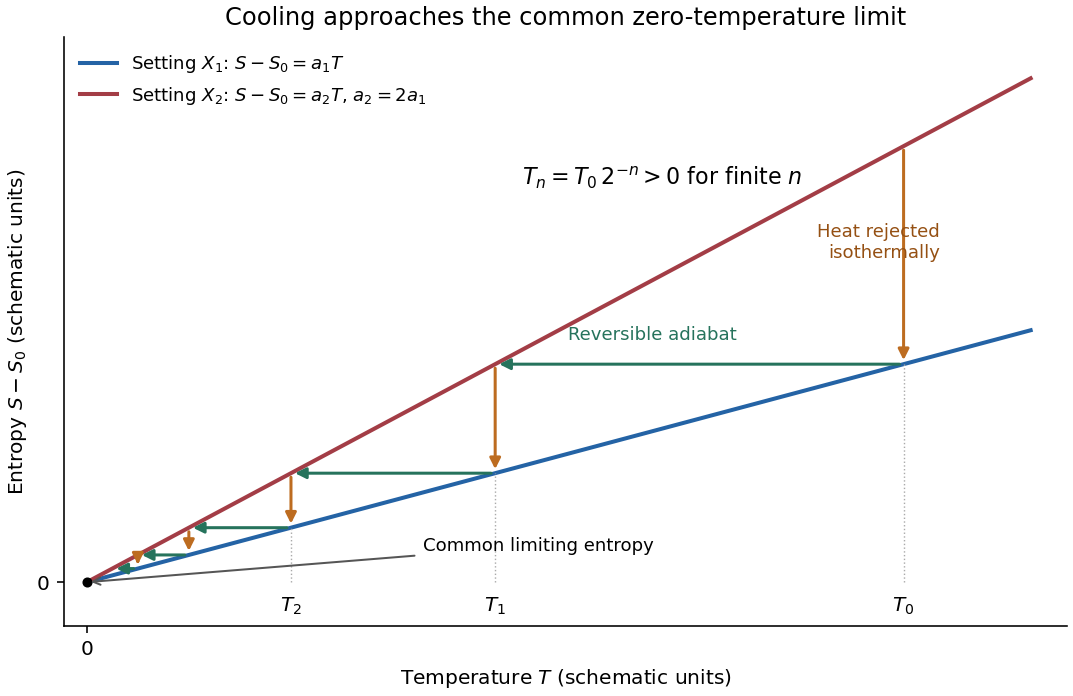

The figure illustrates this with two possible settings having and , where . First change the setting isothermally from the upper to the lower curve, rejecting heat; then change it reversibly and adiabatically back to the upper curve. Entropy conservation on the latter step givesfor every finite . The staircase approaches the origin but reaches it only after infinitely many such stages. Irreversibility generates entropy and cannot improve on the reversible endpoint.
This is a thermodynamic illustration of unattainability of absolute zero, not a claim that every cooling apparatus has this particular linear entropy law. Its conclusion presumes regular equilibrium states and bounded control parameters; dynamical statements about finite cooling time additionally require physical assumptions about the available interactions and cooling rates.
Articles by others on the same topic
There are currently no matching articles.