This is the one-mole, or equivalently molar volume, form of the Van der Waals equation, an approximate equation of state for a real gas:Here is the gas pressure, its absolute temperature, the molar gas constant, and the volume occupied by one mole. If denotes molar volume explicitly, its units are .
The positive parameter represents excluded volume arising from the finite size and short-range repulsion of the molecules. The volume available for translational motion is reduced from to . This is an effective excluded volume, not simply the sum of the molecules' geometric volumes. Its molar units are .
The positive parameter measures intermolecular attraction in a mean-field approximation. Attractions reduce the force exerted on the walls, lowering the measured pressure by relative to the repulsion-only expression. Thus is the pressure corrected for this attraction. The squared inverse-volume dependence reflects a contribution proportional to the square of the molecular number density. The molar units of are .
For an arbitrary amount measured in moles, with total container volume , the corresponding formula isAt low density, when and , it reduces to the ideal gas law. The model captures qualitative attraction, repulsion and liquid-gas behavior, but does not supply an exact equation of state for every material.
The Third law of thermodynamics, in its perfect-crystal form, states that the entropy of a pure, perfectly ordered crystal with a unique ground state tends to zero as . Its more general entropy-difference formulation says that the entropy difference between equilibrium states related by a finite change of a regular external control parameter tends to zero at absolute zero:The common limiting entropy is independent of . Ground-state degeneracy or frozen disorder can produce residual entropy, so zero entropy is not an unconditional assertion about every sample.
In the usual regular thermodynamic setting, absolute zero cannot be attained from positive temperature by a finite sequence of cooling operations with finite resources. An entropy-temperature plot shows why a finite reversible adiabatic step cannot reach the common zero-temperature endpoint from a state with positive entropy above that endpoint: an isentropic process follows a horizontal line, while all the regular entropy curves meet only at .
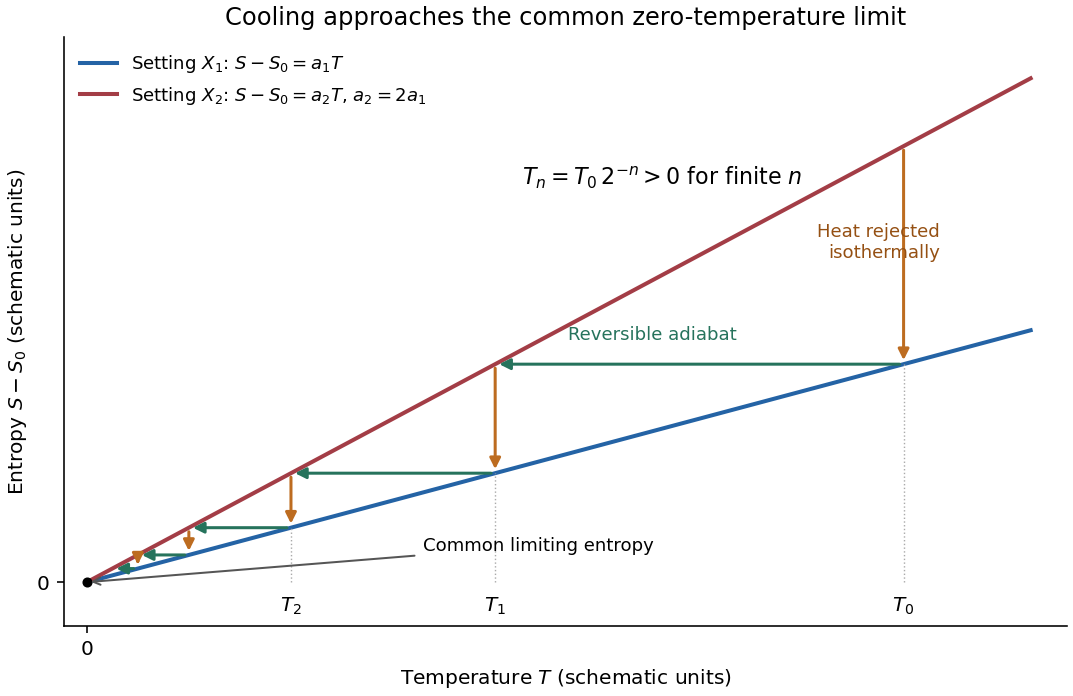
The figure illustrates this with two possible settings having and , where . First change the setting isothermally from the upper to the lower curve, rejecting heat; then change it reversibly and adiabatically back to the upper curve. Entropy conservation on the latter step givesfor every finite . The staircase approaches the origin but reaches it only after infinitely many such stages. Irreversibility generates entropy and cannot improve on the reversible endpoint.
This is a thermodynamic illustration of unattainability of absolute zero, not a claim that every cooling apparatus has this particular linear entropy law. Its conclusion presumes regular equilibrium states and bounded control parameters; dynamical statements about finite cooling time additionally require physical assumptions about the available interactions and cooling rates.
Assume a hollow, perfectly conducting rectangular electromagnetic waveguide filled with air approximated by vacuum. Let its wider side be and its narrower side . The longitudinal propagation constant of a mode isso the waveguide cutoff frequency isFor a mode with transverse electric polarization, one of may vanish, but they cannot both vanish. For a mode with transverse magnetic polarization, both must be positive. A single hollow conducting guide has no transverse electromagnetic mode with zero cutoff.
The lowest cutoff therefore belongs to the mode, varying across the wider side:Strictly, a traveling mode transporting energy down the guide requires . At exactly , and the axial group velocity vanishes. Below cutoff the field is evanescent. A different dielectric filling would replace by the wave speed in that material.
For a fixed magnetic dipole moment in an externally imposed uniform magnetic field, the torque is . Its component in the direction of increasing is . Since , integration giveswhere the arbitrary additive constant has been chosen so that at .
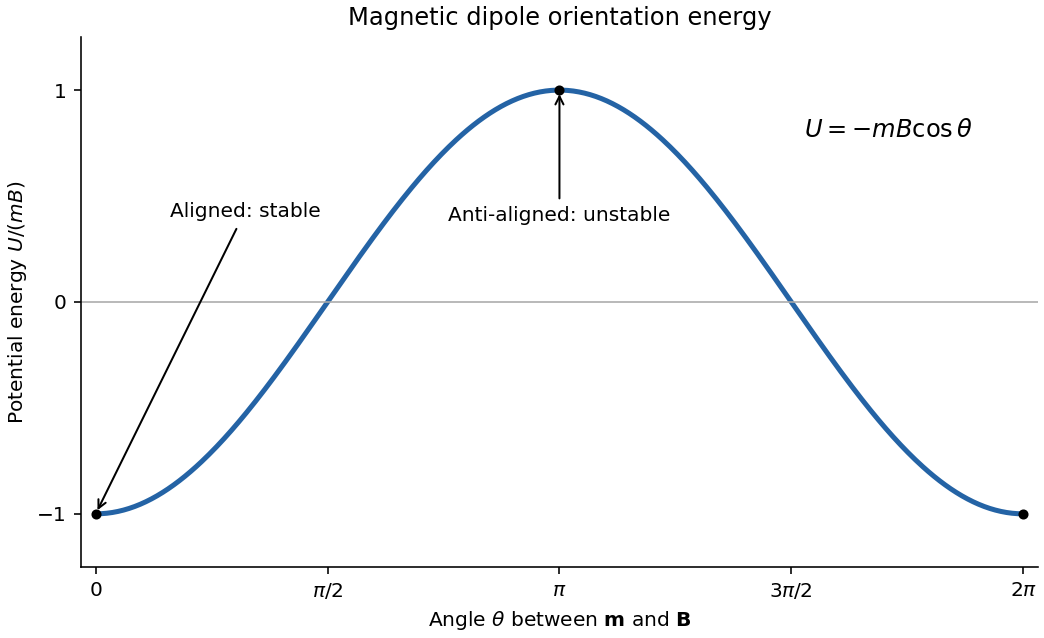


The aligned orientation has the minimum and is stable against small rotations; the anti-aligned orientation has the maximum and is unstable. The graph repeats every . Rotating quasistatically from alignment to anti-alignment requires external work .
For charge sharing between distant connected spheres, use the standard approximation that the spheres are sufficiently far apart for mutual electrostatic effects to be negligible, and that the wire adds negligible capacitance. The capacitance of an isolated conducting sphere is . ThusThe initial charges are . Connecting the spheres allows charge to flow until their potentials are equal. Charge conservation givesThe initial and final electrostatic energies are and . Their difference becomes Joule heating in the resistive wire:Numerically,The resistance determines how fast this happens, not the final energy difference. Sufficient damping suppresses sustained charge-current oscillations; the calculation also neglects energy radiated away. At finite sphere separation the capacitance matrix would be needed, and the radii and initial potentials alone would not specify an exact correction.
Articles by others on the same topic
There are currently no matching articles.