This is the one-mole, or equivalently molar volume, form of the Van der Waals equation, an approximate equation of state for a real gas:Here is the gas pressure, its absolute temperature, the molar gas constant, and the volume occupied by one mole. If denotes molar volume explicitly, its units are .
The positive parameter represents excluded volume arising from the finite size and short-range repulsion of the molecules. The volume available for translational motion is reduced from to . This is an effective excluded volume, not simply the sum of the molecules' geometric volumes. Its molar units are .
The positive parameter measures intermolecular attraction in a mean-field approximation. Attractions reduce the force exerted on the walls, lowering the measured pressure by relative to the repulsion-only expression. Thus is the pressure corrected for this attraction. The squared inverse-volume dependence reflects a contribution proportional to the square of the molecular number density. The molar units of are .
For an arbitrary amount measured in moles, with total container volume , the corresponding formula isAt low density, when and , it reduces to the ideal gas law. The model captures qualitative attraction, repulsion and liquid-gas behavior, but does not supply an exact equation of state for every material.
The Third law of thermodynamics, in its perfect-crystal form, states that the entropy of a pure, perfectly ordered crystal with a unique ground state tends to zero as . Its more general entropy-difference formulation says that the entropy difference between equilibrium states related by a finite change of a regular external control parameter tends to zero at absolute zero:The common limiting entropy is independent of . Ground-state degeneracy or frozen disorder can produce residual entropy, so zero entropy is not an unconditional assertion about every sample.
In the usual regular thermodynamic setting, absolute zero cannot be attained from positive temperature by a finite sequence of cooling operations with finite resources. An entropy-temperature plot shows why a finite reversible adiabatic step cannot reach the common zero-temperature endpoint from a state with positive entropy above that endpoint: an isentropic process follows a horizontal line, while all the regular entropy curves meet only at .
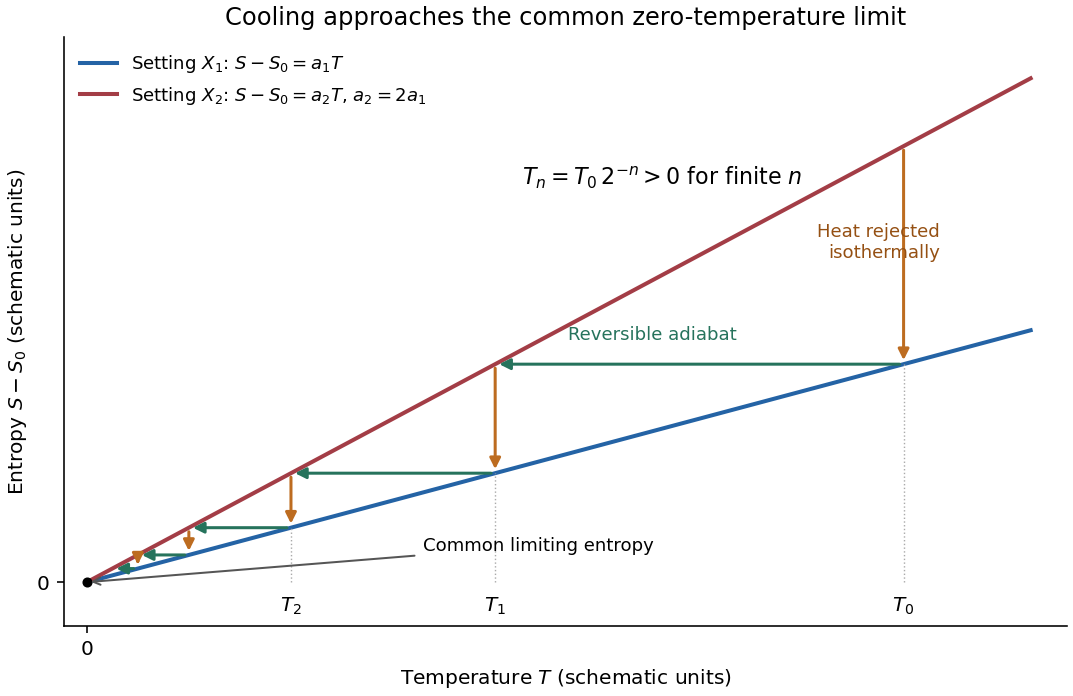
The figure illustrates this with two possible settings having and , where . First change the setting isothermally from the upper to the lower curve, rejecting heat; then change it reversibly and adiabatically back to the upper curve. Entropy conservation on the latter step givesfor every finite . The staircase approaches the origin but reaches it only after infinitely many such stages. Irreversibility generates entropy and cannot improve on the reversible endpoint.
This is a thermodynamic illustration of unattainability of absolute zero, not a claim that every cooling apparatus has this particular linear entropy law. Its conclusion presumes regular equilibrium states and bounded control parameters; dynamical statements about finite cooling time additionally require physical assumptions about the available interactions and cooling rates.
Assume a hollow, perfectly conducting rectangular electromagnetic waveguide filled with air approximated by vacuum. Let its wider side be and its narrower side . The longitudinal propagation constant of a mode isso the waveguide cutoff frequency isFor a mode with transverse electric polarization, one of may vanish, but they cannot both vanish. For a mode with transverse magnetic polarization, both must be positive. A single hollow conducting guide has no transverse electromagnetic mode with zero cutoff.
The lowest cutoff therefore belongs to the mode, varying across the wider side:Strictly, a traveling mode transporting energy down the guide requires . At exactly , and the axial group velocity vanishes. Below cutoff the field is evanescent. A different dielectric filling would replace by the wave speed in that material.
For a fixed magnetic dipole moment in an externally imposed uniform magnetic field, the torque is . Its component in the direction of increasing is . Since , integration giveswhere the arbitrary additive constant has been chosen so that at .
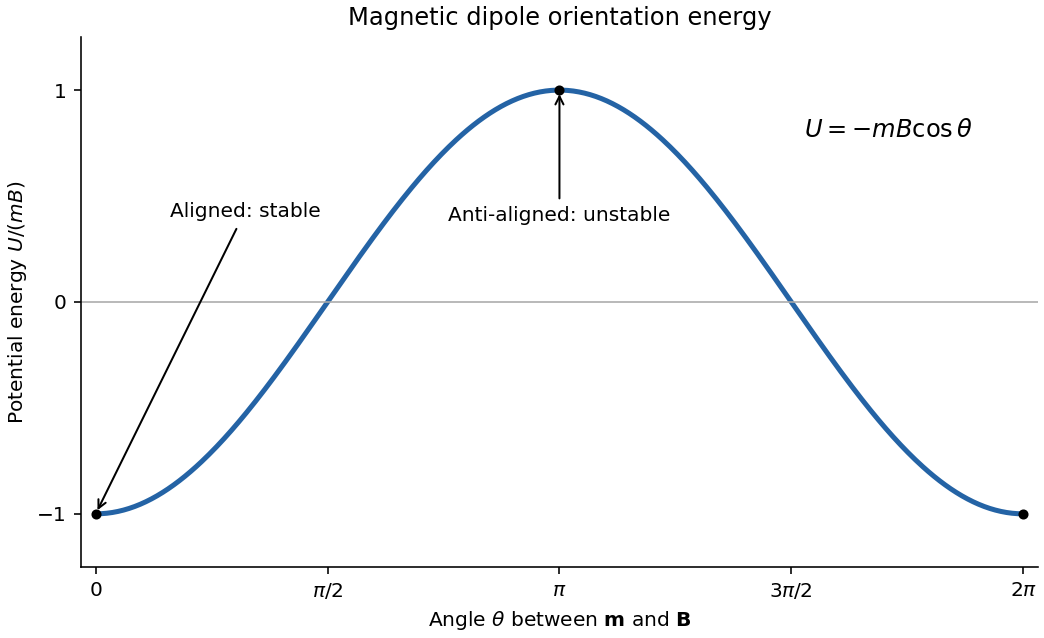
The aligned orientation has the minimum and is stable against small rotations; the anti-aligned orientation has the maximum and is unstable. The graph repeats every . Rotating quasistatically from alignment to anti-alignment requires external work .
For charge sharing between distant connected spheres, use the standard approximation that the spheres are sufficiently far apart for mutual electrostatic effects to be negligible, and that the wire adds negligible capacitance. The capacitance of an isolated conducting sphere is . ThusThe initial charges are . Connecting the spheres allows charge to flow until their potentials are equal. Charge conservation givesThe initial and final electrostatic energies are and . Their difference becomes Joule heating in the resistive wire:Numerically,The resistance determines how fast this happens, not the final energy difference. Sufficient damping suppresses sustained charge-current oscillations; the calculation also neglects energy radiated away. At finite sphere separation the capacitance matrix would be needed, and the radii and initial potentials alone would not specify an exact correction.
The examination requires three notes. All four options are developed here for completeness.
For torque-free precession of a symmetric top, take principal moments of inertia and , with no external torque. In an inertial frame moving with its centre of mass, its angular momentum is constant in an inertial frame, and its rotational kinetic energy is conserved.
In the principal body axes, Euler equations for a torque-free rigid body reduce toTherefore is constant andThus the transverse angular velocity rotates uniformly in the body frame; its signed rate reverses between oblate and prolate inertia tensors. This body-frame wobble rate should be distinguished from the space-frame precession of the symmetry axis.
Let be the body's symmetry axis. Sinceits angle to is constant, with , andHence the symmetry axis describes a cone about fixed at the space-frame precession rateThere is no nutation of this angle for torque-free motion of an exactly symmetric top. In the usual Euler angles, , so . Both rates describe the same motion in different axes. A freely tossed axisymmetric disc illustrates the effect; a top supported at a point under gravity is a different, externally torqued problem.
Lagrangian mechanics expresses dynamics through generalized coordinates that respect the constraints. For a system with conservative, velocity-independent forces and standard kinetic energy, the Lagrangian is . Its equations follow from the principle of stationary action:for variations that vanish at the endpoints. Varying the integral and integrating the term by parts givesIndependent variations therefore yield the Euler-Lagrange equations:Additional nonconservative generalized forces appear on the right-hand side as . The action is stationary, not necessarily a minimum. For ideal holonomic constraints, using suitable generalized coordinates removes the need to solve explicitly for constraint forces.
The conjugate momentum is . If a coordinate is cyclic, and its conjugate momentum is conserved. If has no explicit time dependence, the energy functionis conserved. It equals for the usual quadratic kinetic energy with time-independent geometry, but that identification is not universal for every Lagrangian or constraint.
For example, a simple pendulum with angle , length and bob mass hasThe tension does no virtual work in the allowed angular displacement and never needs to be calculated to obtain the angular equation. The method scales naturally to coupled systems and coordinates with complicated geometry.
For a slender elastic beam, the Euler-Bernoulli beam equation assumes small strain, small deflection slopes and cross-sections that remain plane and normal to the deflected centreline. A fibre at signed distance from the neutral axis has longitudinal strain , where is the centreline curvature. Hooke's law gives , with Young's modulus .
Choose the internal bending-moment sign so that . ThenHere is the second moment of area, with units , not the mass moment of inertia of a rotating body. For a uniform material under pure bending, zero axial resultant places the neutral axis through the section's centroid.
For small slopes, . Combining the moment-curvature relation with transverse force and moment balance gives, with a consistent load sign convention,For constant stiffness this becomes . The bending stiffness has units . Boundary conditions specify displacement and slope at a clamped end, or bending moment and shear force at a free end.
For a cantilever of length carrying a transverse end load , take deflection positive towards the load. The moment magnitude is , and integration with givesThe free-end moment vanishes and the tip shear supplies the applied load. For a rectangular section of width and bending thickness , , so increasing thickness strongly increases bending resistance. The model ceases to be reliable for large deflections, plastic strains or short thick beams where shear deformation matters.
The Magnus effect is the transverse force produced when a spinning body moves relative to a fluid. Rotation changes the flow and circulation around the body; the resulting asymmetric pressure and wake deflect the fluid, with the opposite transverse force on the body. Examples include the curved flight of spinning balls and the lift of rotating-cylinder sails.
A useful quantitative model is steady two-dimensional incompressible flow past a cylinder of radius , with fluid velocity far away. Let circulation be positive anticlockwise as viewed from . The potential-flow velocity at the cylinder surface isThe Bernoulli equation outside the boundary layer givesIntegrating the pressure force around the cylinder, per unit span, yieldsThus the Kutta–Joukowski theorem givesThe sign here refers to the fluid velocity relative to the cylinder. For a body moving through otherwise stationary fluid, that relative fluid velocity points opposite to the body's translational velocity.
Real viscosity and the no-slip boundary condition transmit the surface rotation to the fluid and help set the circulation and separation pattern. Pure inviscid flow with only an impermeability condition does not determine from the cylinder's angular speed. Therefore the circulation must not be assigned a universal spin-rate formula without additional assumptions. The cylinder result illustrates the lift mechanism; quantitative forces on a finite spinning ball also depend on its geometry, Reynolds number, rotation rate, surface roughness and wake.
Electromagnetic waves drive mobile charges in a conducting medium. Their current changes both the phase and attenuation of the wave. A description in terms of a real, frequency-independent refractive index is therefore generally insufficient: the material response and the propagation constant are complex and frequency dependent.
Use phasors proportional to , with and for a passive medium. In a homogeneous, isotropic, linear material, let represent the permittivity associated with bound-charge electric polarization, the magnetic permeability and the mobile-charge conductivity. The macroscopic Maxwell equations giveFor a transverse plane wave, taking another curl yieldsThis division of the response avoids counting mobile Electrons both in and in . Define the complex refractive index . For a nonmagnetic medium, . Its real part determines the phase variation, while the positive optical extinction coefficient gives amplitude attenuation and intensity attenuation . The amplitude penetration length is
A simple microscopic explanation comes from the Drude model. Let Electrons of charge , mass and number density move against an effectively stationary positive background. Collisions relax their mean velocity at rate :ConsequentlyWith a vacuum-like bound-charge background, this givesIts imaginary part is positive for positive , consistent with dissipation under the chosen phasor convention. Real materials can require an effective Electron mass, a nontrivial bound-charge response, or additional absorption associated with the electronic band structure.
A plasma is a conducting ionized medium with mobile Electrons and ions, approximately neutral on large scales because of plasma screening. For the electron-frequency transverse waves considered here, the heavy ions can often be treated as stationary. In a dilute weakly collisional plasma, , soFor , is real in this collisionless model and the wave propagates. Its phase velocity is , while its group velocity is ; their product is . A phase crest exceeding does not imply superluminal information transport. For , the refractive-index square is negative andThe transmitted field is evanescent rather than a traveling bulk wave. A sufficiently thick collisionless plasma reflects such radiation without Ohmic absorption. Collisions make the response complex and permit absorption. This accounts for a plasma cutoff and, qualitatively, the reflection of some radio frequencies by ionized atmospheric layers. The simple model describes transverse waves; plasmas also support longitudinal collective modes.
In a metal, positive ions usually form a crystal lattice. Mobile conduction Electrons occupy states described by the electronic band structure and normally form a degenerate Fermi gas. The conduction-electron density is usually much higher than in a dilute gas plasma. Thus its plasma frequency is commonly in the optical or ultraviolet range, rather than the lower radio-frequency values possible in dilute plasmas. Electron scattering from the lattice, defects and other excitations gives a finite relaxation rate. The distinction is not that every plasma is collisionless and every metal collisional: the controlling ratio for either material is , together with its carrier density and bound-charge response.
At sufficiently low frequency, , the metal's conductivity is approximately real, . In a good conductor the conduction current dominates the displacement current, . The wave equation then givesFor example, a tangential electric field varies asThe current is therefore concentrated within a few skin depths of the surface: this is the skin effect. As frequency increases within this regime, . In a wire whose radius greatly exceeds , only a thin outer region carries appreciable alternating current, increasing the effective resistance. In a conducting shield, the same penetration suppresses the field transmitted through a sufficiently thick wall.
The Poynting theorem identifies the loss as Joule heating. The cycle-averaged heating density for a complex conductivity isThe wave impedance is . For incidence from vacuum at normal incidence, the electric reflection amplitude is , where . A good conductor has small and therefore strong reflection, while the part of the incident power entering it is dissipated over the skin depth.
At high enough frequency that , a metal's free-electron response also approaches the collisionless plasma form. The low-frequency formula must not simply be extrapolated into that regime. Real optical behavior additionally depends on the electronic band structure and transitions between bands. Both plasmas and metals are therefore described by the same electromagnetic response framework, but their relevant densities, scattering rates and frequency regimes differ.
The relation describes the slope of the phase coexistence curve of a pure substance in the pressure-temperature plane:Here is the common equilibrium pressure of the two phases, is their common absolute temperature in kelvins, and the derivative is taken along their coexistence curve. Choose a direction of transformation from phase 1 to phase 2. Then is the reversible latent heat for that transformation and is the corresponding volume change, using the same amount of substance for both quantities.
In the molar convention used below, has units and has units , so the right-hand side has units . For vaporization, both and are positive. The displayed general relation is also called the Clapeyron equation; the ideal-vapor approximation used in (c) gives its usual Clausius form.
At coexistence, the two phases of a pure substance have equal chemical potential, or equivalently equal molar Gibbs free energy:For either phase, . Move an infinitesimal distance along the coexistence curve, where the equality must remain true. Subtracting the two differentials givesA reversible transformation at this common temperature absorbs latent heat . ThusThe derivation assumes thermodynamic equilibrium between two bulk phases of a single pure substance, with the same temperature and pressure, and only ordinary pressure-volume work. Surface-curvature shifts, additional external-field work and composition changes are omitted. It applies to a first-order phase boundary where the latent heat and volume discontinuity are defined. No ideal-gas assumption and no constant- assumption are needed for this differential relation. At the critical endpoint both discontinuities vanish, so their ratio requires a limiting treatment rather than direct substitution of two zeros.
For liquid-vapor equilibrium, use molar quantities. At low vapor pressure the gas is dilute, approximately ideal, and has a much larger molar volume than the liquid. HenceSubstitution into the Clapeyron equation givesIf the molar latent heat varies sufficiently slowly to be treated as constant over the temperature interval, integration givesThe positive constant has pressure units and is an integration constant. It is not necessarily a real infinite-temperature pressure, since the approximations fail before that limit.
For mercury between and , the original plot places this range above the triple point and below the normal boiling and critical temperatures. Its vapor pressure is low relative to the critical pressure, making a dilute-gas description reasonable; the vapor's molar volume greatly exceeds that of the dense liquid. The interval is also far from the critical region where tends to zero, so a roughly constant latent heat is a useful first approximation. The approximations are not exact: Kirchhoff's law of thermochemistry gives, at fixed pressure, the temperature derivative of a transformation enthalpy as the difference between the two molar heat capacities, so a precise fit over a wide interval would allow to vary.
Taking a derivative of the logarithmic form gives a direct way to use the plot's base-ten vertical axis:Alternatively, use two nearby readings and eliminate the unknown :Reading the original PDF graph approximately gives at and at . These bracket the requested temperature and give an average latent heat near :Thus a suitable graph-based estimate isThe graph does not warrant several significant figures; a local tangent or different reasonable nearby readings give a comparable estimate. The factor is essential when using a base-ten logarithmic axis.
The phase diagram must contain three coexistence curves meeting at the triple point: a solid-gas sublimation curve, a solid-liquid melting curve and a liquid-gas vaporization curve. The vaporization curve ends at a liquid-gas critical point; beyond it liquid and gas are continuously connected as a supercritical fluid.
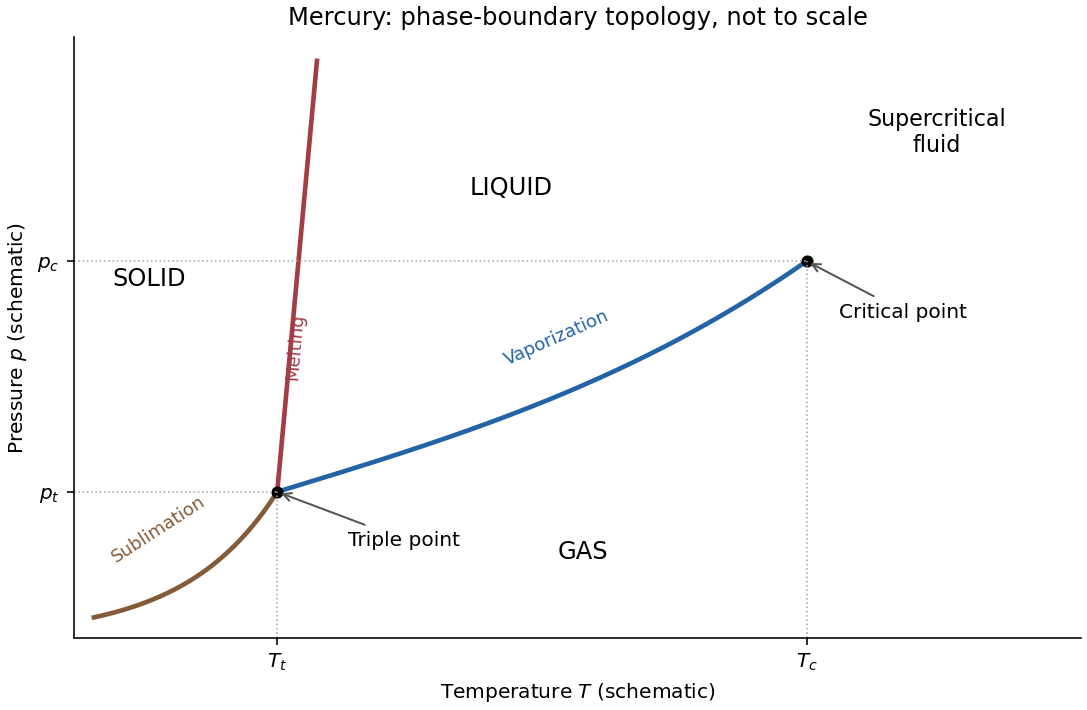


The imposed contraction on freezing means . Melting therefore has and . The Clapeyron equation then requiresThus raising the pressure raises the melting temperature. The liquid-gas and solid-gas slopes are also positive because the transformations into gas increase both entropy and volume. The liquid region lies between the positively sloping melting line and the vaporization curve, while gas occupies the low-pressure side. The figure is a qualitative solution sketch, not a reproduction or fit of the paper's vapor-pressure measurements; its axes are schematic.
The expression is the canonical partition function for a system in thermal equilibrium with a large heat bath at fixed temperature . The system exchanges energy with the bath, while its particle number and external mechanical parameters, such as volume, are fixed. The bath is large enough that its temperature is not appreciably changed by this exchange.
The system has allowed energy levels . The index labels distinct energy values, and the integer degeneracy factor counts distinct quantum states with that same energy. is the Boltzmann constant, and is a state's Boltzmann factor. The dimensionless sum normalizes the probabilities:Thus the degeneracy multiplies the probability of occupying the level, not the probability assigned to each individual state within it.
The canonical model is not restricted to a classical ideal gas. It applies to a quantum rotor, for example, provided the sum counts all of that system's allowed states with their proper degeneracies. For a many-particle system, would be the energy of a many-particle state, with any quantum-statistical restrictions already built into the state count.
The internal energy is the canonical mean of the energy:Holding the external mechanical parameters fixed, so that the spectrum and degeneracies do not change when differentiating with respect to , givesComparison yieldsAn explicitly temperature-dependent effective Hamiltonian would require care: differentiating its partition sum would also differentiate the assigned energy levels. The stated result uses the fixed physical spectrum of the canonical system.
For the supplied linear rigid rotor spectrum, sum over every nonnegative integer and include all magnetic substates:It is convenient to introduce the rotational temperatureso that the first terms are . Here is the moment of inertia and is the reduced Planck constant, as confirmed in the original PDF. The stipulated degeneracies are used as given, without adding nuclear-spin weights or omitting selected values.
At low temperature, , retain the ground level and the first excited level. Their energies are and , with degeneracies and . Thereforeso in the notation of the question, is dimensionless and has units of kelvins. The first omitted level has three times the first excitation energy, explaining the exponent in the error term.
At high temperature, , many rotational levels are occupied and the sum can be replaced to leading order by an integral:Set , so that . ThenThusThe high-temperature approximation here concerns the rotational spectrum. For a real molecule it should still be used below temperatures where neglected vibrational excitation or dissociation invalidates the rigid-rotor model.
Using givesThe internal-energy identity from (b), followed by differentiation with respect to temperature at fixed moment of inertia, yieldsFor one mole of independent rotors, the rotational energy is and the rotational molar heat capacity is .
This agrees with the equipartition theorem. The given spectrum describes a linear rotor with two independent rotational degrees of freedom, each contributing to the high-temperature mean energy. Rotation about the molecular axis is not an additional degree of freedom of this ideal linear-rotor model, so the result is rather than per rotor. These are rotational contributions alone; translational and vibrational heat capacities have not been included. At low temperature the discrete excitation gap freezes rotational excitation out, so the rotational heat capacity tends to zero instead of remaining at its classical value.
Articles by others on the same topic
There are currently no matching articles.