The original diagram has a horizontal bottle neck, so weight does not enter the axial force balance. Gauge pressure acts on the cork's end area and supplies outward force . The radial contact force is the contact pressure times the cylindrical contact area, . The limiting friction is , so outward sliding occurs whenThe assumption of equal static and kinetic friction coefficients removes a separate force drop when slipping starts.
Initially the pressure is marginal at , so . During extraction the contact length decreases, while the pressure force stays constant. The net force is therefore . The cork's mass is , giving the pressure-driven cork ejection equationFor and , solving the constant-coefficient equation givesThe equilibrium is unstable: as the cork moves out, friction decreases and the unbalanced force grows.
Multiplying the equation of motion by and integrating gives . The contact ends at , soEquivalently, the net work is . Exactly zero initial velocity would leave the ideal marginal configuration stationary. The exit time diverges as , even though the limiting exit speed is finite.
The density is , so . For an ideal upward launch at this speed, conservation of mechanical energy gives height above the exitThis neglects air resistance and the small gravitational work during extraction compared with the launch energy. Actual gas pressure need not stay constant, so it is an idealized estimate.
Adding a stopper that doubles the moving mass, while preserving the same pressured area and contact friction, leaves the extraction work unchanged. The squared exit speed and the ballistic height are therefore halved:
For particles in an inertial frame, total momentum and angular momentum about a fixed origin areThe momentum derivative is the total external force when internal forces cancel pairwise. Angular momentum is conserved when the total external torque vanishes and the internal torques sum to zero, as for pairwise equal-and-opposite central forces. Equal-and-opposite internal forces alone need not cancel internal torque if their lines of action are different. An isolated system with these internal-force properties conserves both quantities; if fields carry momentum, the complete system must include them.
For a straight rocket, let its instantaneous remaining mass be and let be ejected during a velocity increase . The exhaust's inertial velocity is to first order. Conservation of momentum givesIntegrating from initial mass to dry mass yields the rocket equationIt is the rocket-plus-exhaust system that is isolated; the rocket alone is a variable-mass open system.
For the firework, the original diagram places one tangentially firing point rocket at the end of each radial rod. The parallel axis theorem changes each rod's central inertia to . Adding all rods and fueled rockets givesWhen fuel is exhausted, .
Let now denote the total remaining fuel in all three rockets, so . Fuel at the rim co-rotates before ejection. Its backward tangential exhaust velocity is , and its angular momentum per unit mass about the axle is . For an infinitesimal ejection,Since , the co-rotation terms cancel and leave . The tangential-exhaust rotor with a fixed dry inertia therefore obeysNeglecting the exhaust's initial tangential motion would give an incorrect angular-momentum balance. The rod mass remains in the denominator throughout the burn.
After the burn, the opposing constant axle torque acts on the fixed inertia . Its work over the remaining turn equals the initial rotational kinetic energy:
Use the PDF's notation for the source-frame pulse frequency, and set , . Successive emissions occur at the same train-frame position and are separated by proper time . The Lorentz transformation gives a station-frame emission interval and displacement . For a receding beacon, the second pulse travels an extra distance , soThis derivation includes both time dilation and the change in light-travel time. Expanding for gives , recovering the stated nonrelativistic approximation.
Let be the common wavelength of the identical lights at rest. The approaching and receding relativistic Doppler effect factors giveTheir ratio and product therefore determine the speed and rest wavelength separately:No assumption about the rest color was needed.
The last observation requires a transverse-geometry convention. The general observer-frame ray formula iswhere is the angle between source velocity and photon propagation in the platform frame at emission. Under the usual transverse-ray interpretation, , so for and ,This is the standard transverse redshift from time dilation.
There is a genuine distinction between emission and reception at the instant of passing. A side-mounted source emitting perpendicularly in its own frame instead has by aberration of light, giving . The same blue result occurs if “at the exact moment” means reception when the source's current position is at closest approach, with a small finite transverse offset. For offset , reception and emission satisfy . Setting gives and ; setting instead gives the transverse ray received at . These limits remain different as .
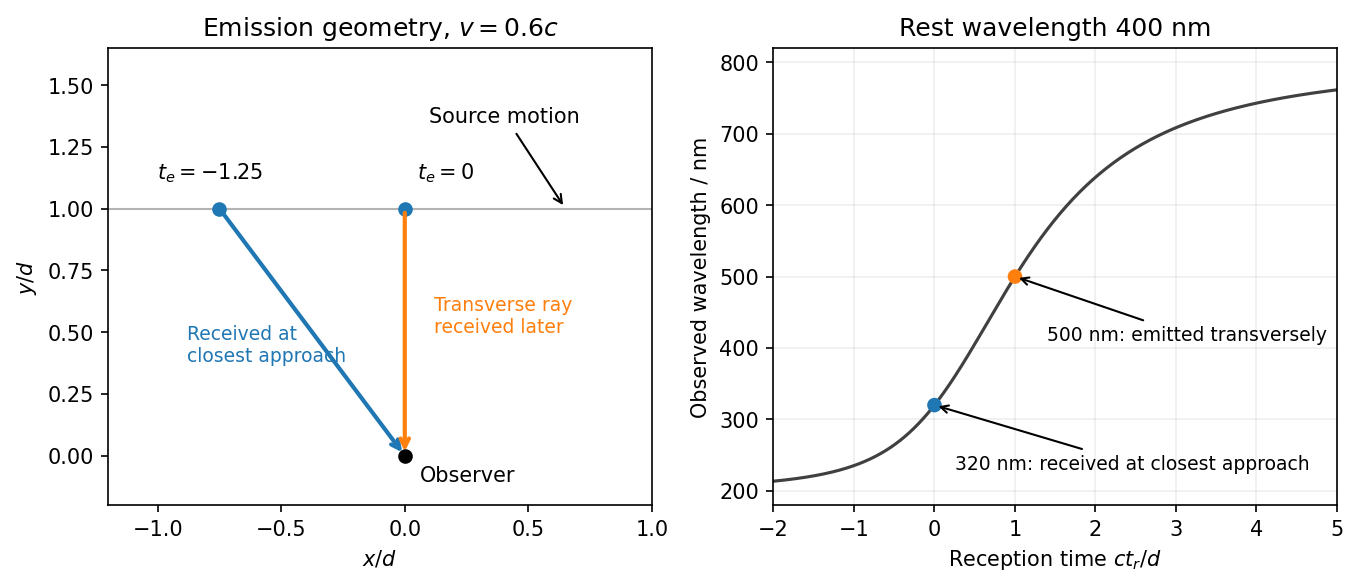
Emission at closest approach and reception at closest approach give different Doppler factors
. Details. 
Thus 500 nm requires the transverse ray in the platform frame; 320 nm applies to reception at closest approach or transverse emission in the train frame. The wording does not distinguish these event/frame choices, so merely neglecting the source-observer separation is insufficient to select between them. The reusable derivation is transverse Doppler shift and observation time.
Articles by others on the same topic
There are currently no matching articles.