Reflection and central spot. At a boundary from lower to higher refractive index, the near-normal electric-field reflection coefficient is negative, . This gives a wave phase reversal on reflection from the glass plate through the air film. Reflection at the lens's glass-to-air underside has no such reversal. These are consequences of the Fresnel equations for the reflected electric field.
At ideal contact the film thickness is zero, so the two reflected contributions have zero geometrical optical path difference but a relative phase reversal. They produce destructive interference, and the central spot is dark. This conclusion concerns the film reflection; other lens surfaces can add a weak background.
Rings and their radii. At radial distance , let the air thickness be . The two relevant rays reflect at the upper and lower film interfaces. The lower reflection accumulates an extra round-trip optical path length , plus the relative reflection shift. As increases away from contact, alternating constructive and destructive thin-film interference forms Newton's rings. At near-normal incidence, a bright ring satisfiesThe extended source can illuminate these localized film fringes: each incident contribution interferes with its own two reflected paths; unrelated source points need not be mutually coherent.
For the spherical lens surface, geometry gives , so . Since , . Combining the equations yieldsThe bright ring is the first bright ring around the dark contact point.
Curvature from ring diameters. Writing , subtract the squared diameters to eliminate the unknown initial order:Using SI units,
Liquid-filled film. With film refractive index , still smaller than both glass indices, there remains exactly one relative reflection phase reversal. The round-trip optical path length is now , soHere is the illuminating vacuum wavelength, approximately its air value, rather than its shorter value inside the liquid. The ring labelled therefore has diameterFilling the gap contracts each ring radius by at fixed order and curvature.
Equation and interpretation. The supplied equation is the Time-independent Schrödinger equation for a nonrelativistic particle with mass in a prescribed potential energy . Equivalently,It is an eigenvalue problem for the Hamiltonian operator. A stationary energy state has full wavefunction . By the Born rule, is the probability of finding the particle in a small interval , with wavefunction normalization .
Infinite barriers. Infinite exterior potential energy excludes any finite-energy probability outside the interval. The infinite square well consequently has outside and the hard-wall boundary conditionsThe interior wavefunction must meet the zero exterior amplitude continuously. Its derivative need not be continuous across an infinite wall; imposing both zero value and zero derivative would eliminate every nonzero interior solution.
Ground state. Inside the well , so , with . Its general solution is . The left wall gives , and the right wall gives for . Thus the discrete energy eigenvalues are . The smallest, , is the ground state. Sinceits normalized wavefunction, choosing an irrelevant overall phase to make it positive inside, is
Finite barriers. For a finite step and constant particle mass, both and are continuous at . Wavefunction matching at a finite potential step follows by integrating the Schrödinger equation across a vanishingly small neighborhood of the step: a bounded potential cannot generate a finite jump in . The bound-state exterior solutions decay rather than vanish identically:Normalizability excludes the growing exterior exponentials. The equivalent interior boundary conditions are and ; neither boundary value is zero for the nontrivial ground state.
The ground state of a finite square well remains symmetric about and has no nodes. It bends smoothly into exponential tails at both walls, extending over a larger region than the infinite-well state. Its maximum after normalization is lower for the deep well considered here. When , the penetration length is short, so the two shapes are close except near the walls and in the exterior tails.
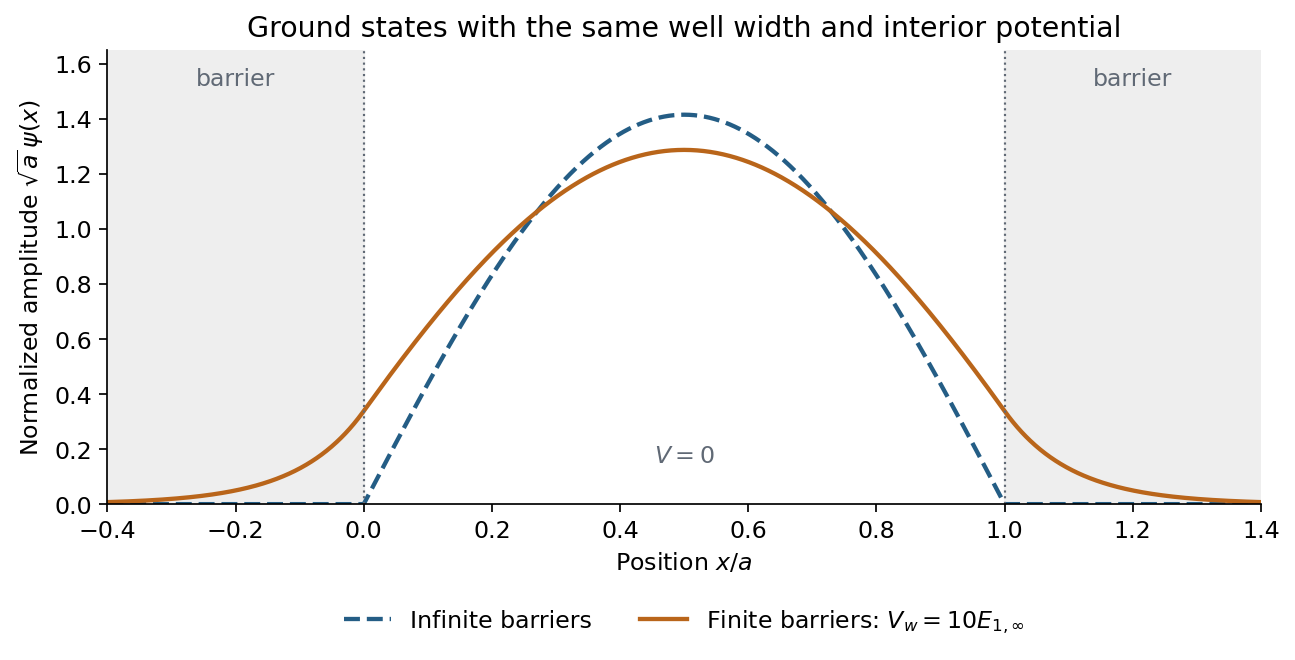
Normalized infinite- and finite-well ground states, with smooth exponentially decaying tails for the finite well
. Details. 
The finite curve is an illustrative exact matched solution with ; no numerical wall height is specified by the question.
Energy comparison. The finite barriers relax the confinement, allowing a less rapidly varying interior wavefunction and therefore smaller kinetic energy. More explicitly, the even interior solution is proportional to , and matching to the tails gives . The lowest root lies at , while the infinite well has . HenceAs , the tails disappear and the finite-well energy approaches the infinite-well value from below. This comparison uses the same zero of potential energy inside both wells.
Articles by others on the same topic
There are currently no matching articles.