Equation and interpretation. The supplied equation is the Time-independent Schrödinger equation for a nonrelativistic particle with mass in a prescribed potential energy . Equivalently,It is an eigenvalue problem for the Hamiltonian operator. A stationary energy state has full wavefunction . By the Born rule, is the probability of finding the particle in a small interval , with wavefunction normalization .
Infinite barriers. Infinite exterior potential energy excludes any finite-energy probability outside the interval. The infinite square well consequently has outside and the hard-wall boundary conditionsThe interior wavefunction must meet the zero exterior amplitude continuously. Its derivative need not be continuous across an infinite wall; imposing both zero value and zero derivative would eliminate every nonzero interior solution.
Ground state. Inside the well , so , with . Its general solution is . The left wall gives , and the right wall gives for . Thus the discrete energy eigenvalues are . The smallest, , is the ground state. Sinceits normalized wavefunction, choosing an irrelevant overall phase to make it positive inside, is
Finite barriers. For a finite step and constant particle mass, both and are continuous at . Wavefunction matching at a finite potential step follows by integrating the Schrödinger equation across a vanishingly small neighborhood of the step: a bounded potential cannot generate a finite jump in . The bound-state exterior solutions decay rather than vanish identically:Normalizability excludes the growing exterior exponentials. The equivalent interior boundary conditions are and ; neither boundary value is zero for the nontrivial ground state.
The ground state of a finite square well remains symmetric about and has no nodes. It bends smoothly into exponential tails at both walls, extending over a larger region than the infinite-well state. Its maximum after normalization is lower for the deep well considered here. When , the penetration length is short, so the two shapes are close except near the walls and in the exterior tails.
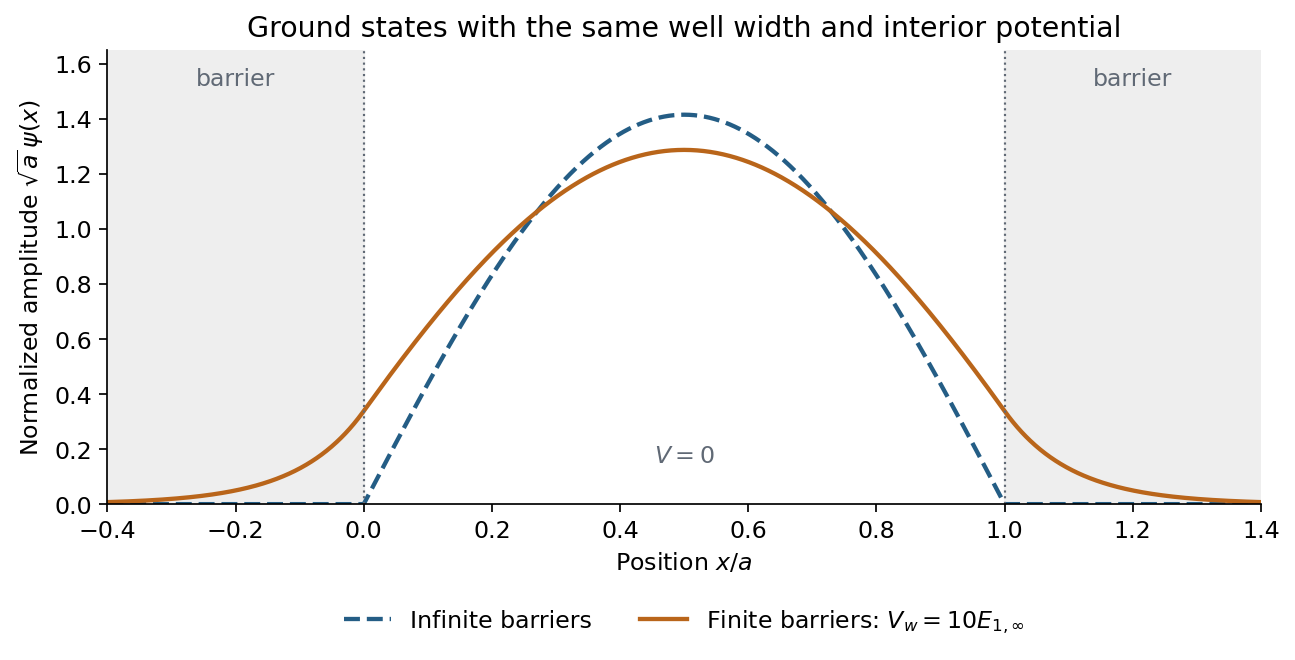
Normalized infinite- and finite-well ground states, with smooth exponentially decaying tails for the finite well
. Details. 
The finite curve is an illustrative exact matched solution with ; no numerical wall height is specified by the question.
Energy comparison. The finite barriers relax the confinement, allowing a less rapidly varying interior wavefunction and therefore smaller kinetic energy. More explicitly, the even interior solution is proportional to , and matching to the tails gives . The lowest root lies at , while the infinite well has . HenceAs , the tails disappear and the finite-well energy approaches the infinite-well value from below. This comparison uses the same zero of potential energy inside both wells.
Articles by others on the same topic
There are currently no matching articles.