For an infinite cubic potential well of side , the one-particle energy eigenvalues are , where and each quantum number is a positive integer. The lowest spatial orbital is , with energy and orbital degeneracy one. The next energy is , with three orbitals given by permutations of .
Spin-zero identical particles are bosons. Both can occupy the lowest orbital, so the two-boson ground state is nondegenerate. The first excited total energy is : one particle occupies the lowest orbital and one an excited orbital. Symmetrizing the two-particle wavefunction gives one state for each of the three excited orbitals, so the first-excited degeneracy is three.
Spin-half identical particles are fermions, so the total state must be antisymmetric. Two particles in the same lowest orbital have a symmetric spatial wavefunction and must form the unique spin singlet state. Thus the fermion ground state is also nondegenerate. At the first excited energy, each choice of excited spatial orbital permits a symmetric spatial state with a singlet state, or an antisymmetric spatial state with a three-dimensional triplet state. ThereforeThe spin multiplicity is essential: counting only the three orbital choices would omit allowed triplet states. The result assumes ordinary spin-statistics, an unsplit spin degeneracy and the hard-wall cube model.
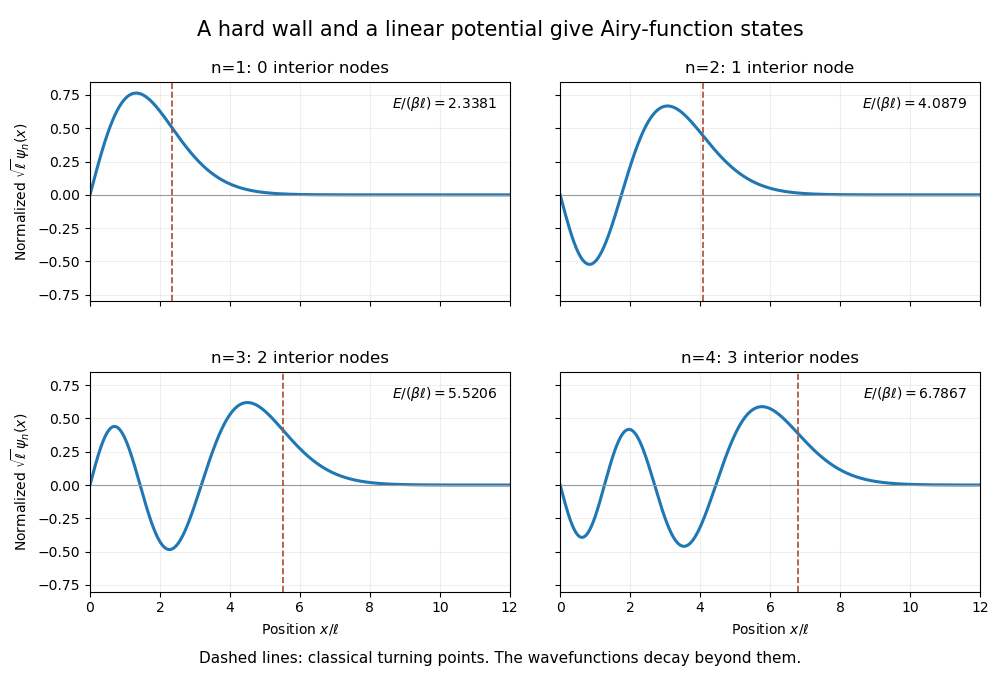
The hard wall imposes , while the increasing linear potential requires decay as . SetThe stationary Schrödinger equation becomes . The growing Airy function solution is excluded, leavingThis is the quantum bouncer. For the first four states, . Their interior node counts are respectively zero, one, two and three. Each wavefunction starts at zero at the wall, oscillates in the classically allowed interval, and crosses smoothly into an exponentially decaying tail beyond the turning point . The turning point is not an extra hard wall: the wavefunction generally remains nonzero there and beyond it.

In the sudden approximation, the nuclear charge changes before the electronic wavefunction has time to evolve. Immediately afterward the state is still the original hydrogenic 1s wavefunction, now expanded in the eigenstates of the new Coulomb Hamiltonian. The final-ground-state probability is the squared overlap, rather than one minus an energy change.
For initial and final charges , the normalized 1s overlap isUsing givesThe remaining probability includes higher bound states and the -wave ionization continuum. In this central, instantaneous model the initial orbital has , and angular orthogonality excludes states with . The electronic spin is unchanged. Nuclear recoil and interactions with the emitted decay particles are outside this leading sudden-charge-change approximation.
For a homogeneous ideal gas in a two-dimensional box of area , with dispersion and one internal state, the density of states is . The excited-particle density at temperature isAs , this diverges. Hence at every fixed positive temperature the excited states can accommodate any finite areal density with ; they never saturate at a finite critical density. There is no finite-temperature Bose-Einstein condensation in the homogeneous two-dimensional ideal gas thermodynamic limit.
The low-energy logarithmic divergence is the reason, not merely the small number of spatial dimensions. A finite box has a low-energy cutoff and a crossover; a trap changes the density of states and can change the conclusion. Condensation at zero temperature and an interacting gas's Berezinskii–Kosterlitz–Thouless transition are separate issues. The proof assumes the uniform quadratic-dispersion model, rather than every conceivable two-dimensional trapping potential.
A spin-half gas has two spin states. Filling the Fermi sphere at zero temperature gives , soWith , the number density is and . ThusThe associated Fermi temperature isFermionic degeneracy matters on cooling to a few kelvin or below in this model, and is pronounced for . Liquid helium-3 is interacting; its quasiparticle effective mass and thermodynamics need not equal the bare-mass free-gas predictions. The requested calculation is the ideal Fermi-gas scale.
For total relativistic energy , the speed is . Both beam energies are enormously greater than the rest energy, so expanding the square root avoids obscuring the small difference:With all energies in GeV, , and , givingThe deficits below the speed of light are about and . The large energy increase therefore produces only a small speed increase; the energy mainly changes the Lorentz factor. These numbers use the quoted beam energies as total energies. Interpreting them as kinetic energies requires adding the rest energy, with only a tiny correction at these scales.
Let be the cylinder centre's small displacement away from the wall. Rolling without slipping gives rotation angle of magnitude . The material point initially at the top moves horizontally by another relative to the centre to first order, so the spring extension is , not . Its small vertical displacement affects the extension only at higher order.
The kinetic and potential energies areThe linearized equation is , givingStatic friction enforces the rolling constraint and does no work at the instantaneous contact point. Omitting rotational kinetic energy, or attaching the spring to the centre instead of the top material point, would change the result.
An element at carries charge . Its field at the origin points opposite its radial position. By Coulomb's law,ConsequentlyFor the particle starts along ; for the opposite sign it starts along . Reflection symmetries make the axis invariant for motion released there from rest. The ring has zero net charge but a nonzero dipole moment, so zero total charge does not imply zero field at its centre.
Assume independent arrivals at constant rate , so the count follows a Poisson distribution. In its mean is . ThereforeOver observation time , the rate estimate is and its standard deviation is . Thus the fractional one-standard-error uncertainty is . To make this strictly less than ten per cent requiresThe mean current magnitude is . The accuracy statement needs a confidence convention: the boxed time uses one standard error, not a guaranteed bound on every realization. A Gaussian 95-percent relative interval would instead require approximately events, or . Dead time and correlated arrivals would need another count model; the mean rate alone does not establish Poisson statistics.
Normalize the central slit amplitude to one. The two outer amplitudes are each, not , because the specified attenuation concerns amplitude. For centre spacing , adjacent slits have phase difference . The far-field amplitude and intensity are thereforewhere is the central slit's intensity alone in the same narrow-slit approximation. Principal maxima have and height ; between them, zeros occur at . Only values in are physical. The endpoints are grazing-direction limits of this ideal angular model.
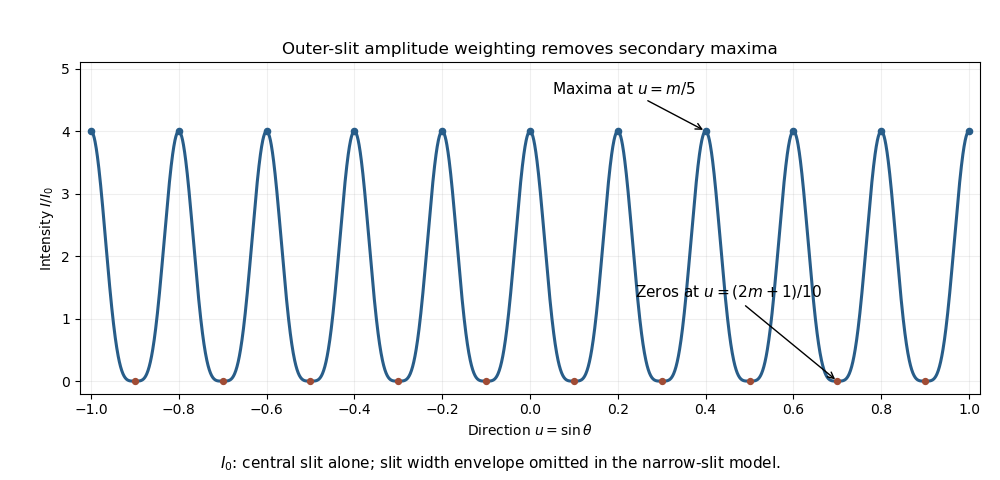

The amplitude weights form a binomial pattern. They remove the secondary maxima that an equal-amplitude three-slit array would have between its principal peaks. No phase shift is needed: changing the coherent weights already changes the interference structure.
Articles by others on the same topic
There are currently no matching articles.