For a unit mass of ideal gas, the first law of thermodynamics in enthalpy form is . A reversible adiabatic displacement has , and the ideal gas law gives . ThusThe atmospheric profile approaches this dry adiabat when convection efficiently mixes potential temperature and there is no condensation or other strong diabatic source. The first law by itself determines a parcel path, not every possible environmental temperature profile; the convective mixing assumption is needed. Hydrostatic balance gives the corresponding height lapse rate .
For rigid linear molecules with translation and rotation active but vibration frozen, the molecular heat capacities are and , hence . Earth is dominated by the diatomic gases nitrogen and oxygen. Mars is dominated by carbon dioxide, which is triatomic but linear and has the same two rotational degrees of freedom. In the rigid-molecule approximation it therefore has the same ratio. The value is not exact for carbon dioxide when its bending vibrations contribute appreciably to heat capacity, and variable heat capacities give a nonconstant dry-adiabatic exponent. Here denotes , not the distinct adiabatic index .
Assume a plane-parallel atmosphere in local thermodynamic equilibrium, negligible infrared scattering, a black surface, and surface temperature equal to the adjacent air temperature. For a specified ray, let be its transmittance from a level to space, increasing from at the surface to one at the top. The formal radiative transfer solution isUsing yieldsThis expresses absorption and re-emission together: opacity does not simply remove surface radiation without adding atmospheric radiation. An absorber close to a thermally coupled surface has nearly the same Planck function as that surface, so is small. Its emission nearly compensates the surface radiation it absorbs, giving weak radiance sensitivity to near-surface concentration. In an exactly isothermal atmosphere at surface temperature, for every optical depth, a concrete example of complete concentration ambiguity in this thermal measurement. Finite surface emissivity, reflection, scattering or a surface-air temperature discontinuity would require additional terms.
A hydrostatic pressure interval contains moles of background gas per area. Its absorbing column is , so for a nadir rayThe assumed Planck-temperature power and dry adiabat give . To first order in optical depth, , and the radiance solution becomesFor a uniform mixing ratio this also evaluates to . Its total optical depth is , so the deficit is .
A pressure-resolved perturbation defines the infrared absorber sensitivity kernel by , withIt is zero at the top, negative in the interior, and zero again at the surface. The magnitude is largest where , namelySign and coordinate qualification. Literally the maximum of the signed kernel is zero at the endpoints; is its minimum and the maximum of its absolute value. The derivative with respect to a single vertically uniform is the integrated constant and has no pressure location. For equal-width logarithmic pressure perturbations the kernel is instead and its magnitude peaks at . The stated pressure-interval convention is therefore essential.
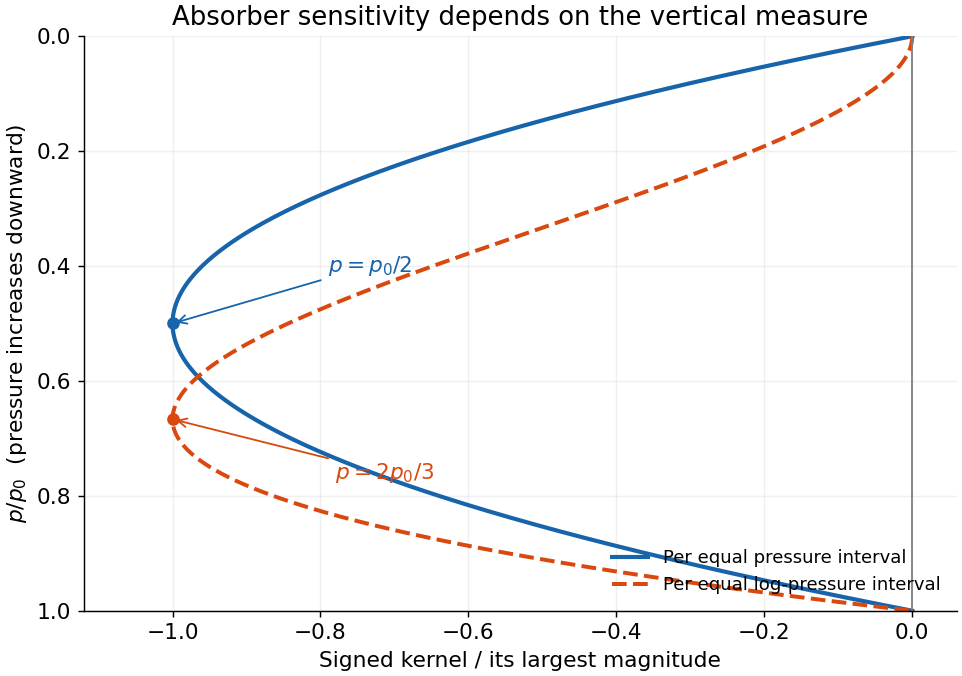

The low top-of-atmosphere sensitivity reflects the small pressure-broadened absorption coefficient and small molecular column per there; the low surface sensitivity reflects small thermal contrast. The printed phrase that temperature decreases with pressure reverses the actual stipulated relation: with positive exponent, temperature decreases as pressure decreases upward. The derivation uses the explicit adiabatic formula.
Articles by others on the same topic
There are currently no matching articles.