Pressure convention matters. With the entropy-buoyancyequation just described, a consistent reduced-pressure form writes the pressureaccelerationas −∇Φ, where Φ=p′/ρ0. Its vertical term is −∂z(p′/ρ0), not simply −ρ0−1pz′. The original source explicitly specifies variable ρ0(z) but prints the latter. Those differ by p′/(ρ0H), so the two cannot silently be equated. Parts b and c display the consequence and then solve the explicitly corrected reduced-pressuremodel that yields the requested wave equation. This is a mathematical inconsistency in the printed set, not missing source material.
which differs from the requested equation. The factor two arises when differentiating both ρ0 and wz−w/H. Keeping variable density in continuity while treating it as constant during that differentiation would be inconsistent.
For the intended anelastic reduced-pressure Kelvin wave, make the explicit correction wt−b+Φz=0, while ut+Φx=0 and Φ=p′/ρ0. Continuity then gives Φxx=wzt−wt/H, and vertical momentum gives wtt+N2w=−Φzt. Cross differentiation now produces
This proves the advertised equation for the corrected model, without claiming it follows from the incompatible printed set.
A concrete counterexample makes the distinction testable. In nondimensional units H=N=k=1, take m=0, ω=2/5 and w=ez/2ei(x−ωt), multiplied by its Gaussian meridional envelope. This satisfies the last boxed wave equation, but substitution into the literal printed-system wave operator gives −2w/5=0. No choice of accompanying pressure and horizontal velocity can then make it a solution of all five printed equations. Conversely, the literal operator has vertical factors ez/H+imz and dispersion ω2=N2k2/(k2+m2); its scaling is different from the requested half-scale-height factor.
Work with the explicitly corrected reduced-pressure system in b. Write d=1/(2H) and use the complex wave amplitude, taking real parts at the end. The vertical factor satisfies (∂z2−H−1∂z)w=−(m2+d2)w, so the wave equation gives
In particular u,w,b,Φ have amplitude proportional to ez/(2H), whereas pressurep′ has amplitude proportional to e−z/(2H). Directly substituting these expressions into vertical momentum gives Φz=−iω(m2+d2)w/k2=i(ω−N2/ω)w, verifying both the sign and the dispersion relation.
Meridional momentum is βyu+Φy=0. Since Φ=cu, it integrates to a Gaussianexp[−βy2/(2c)]. Thus
For short vertical wavelengths, m2≫k2+d2, so ω2≃N2k2/m2, c≃N/∣m∣ and LD2≃N/(β∣m∣). The wave is a slowly oscillating, hydrostatic internal gravity wave with strong vertical variation and relatively narrow trapping. Here u≃−(m/k)w and p′/ρ0≃−(ωm/k2)w; the buoyancy expression above remains valid.
For long vertical wavelengths, ∣m∣≪k2+d2, the exact limiting speed is c=N/k2+d2. To obtain the stated height-controlled limit also requires long horizontal wavelength, ∣k∣H≪1. With both ∣m∣H≪1 and ∣k∣H≪1,
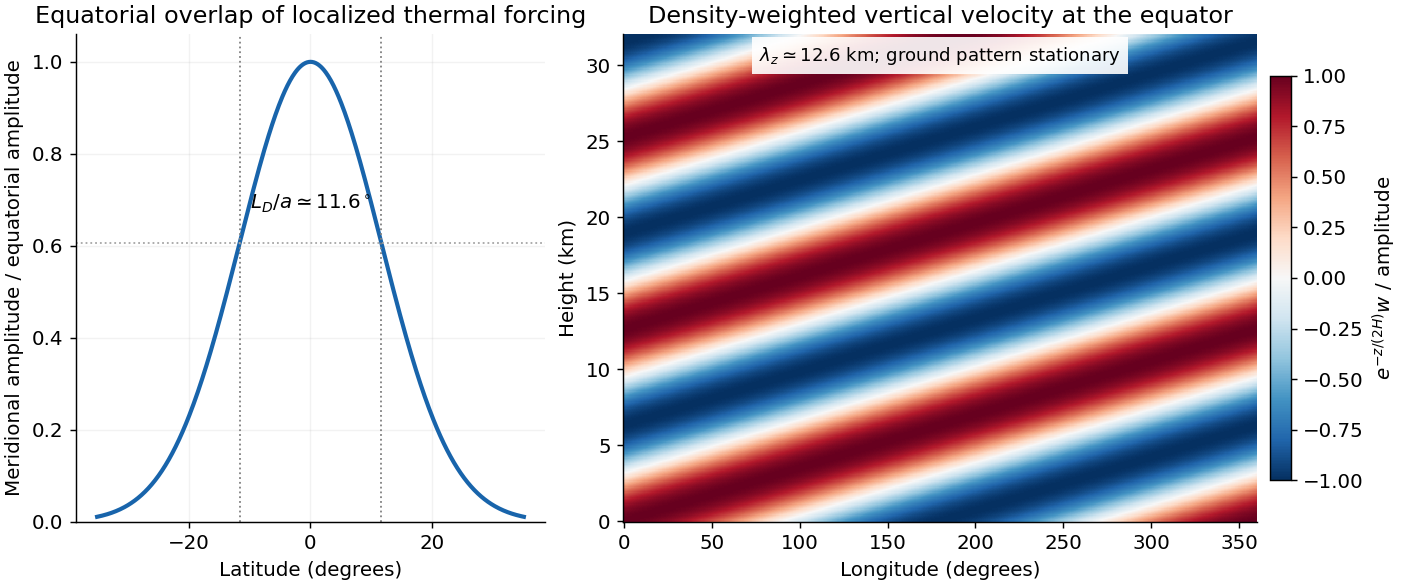
Apply the intended, corrected dispersion relation in c. A uniform mean zonal wind gives ωground=ω+kU. Stationarity with U=−20ms−1 therefore requires eastward intrinsic phase speedω/k=−U=20ms−1. With k=1/a,
Astorm within roughly 12∘ of the equator has substantial projection on the Gaussian mode. There is no sharp latitude cutoff: ∣y∣=LD gives amplitude e−1/2 and the 1/eamplitude latitude is about 16.4∘. Forcing outside that core has progressively weaker overlap.
The intrinsic wave is eastward even though its observed ground pattern is stationary; westward advection cancels its phase propagation. Its intrinsic period is about 12.4Earthdays. The inferred ∣m∣≫1/(2H) puts it in the short-vertical-wavelength branch, well below the long-wavespeed 2NH=200ms−1. For upward energyradiation, ∂ω/∂m must be positive, which selects m<0 for positive k,ω: vertical phase propagation is then downward. Dust absorption supplies thermal forcing with a zonally asymmetric component; the response does not imply that dust itself moves eastward at the intrinsic phase speed.