Linearize about a uniform horizontal flow and a hydrostatic, vertically stratified basic state. The basic-flow material derivative is . The first two equations are the horizontal and vertical perturbation momentum balances: pressure gradients accelerate the disturbance, while the vertical equation retains the buoyancy force after the basic hydrostatic balance is subtracted.
The Boussinesq approximation neglects fractional density variations in inertia and enforces incompressibility, , but retains them in buoyancy. Advecting the stable background density gradient gives . With , this is the fourth supplied equation. A displaced parcel then has a restoring buoyancy tendency.
Small amplitude allows products of perturbations to be discarded; two-dimensional motion removes dependence and transverse flow. Rotation, viscosity, diffusion, diabatic heating and mean shear are neglected. is the reference inertial density, whereas the small background density gradient still sets . In a compressible real atmosphere the appropriate stability measure involves potential temperature; this Boussinesq system is a local idealization that filters acoustic waves rather than a full compressible atmospheric model.
Put and . Acting on the Fourier mode, . Continuity and horizontal momentum give and . The buoyancy equation gives . Substitution into vertical momentum yieldsThe two signs describe the two frequency branches; when the intrinsic frequency is required positive, . For a stationary disturbance , so . With this requires and selects the minus sign, . The stationary dispersion condition isDifferentiate the unconstrained dispersion before imposing stationarity. The stationary mountain-wave group velocity is obtained from the ground-frame dispersion; before imposing stationarity it isOn the stationary locus this becomesDifferentiating after substituting as though all neighbouring modes were stationary would incorrectly erase the frequency gradients.
For upward energy propagation from the lower boundary, choose , since and . It requires real nonzero , henceThe downstream ray inclination above horizontal isIt is fixed for a given monochromatic forcing, with the two signs of giving the upward/downward rays.
Frame qualification for the requested phase angle: the normal intrinsic phase velocity is . Because , the boxed stationary group velocity is exactly : its angle to intrinsic phase propagation is , and it is perpendicular to the stationary phase lines. By contrast the intrinsic group velocity satisfies , so its angle to intrinsic phase propagation is . In the ground frame the phase velocity of a strictly stationary pattern is zero and has no nonzero propagation direction. For example , gives and . These distinctions prevent applying the usual zero-flow perpendicularity rule to two velocities expressed in different frames.
A mountain width is not an exactly specified sinusoidal wavelength. Taking its characteristic horizontal inverse length as with gives . Since , the stationary vertical wavenumber isThis is close to the long-horizontal-scale/hydrostatic estimate . If instead the quoted width is identified with a sinusoidal wavelength , then and . Thus several kilometres, roughly – under these two common width conventions, is the justified estimate; the terrain profile would fix its actual forcing spectrum.
For the inverse-width choice, both and are negative for upward energy radiation. The stationary phase lines tilt upstream with increasing height, while energy propagates upward and slightly downstream. Numerically , with ray inclination about . Intrinsic phase propagation points upstream and downwards; the ground pattern itself remains fixed. The original sketch below uses this explicit convention.
A ground observer may see stationary lenticular or wave clouds where ascent cools sufficiently moist air, with continuing air flow through a cloud whose position remains almost fixed. Descending regions can clear or warm. An aircraft crossing the pattern encounters alternating updraughts and downdraughts; gliders can exploit the lift. Strong amplitudes, shear or rotors may cause turbulence, but a linear gravity wave can also be smooth, and clear-air waves need not produce any visible cloud. Mountain height, humidity and nonlinear stability are not supplied, so neither a vertical-wind amplitude nor a definite atmospheric precipitation forecast follows.
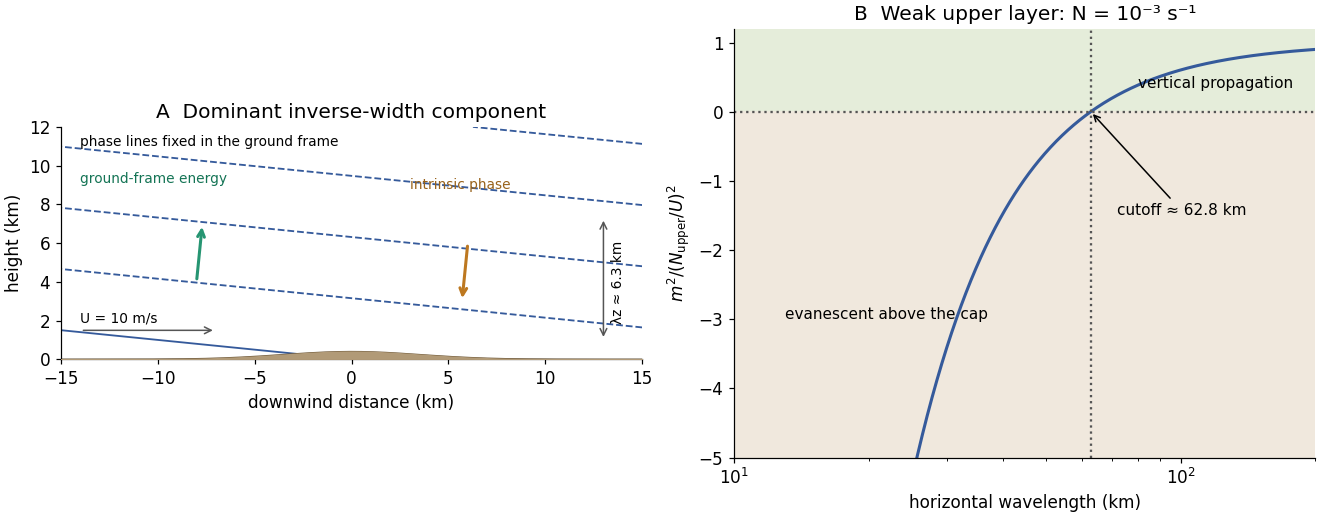
Stationary mountain-wave phase lines, intrinsic phase direction, energy rays and an upper-layer propagation cutoff
. Original schematic and dispersion calculation. The ridge height is illustrative; the phase sketch uses , while the upper-layer panel shows the cutoff for the reduced Brunt–Väisälä frequency. No cloud or turbulence amplitude is inferred. Details.
Assuming the mean wind remains , the weakly stratified upper layer hasFor the inverse-width estimate , it is near the turning threshold , with negligible upward group-velocity component. Components of larger are evanescent aloft and are substantially reflected; only horizontal wavelengths exceeding can propagate vertically there. For the alternative sinusoidal wavelength, and the evanescent decay length is about .
The sharp inversion and change of stability can therefore cap the upward-radiating disturbance. Reflection between the ground and cap may trap energy in the lower layer and allow downstream lee-wave trains or resonant guided modes, with permitted wavelengths depending on the interface and lower-layer structure. Reflection, leakage and possible resonance are distinct: a specified height does not by itself fix a unique mode amplitude or wavelength.
Wave clouds may become confined below the cap or organized into persistent lee bands if there is enough moisture. Inversion-limited vertical mixing can also retain low cloud, haze or pollutants; sufficiently strong trapped motions can promote rotors or turbulence. These are possible changes, not inevitable weather outcomes: humidity, wave amplitude, detailed stability and wind shear are unspecified. The new structure suppresses upward energy transmission for the dominant short horizontal scales even though the lower atmosphere can still support waves.
Articles by others on the same topic
There are currently no matching articles.