A single gate-defined dot can trap one electron whose lower and upper Zeeman states define . Initialize by energy-selective loading or relaxation, coherently rotate the spin with a resonant magnetic drive or electrically generated spin-dependent drive, and use neighbouring-dot exchange interaction for two-qubit operations. The dot supplies confinement; a full qubit also requires control, coherence and calibrated readout. A nearby quantum point contact or single-electron transistor detects charge capacitively, so spin-to-charge conversion is needed.
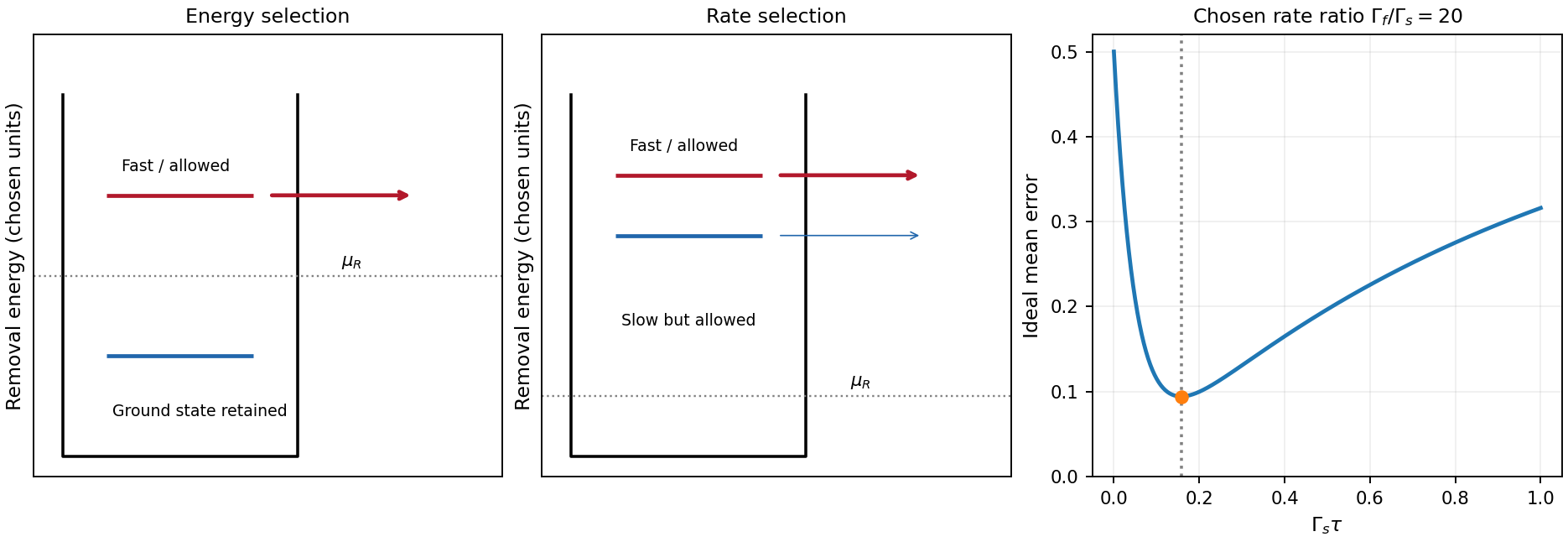
In energy-selective spin readout, set the reservoir chemical potential between the two spin-dependent removal energies. The upper state can tunnel out; the lower remains. Reloading can create a temporary empty-dot signal that a time-resolved charge detector records. Resolving this window requires sufficiently small electron-temperature broadening and stable level alignment. The escape should be faster than spin relaxation, but the empty interval must remain long enough for detection. Useful controls include known-state preparation, sensor-noise measurement, varied waiting time and readout pulses, and checks for missed events or thermally activated false escape.[ref]
Single-shot read-out of an individual electron spin in a quantum dot by J. M. Elzerman and others. main-text readout pulse sequence and spin-to-charge conversion, Fig. 1
tunnel-rate-selective spin readout instead places both candidate removal energies on the allowed side of the reservoir and uses different escape rates . After a window with , the fast state has usually changed charge while the slow state has not. It does not require the reservoir Fermi edge to resolve the state splitting, although it still requires controlled charge occupation, substantial rate contrast and relaxation slower than the mapping. The contrast must have a physical origin. A demonstrated single-dot implementation uses two-electron singlet and triplet states: Pauli symmetry puts the triplet's second electron in a higher orbital with stronger lead coupling. Nearly degenerate states can then be distinguished by rate rather than by their energy difference.[ref]
For a bare one-electron Zeeman pair in the same orbital with an unpolarized lead, different tunnel rates are not automatic. A spin-selective barrier/reservoir or another spin-dependent mechanism is needed. The two-electron singlet/triplet example is a different state encoding/readout arrangement, not evidence that the bare single-electron pair already has useful rate contrast.
For the optimal tunnel-rate readout time, assume no relaxation and equal prior probabilities. The fast-state missed-event probability is and the slow-state false-event probability is . Their average is minimized atFinite detector bandwidth, preparation errors, state relaxation and unwanted reloading alter this optimum. energy selection is direct for a resolved single-electron spin but sensitive to the narrow alignment window; rate selection has a wider energy operating window but requires engineered rate contrast and a carefully timed charge measurement. Neither method is an ideal nondestructive spin measurement merely because the charge sensor itself is noninvasive.
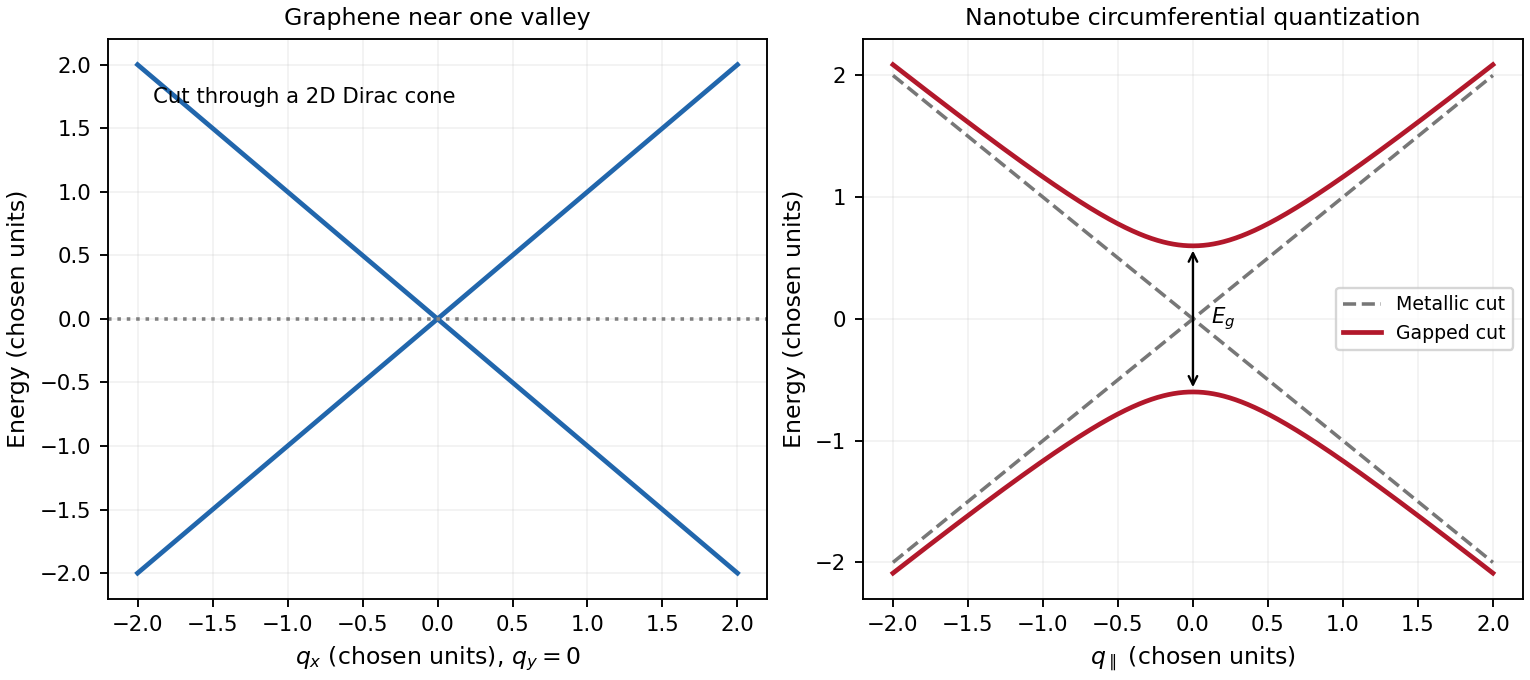
graphene is a two-dimensional honeycomb lattice with two sublattices. Nearest-neighbour hopping gives two bands . They touch at two inequivalent valleys. Expanding near valley givesThe two-component spinor describes sublattice amplitudes, not real spin. This is a massless two-dimensional Dirac Hamiltonian with material velocity in place of . The emergent band quasiparticles are relativistic in this mathematical sense; the electron's vacuum rest mass is not set to zero. Real spin and valley each contribute a degeneracy of two in the ideal low-energy model.
A single-walled carbon nanotube is a rolled graphene sheet with carbon nanotube chiral vector . Periodicity requires , selecting lines through graphene momentum space and producing one-dimensional transverse electronic modes. Near a valley,A quantization line through one of the Dirac valleys in graphene gives a metallic branch; ideal nanotube zone folding gives the criterion . Otherwise the nearest line misses the valley and opens . The transverse momentum gives a carbon-nanotube Dirac mass, with . For a large-radius ideal semiconducting tube, and , showing the inverse-diameter gap. Curvature, strain, spin-orbit coupling and interactions can change the simple classification; nominally metallic non-armchair tubes can acquire small gaps. One-dimensional transverse electronic mode thresholds give Van Hove singularities, unlike graphene's low-energy density of states proportional to .
A gate changes occupation and the Fermi level in both systems. Ideal monolayer graphene can be tuned through charge neutrality from holes to electrons, but an ordinary scalar gate does not open a bulk band gap. Including spin and valley,The gate relation includes geometric and quantum capacitances, so one should not equate gate voltage to Fermi energy without the capacitance model. A semiconducting carbon nanotube can instead be depleted when its Fermi level lies in a gap and turned on in electron or hole bands. Contact Schottky barriers can strongly influence the observed nanotube field effect. A truly gapless ideal metallic tube cannot be switched off simply by moving the Fermi level through its band crossing. These gate responses reflect band structure and contacts, not a change of wrapping indices.


Articles by others on the same topic
There are currently no matching articles.