Original paper: Public original, physical PDF pages 598–600.
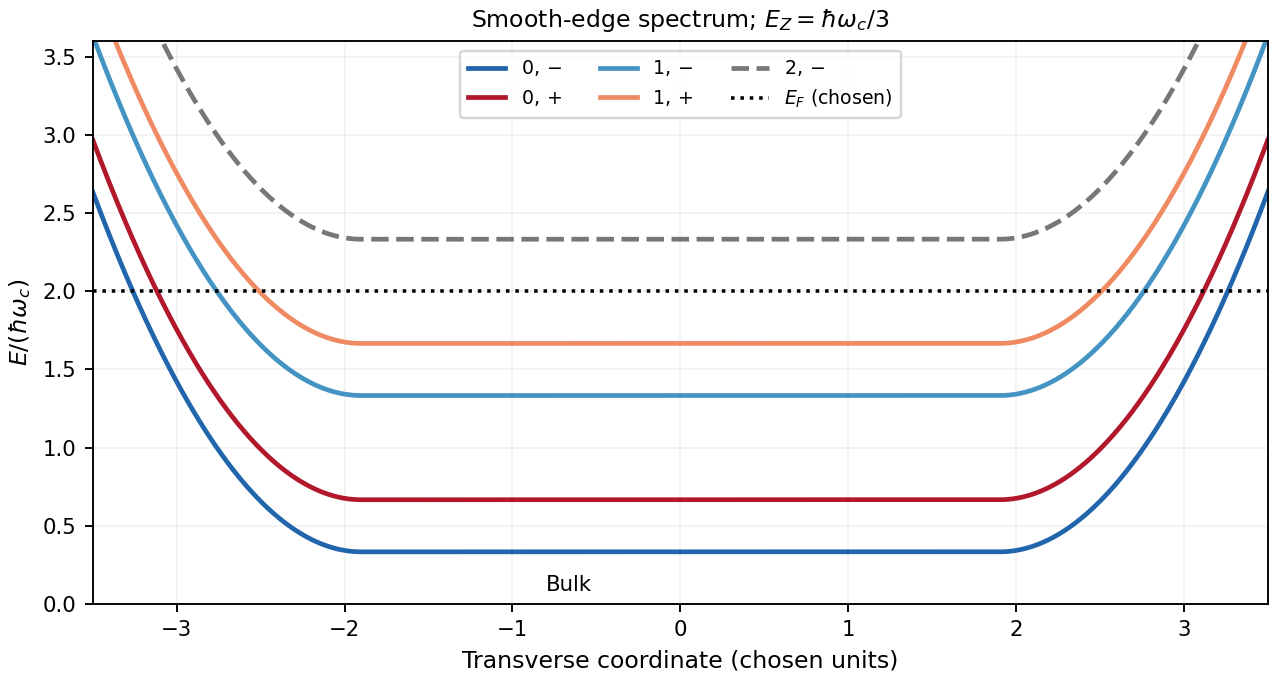
Use , along , and for the electron's confinement potential energy. The spin-resolved Landau level branches in the smooth-edge approximation areThe spin labels denote upper and lower energies; the sign of a material's effective factor is not inferred from the stated positive splitting. In units of , the four occupied bulk energies are . A chemical potential in therefore gives filling factor four. The branches rise at both confining edges and cross the common Fermi energy once at each edge. Each crossing is one spin-resolved quantum Hall edge state; there are four on either side. The two spin branches within an orbital level are separated by , while the intervening gap to the next orbital pair is .
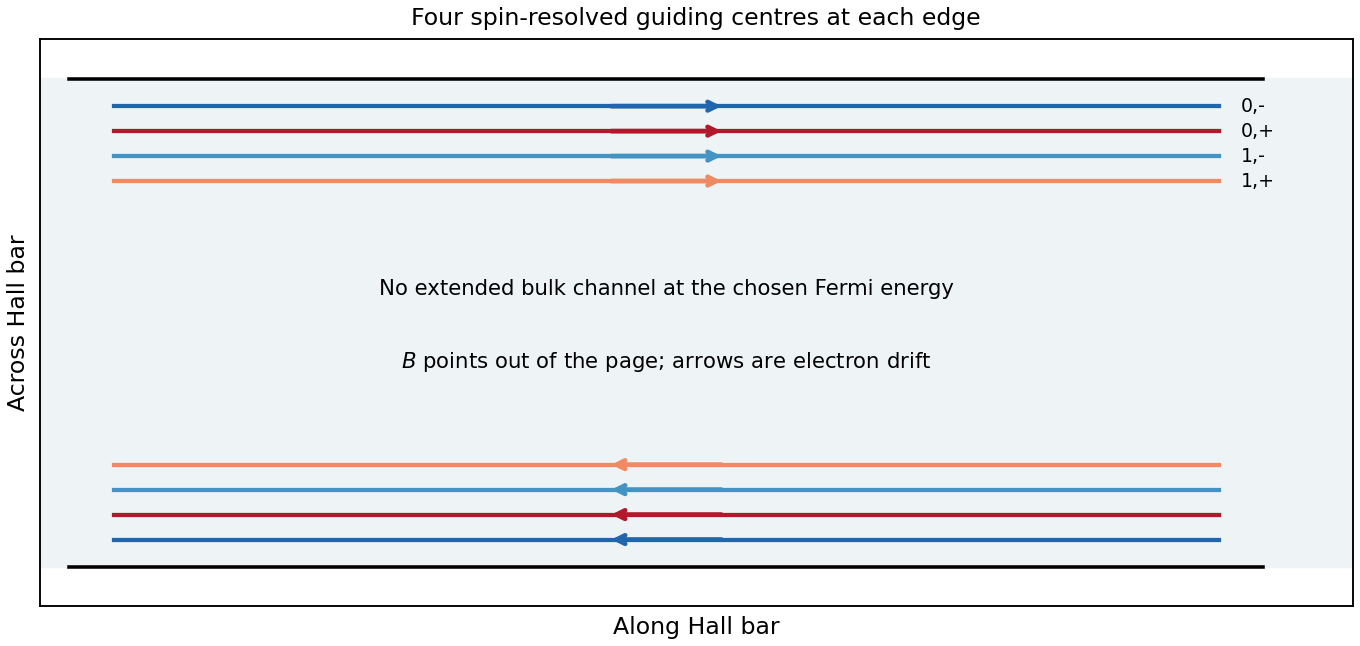
In Landau gauge for a uniform magnetic field , the guiding centre is . The group velocity isThus the upper edge in the original trajectory diagram carries electrons to the right and the lower edge to the left. Reversing the magnetic field reverses both arrows. Semiclassically these are skipping trajectories; quantum mechanically the guiding centres label propagating quantum Hall edge states. The larger orbital-plus-spin energy crosses the Fermi energy farther toward the interior, because less confinement energy is needed. Opposite spins in one orbital branch are therefore spatially separated.
In a clean bulk with the Fermi energy between Landau levels, there are no extended bulk states at that energy. Occupied bulk cyclotron orbits lie below it; one must not draw them as extra conducting Fermi-level channels. Smooth disorder can instead produce localized bulk contours without adding a direct source-to-drain channel.
For the spin separation at a smooth quantum Hall edge, linearize the confinement energy at a crossing. Compensating a spin energy difference by a potential-energy change givesHere is interpreted as the specified slope of electron potential energy. If it denotes electrostatic voltage per length instead, the denominator is . The two edges of a neck and the two sides of an antidot have oppositely directed slopes; the formula is a positive local separation on any one edge. For local filling two, only the spin pair is occupied at the neck minimum: . Raising both branches with the confinement produces two crossings on each side, as shown in the original neck sketch. This fixed-slope estimate precedes self-consistent electrostatic screening.
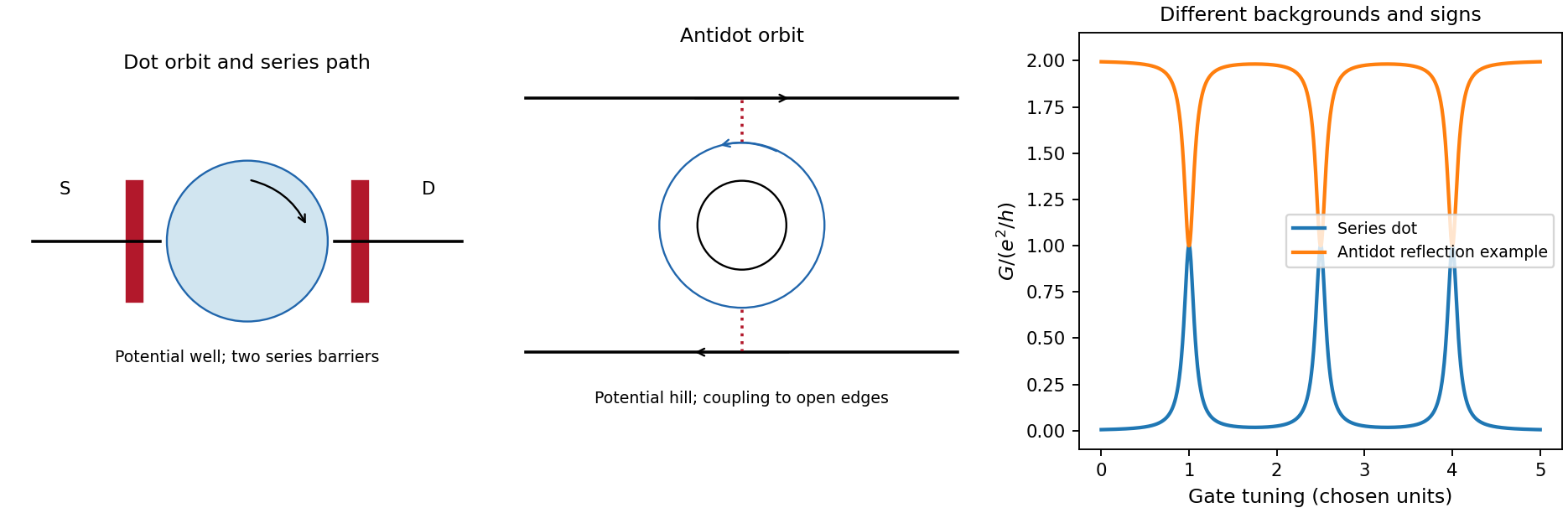
An antidot is a depleted potential hill. guiding centres circulate around its closed equipotentials, with chirality opposite to the outer sample edge. A phase-coherent round trip contributes magnetic phase , with . A localized orbit resonant with the incident energy can transfer an electron between extended channels. If the outgoing channel returns toward the injecting reservoir, the process is resonant reflection and reduces electrical conductance. If coupling instead connects an otherwise blocked incident channel to the far reservoir, it is resonant transmission and adds electrical conductance. Transmission peaks require that forward connectivity; a closed orbit by itself does not guarantee them. Interchannel scattering can change which orbit participates.[ref]
Electron-electron interactions in antidot-based Aharonov-Bohm interferometers by S. Ihnatsenka and others. section I and section III.C, especially Fig. 7: localized states, interchannel scattering and resonant transmission
For the antidot resonance conductance bounds with one active spin-resolved resonance, writeHere are energy broadenings; the corresponding escape rates are . In a reflection-dominated configuration with two otherwise transmitted channels, : a background can dip to . In a transmission-dominated configuration with one spectator channel and the second otherwise blocked, : peaks rise from toward . These are the two ideal channel-count examples plotted below. More generally, or ; a different spectator count changes the integer offset. The constriction filling alone does not specify every tunnel coupling or resonance height. Equal couplings permit unit resonant transfer in the isolated-level model; asymmetry, temperature and dephasing reduce the contrast. Holding the effective orbit area approximately fixed gives for one branch, not a universal charging-corrected period.
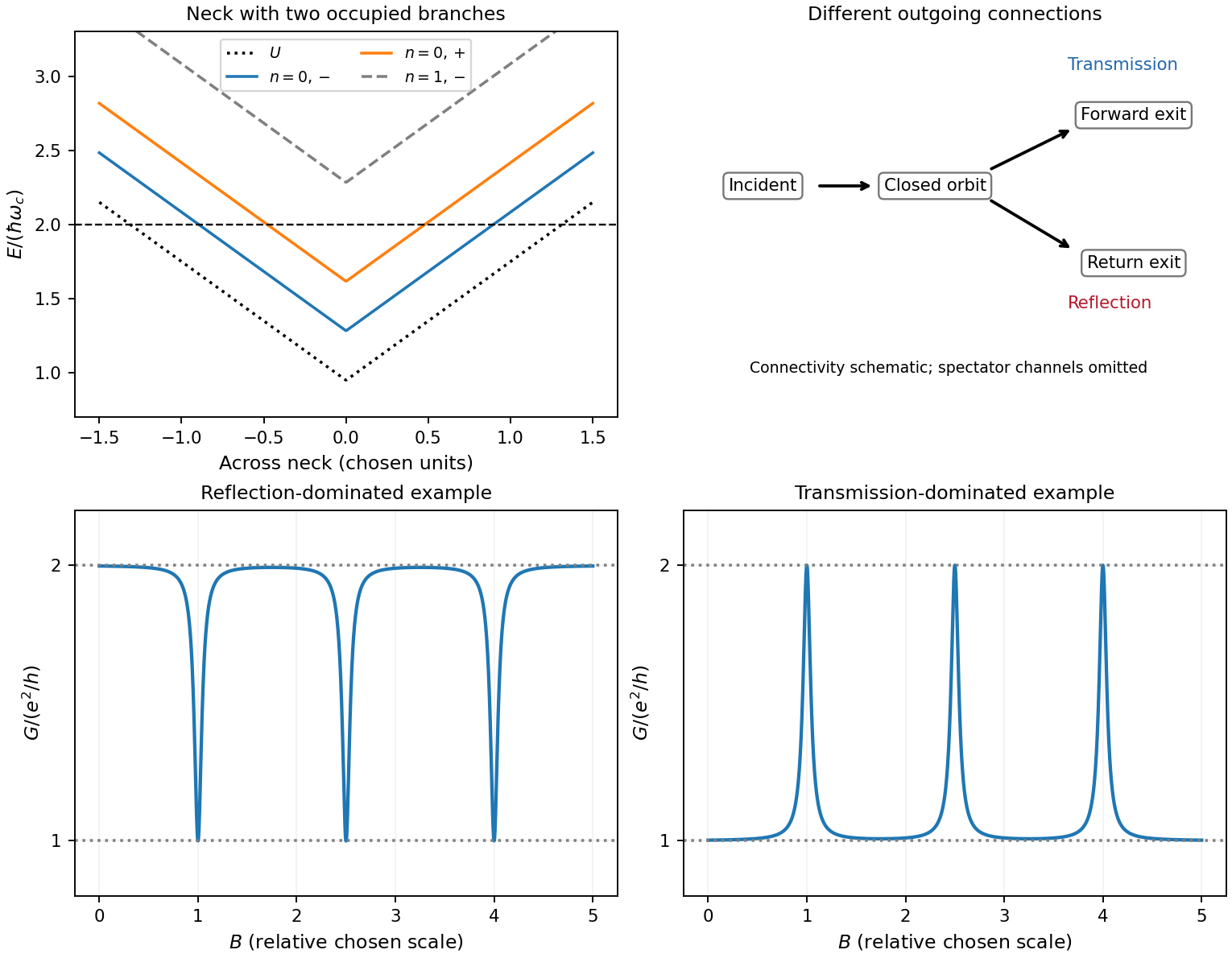
Original neck spectrum, alternative channel connectivities and illustrative antidot conductance dips and peaks
. Details. In quantum-dot versus antidot resonance topology, a quantum dot is a potential well holding a finite electron island. Its closed guiding-centre circulation is reversed relative to an antidot at the same field. With two barriers in series, current follows source dot drain; off resonance there need not be a direct conducting path. A gate shifts a level or an addition electrochemical potential into alignment with the reservoirs and produces a electrical conductance peak. For an isolated coherent spin-resolved level, the zero-temperature peak is at most and reaches it only for equal couplings; unresolved noninteracting spin degeneracy doubles this bound. In weak sequential tunnelling, peak height depends on rates and temperature rather than being quantized. Charging produces Coulomb blockade peaks with spacing set by addition energy and gate lever arm. An antidot also supports discrete orbit/charging resonances, but can be side-coupled to already open channels and produce dips. Gate voltage changes both orbit area and confinement, whereas a magnetic sweep directly changes enclosed flux.
Coulomb interactions require a self-consistent confinement potential. A gradual decrease in electron density cannot leave arbitrary uncompensated donor charge at no cost. Partly occupied Landau levels have a large charge response: electrostatic screening flattens their effective energy near the Fermi energy over compressible quantum Hall edge strips. Between them, integer-filled incompressible quantum Hall edge strips have a gap, weak density response and most of the potential variation. In an idealized cross-section the effective branch thus alternates between flat, partially occupied portions and rising portions crossing a gap; its carrier density varies oppositely. The bare levels still have Landau level and spin splittings locally, but the common electrostatic potential is no longer an imposed straight slope. exchange interaction can additionally renormalize spin gaps. Widths must follow electrostatics and the density gradient, so the unscreened separation is not a quantitative screened-strip width.[ref]
Electrostatics of edge channels by D. B. Chklovskii and others. abstract: steplike self-consistent potential and alternating compressible and incompressible strips
A modulation-doped GaAs-AlGaAs electron gas is confined on the GaAs side of the interface. The larger-gap AlGaAs supplies a conduction-band barrier; charge transfer from remote donors and the resulting electric field bend the bands into an approximately triangular well. transverse electronic mode wavefunctions are confined normal to the interface but free in its plane. electrons settle into the well until their electrochemical potential agrees with the donor/contact environment. An undoped spacer separates mobile electrons from ionized donors, reducing impurity scattering. Equilibrium has one Fermi level across the structure; the conduction-band edge is not flat. Surface depletion and the cap also affect the profile. The original drawing illustrates one occupied confinement transverse electronic mode; a single spatial electron gas need not in general imply only one occupied vertical transverse electronic mode.
molecular beam epitaxy can grow a clean GaAs buffer/channel, an undoped AlGaAs spacer, a Si-doped AlGaAs supply region and a protective GaAs cap on a suitable substrate. Control composition, interface quality and background impurities during growth; placing dopants directly in the channel defeats the principal mobility advantage. Define a mesa or isolation region, fabricate low-resistance ohmic contacts to the buried gas, and pattern fine metal split gates by electron beam lithography and the lift-off process. Negative gate bias depletes the underlying gas, leaving a narrow channel between the gates. Check contact resistance, leakage, carrier density and mobility; operation with ballistic electron transport requires channel length shorter than the relevant scattering lengths and smooth confinement on the wavelength scale. The lithographic gap does not equal the electrical width because of lateral depletion.
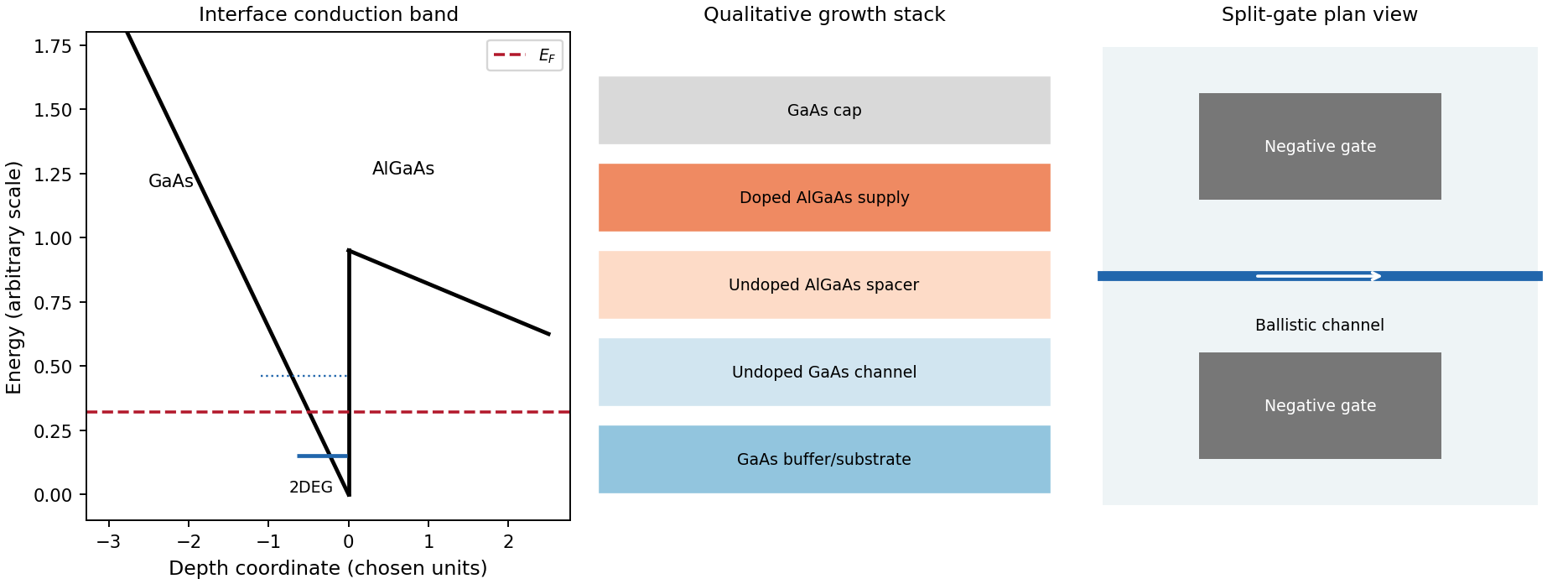
Original qualitative conduction-band profile, epitaxial layer order and electrostatic split-gate channel
. Details. For a long uniform channel supporting ballistic electron transport, transverse confinement creates thresholds with continuous longitudinal propagation above each threshold. One directed spin branch of a transverse electronic mode has states per length and group velocity . Hence : velocity cancels the one-dimensional density of states. Including two unresolved spin states,For low temperature and small bias, a fully open transverse electronic mode has , givingThe assumptions are ideal reservoirs/contacts, negligible reflection and interactions that would invalidate the independent-subband description, and unresolved spin splitting. A resolved spin branch contributes . The finite two-terminal electrical resistance is a contact/mode-injection effect, despite the absence of dissipative scattering inside the ideal channel.
For voltage partition in a ballistic constriction, a short saddle has strong local electric-field and electrostatic screening variation near its entrances and barrier, rather than the uniform Ohmic voltage gradient of a diffusive wire. Right-moving incident states inherit the source distribution and left-moving states the drain distribution; there is no unique local equilibrium chemical potential inside an ideal ballistic saddle. The electrostatic potential must be determined self-consistently. In a symmetric rigid-barrier approximation, the barrier follows the mean lead potential and half the electrochemical bias lies on each side. This is a stated approximation, not a universal spatial voltage profile.
For a saddle , transverse electronic mode thresholds are . The smooth-barrier transmission is , approaching a step for a sharp threshold on the bias/thermal scale.[ref]
Quantized transmission of a saddle-point constriction by M. Büttiker. Phys. Rev. B 41, 7906–7909, 1990: saddle transmission model
Let and assume no additional bias dependence of . At zero temperature,When the source and drain sample and thresholds, the differential electrical conductance is . These half plateaus arise from the two ends of the bias window, not fractional carriers. The dc ratio need not share their plateau values. Heating, spin splitting and interaction-induced features must be distinguished experimentally.
In bias spectroscopy of one-dimensional subbands, plot differential electrical conductance or its gate derivative against gate bias and source-drain bias. Threshold branches occur where or . When one bias-window edge meets and the other ,Thus the intersections of adjacent threshold branches calibrate the one-dimensional spacing directly in energy. A gate lever arm can then convert gate intervals to energy; it should be measured rather than guessed. Asymmetric bias partition, a moving barrier or a gate-dependent spacing modifies slopes and plateau weights, requiring the corresponding self-consistent bias model.
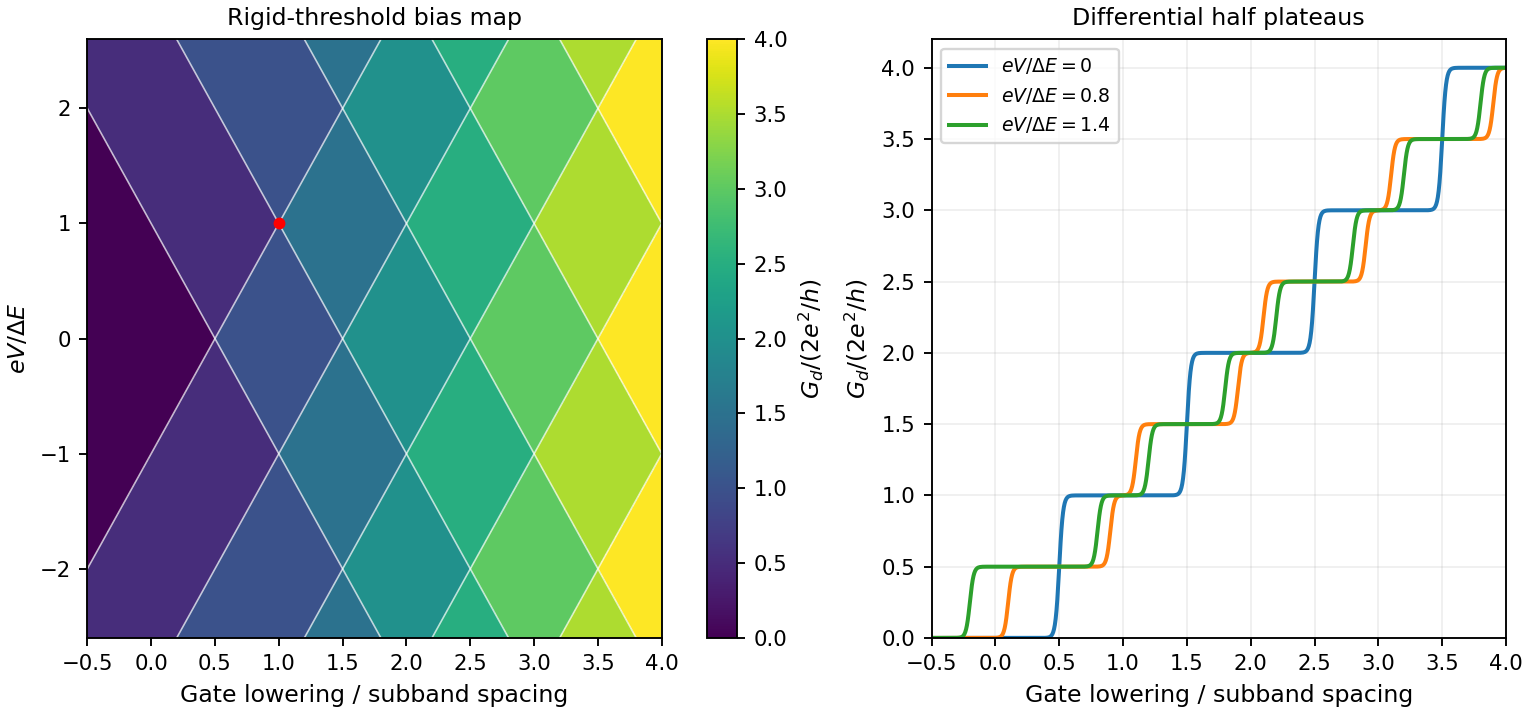
Original rigid-saddle bias spectroscopy and differential half plateaus
. Details. A single gate-defined dot can trap one electron whose lower and upper Zeeman states define . Initialize by energy-selective loading or relaxation, coherently rotate the spin with a resonant magnetic drive or electrically generated spin-dependent drive, and use neighbouring-dot exchange interaction for two-qubit operations. The dot supplies confinement; a full qubit also requires control, coherence and calibrated readout. A nearby quantum point contact or single-electron transistor detects charge capacitively, so spin-to-charge conversion is needed.
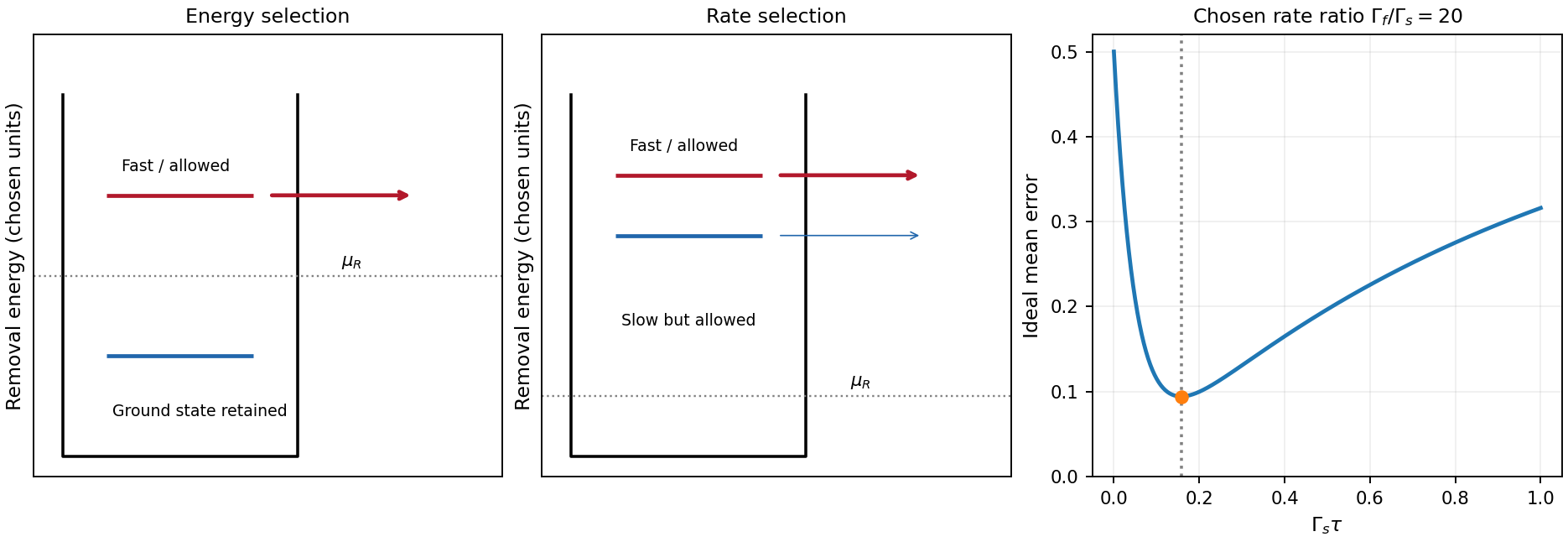
In energy-selective spin readout, set the reservoir chemical potential between the two spin-dependent removal energies. The upper state can tunnel out; the lower remains. Reloading can create a temporary empty-dot signal that a time-resolved charge detector records. Resolving this window requires sufficiently small electron-temperature broadening and stable level alignment. The escape should be faster than spin relaxation, but the empty interval must remain long enough for detection. Useful controls include known-state preparation, sensor-noise measurement, varied waiting time and readout pulses, and checks for missed events or thermally activated false escape.[ref]
Single-shot read-out of an individual electron spin in a quantum dot by J. M. Elzerman and others. main-text readout pulse sequence and spin-to-charge conversion, Fig. 1
tunnel-rate-selective spin readout instead places both candidate removal energies on the allowed side of the reservoir and uses different escape rates . After a window with , the fast state has usually changed charge while the slow state has not. It does not require the reservoir Fermi edge to resolve the state splitting, although it still requires controlled charge occupation, substantial rate contrast and relaxation slower than the mapping. The contrast must have a physical origin. A demonstrated single-dot implementation uses two-electron singlet and triplet states: Pauli symmetry puts the triplet's second electron in a higher orbital with stronger lead coupling. Nearly degenerate states can then be distinguished by rate rather than by their energy difference.[ref]
For a bare one-electron Zeeman pair in the same orbital with an unpolarized lead, different tunnel rates are not automatic. A spin-selective barrier/reservoir or another spin-dependent mechanism is needed. The two-electron singlet/triplet example is a different state encoding/readout arrangement, not evidence that the bare single-electron pair already has useful rate contrast.
For the optimal tunnel-rate readout time, assume no relaxation and equal prior probabilities. The fast-state missed-event probability is and the slow-state false-event probability is . Their average is minimized atFinite detector bandwidth, preparation errors, state relaxation and unwanted reloading alter this optimum. energy selection is direct for a resolved single-electron spin but sensitive to the narrow alignment window; rate selection has a wider energy operating window but requires engineered rate contrast and a carefully timed charge measurement. Neither method is an ideal nondestructive spin measurement merely because the charge sensor itself is noninvasive.
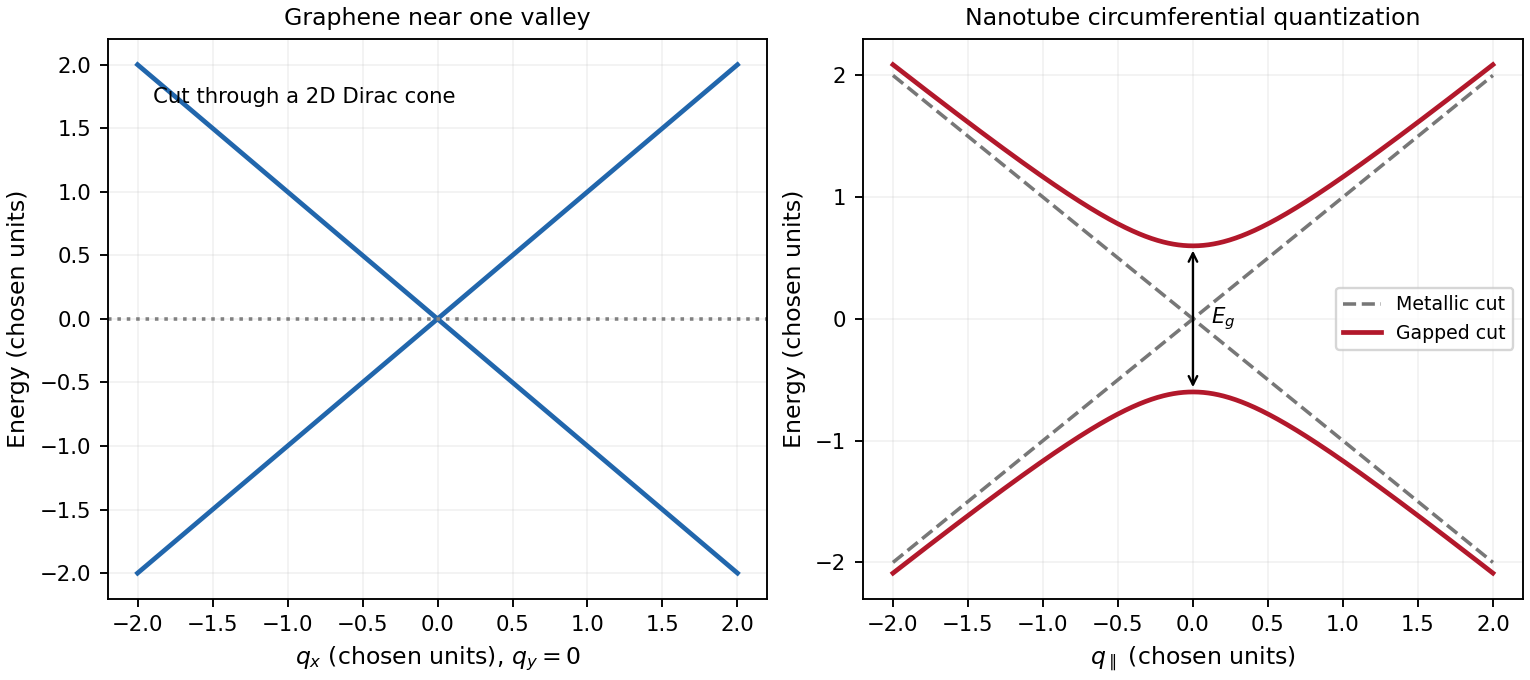
graphene is a two-dimensional honeycomb lattice with two sublattices. Nearest-neighbour hopping gives two bands . They touch at two inequivalent valleys. Expanding near valley givesThe two-component spinor describes sublattice amplitudes, not real spin. This is a massless two-dimensional Dirac Hamiltonian with material velocity in place of . The emergent band quasiparticles are relativistic in this mathematical sense; the electron's vacuum rest mass is not set to zero. Real spin and valley each contribute a degeneracy of two in the ideal low-energy model.
A single-walled carbon nanotube is a rolled graphene sheet with carbon nanotube chiral vector . Periodicity requires , selecting lines through graphene momentum space and producing one-dimensional transverse electronic modes. Near a valley,A quantization line through one of the Dirac valleys in graphene gives a metallic branch; ideal nanotube zone folding gives the criterion . Otherwise the nearest line misses the valley and opens . The transverse momentum gives a carbon-nanotube Dirac mass, with . For a large-radius ideal semiconducting tube, and , showing the inverse-diameter gap. Curvature, strain, spin-orbit coupling and interactions can change the simple classification; nominally metallic non-armchair tubes can acquire small gaps. One-dimensional transverse electronic mode thresholds give Van Hove singularities, unlike graphene's low-energy density of states proportional to .
A gate changes occupation and the Fermi level in both systems. Ideal monolayer graphene can be tuned through charge neutrality from holes to electrons, but an ordinary scalar gate does not open a bulk band gap. Including spin and valley,The gate relation includes geometric and quantum capacitances, so one should not equate gate voltage to Fermi energy without the capacitance model. A semiconducting carbon nanotube can instead be depleted when its Fermi level lies in a gap and turned on in electron or hole bands. Contact Schottky barriers can strongly influence the observed nanotube field effect. A truly gapless ideal metallic tube cannot be switched off simply by moving the Fermi level through its band crossing. These gate responses reflect band structure and contacts, not a change of wrapping indices.


Articles by others on the same topic
There are currently no matching articles.