In the oceanic plate cooling model, is temperature, height above the plate base, plate thickness, and age since formation at the spreading axis. With half-spreading rate , a parcel at distance has . The surface and basal temperatures are and respectively. The positive integer labels a sine diffusion mode. For constant thermal diffusivity ,Substituting one sine mode into fixes this normalization; itself is the diffusion timescale before the factor .
Source qualification. The printed transient coefficients have the wrong sign for the intended initially hot plate. Indeed, in the interior,Thus the literal zero-age profile is , where , rather than . It would even approach from inside the upper boundary. The intended hot-ridge cooling solution reverses the transient sign, using . Both versions have the same boundary temperatures and old-age limit. Part (b) gives both surface-flux expressions; the physical ridge-elevation and ridge-push calculations explicitly use the hot initial plate. This sign is present in the original PDF as well as the held transcription.
At the top, . Ocean water provides a cold thermal reservoir relative to mantle temperatures, so a fixed surface temperature is a useful idealization. The model does not resolve near-axis hydrothermal circulation or spatially variable bottom-water temperatures.
At the ridge axis, for in the intended cooling model. Upwelling and magmatic heat supply continually bring hot material into the newly formed plate. The abrupt meeting of this hot interior with the cold upper boundary is an idealized corner discontinuity, resolved diffusively for . The printed series fails this initial condition, as shown in the parent Solution.
At the bottom, . Convecting mantle is treated as maintaining the basal temperature and supplying heat to the plate. This is a prescribed thermal boundary at fixed thickness, not a claim that the real mechanical base is an impermeable material interface.
Far from the ridge, . Transients have decayed and the heat equation reduces to . A finite basal heat supply sustains this gradient. Thermal thickness, seafloor depth and surface heat flux therefore approach finite limits rather than continuing the laws of the half-space cooling model indefinitely.
Take positive heat flux upwards, along increasing , and denote thermal conductivity by . Fourier's law gives . Since , differentiation of the literal printed expression givesIts negative young-age flux is another sign of the unphysical initial profile. For the explicitly corrected hot initial plate, the surface heat flux of a cooling plate is insteadThe old-age limit is . For , replacing the Gaussian sum by its leading integral gives , recovering the half-space cooling model. Neither nor is numerically specified, so the age-dependent flux remains symbolic as requested.
Use the intended hot-ridge state and a linear law of thermal expansion about mantle density at . Let be depth below the old seafloor. Its excess density isand its excess column mass is . Isostasy requires equal pressure at a compensation depth below both columns. Lowering the old seafloor by replaces rock by water, reducing column mass by . Therefore the isostatic ridge elevation in a plate model isHere ; the result is a first-order estimate and neglects sediments, crustal-composition differences and flexural support. If one instead insists on the literal printed zero-age profile, its column is denser than the old plate and the formal relative elevation reverses sign, to this order. That profile cannot describe the elevated hot ridge posited by the question.
Ridge push is a horizontal pressure force integrated with depth, equivalently a difference in gravitational potential energy per horizontal area. It is not the weight of a slab multiplied by the surface slope at one chosen point.
For an explicit compensated-column derivation, let measure depth below the ridge seafloor; the old seafloor is at . Set . The hot column has greater pressure. Its pressure excess over the old column isThe second line follows by integrating upwards from the compensation level. The two expressions agree at because . Integrating this positive pressure excess gives the ridge-push force in a plate model, directed away from the ridge:Consistently retaining only first order in thermal expansion givesIf the topographic term is retained within the same linear-density column model, it adds , giving . This is a useful small correction, not a claim that all other second-order material effects have been included. Both values use the intended hot initial plate, not the inconsistent printed zero-age profile.
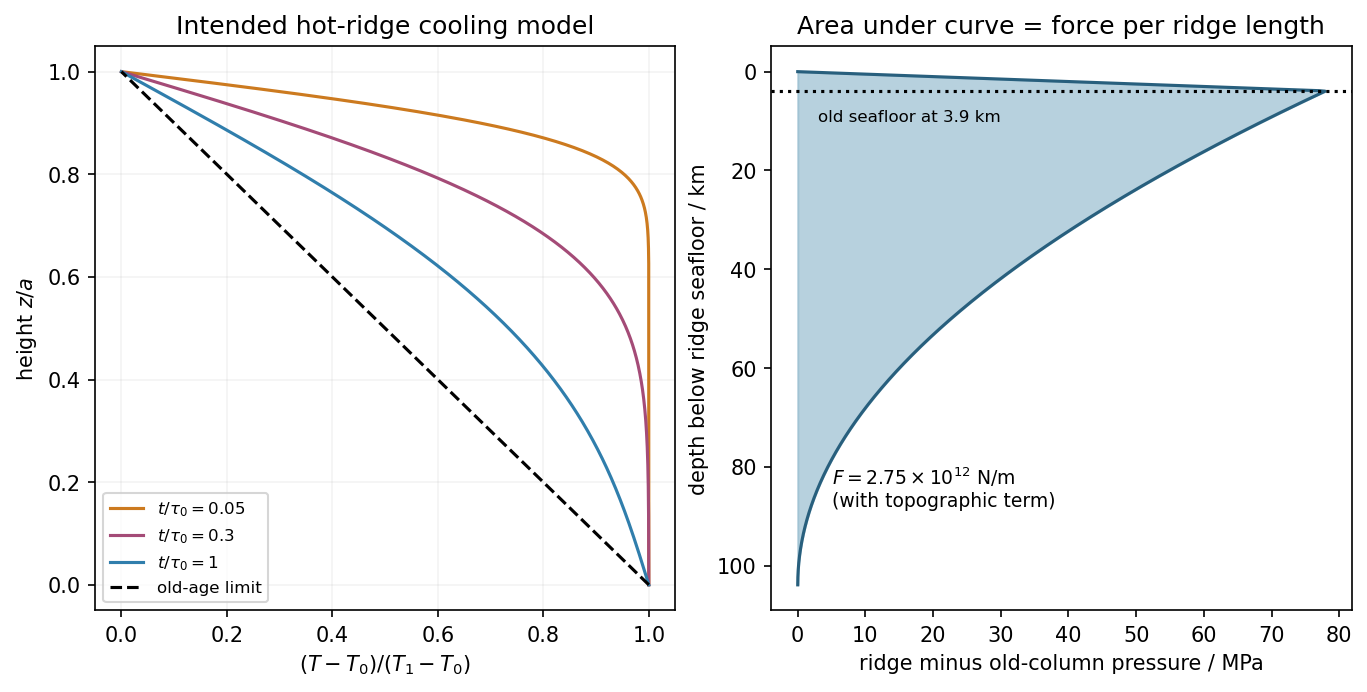
Hot-ridge and old-plate columns, and their compensated pressure difference in the intended cooling model
. Details. 
The depth-averaged added horizontal compressive stress is . Resolving its traction on a plane dipping at angle gives the fault shear stress from a plate-integrated force,Keeping the previous topographic correction gives about . This is the mean additional shear from ridge push, assuming the force is transmitted through thickness and resolving the nonisotropic stress increment. An isotropic lithostatic pressure adds normal traction but no shear. The force integral alone does not specify the local stress at each point on the fault or establish failure.
Articles by others on the same topic
There are currently no matching articles.