The radial distribution function is the conditional number density of neighbors at separation , divided by the bulk number density . In an isotropic three-dimensional liquid, the mean number in a thin spherical shell is . Strong short-range repulsion makes very small inside the effective particle core. A first maximum marks the nearest-neighbor coordination shell. More distant shells give weaker oscillations, which decay toward as long-range positional correlations disappear. A typical simple liquid has no indefinitely repeated sharp lattice peaks.
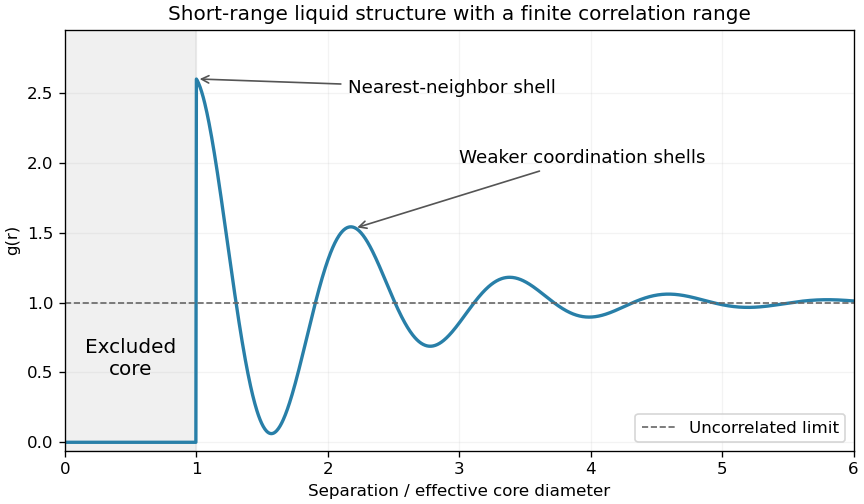

The static structure factor measured by diffraction is related to the Fourier transform of . Thus the broad diffraction maxima of a liquid and the damped real-space coordination shells describe the same short-range organization.
Treat as a constant and use the canonical ensemble identity . The given formal partition function gives . The pressure is its negative volume derivative at fixed :Equivalently . The explicit temperature dependence in must be retained; this is not the ideal-gas pressure law.
In a p-n junction, diffusion and electron-hole recombination near the contact leave a depletion region of ionized dopants. Its built-in electric field opposes further majority-carrier diffusion. At thermodynamic equilibrium drift and diffusion currents cancel. Forward bias lowers the electrostatic barrier and injects electrons and electron holes across the junction; reverse bias raises the barrier and suppresses that majority-carrier injection. For an ideal diode below breakdown,Thus a modest forward voltage gives a rapidly increasing current, whereas reverse current remains approximately . This asymmetric current-voltage relation makes the junction a rectifier. Real leakage, electron-hole recombination and breakdown limit the ideal expression.
A straight line in against means . Reading its intercept and slope gives approximately and ; the graphical precision is only a few percent. Hence the molar heat capacity is approximatelyThe linear electronic heat capacity comes from conduction electrons within energy of order of the Fermi energy; the Pauli exclusion principle prevents deeply occupied states from contributing freely. The cubic lattice term is the low-temperature Debye heat capacity of three-dimensional acoustic phonons, whose low-frequency density of states is proportional to frequency squared. These are molar coefficients, so the temperature powers carry the extra kelvin factors indicated.
For a low circular orbit, Newton's law of universal gravitation gives . Using yieldsThus the Moon and Mars have roughly comparable mean densities: low circular-orbit period measures mean density. Equal periods would mean equal mean densities in this approximation. This does not require their masses or radii to be similar. The orbit altitudes must be small compared with the body radii, and the bodies are being treated as approximately spherical.
The gain bandwidth must be expressed as a frequency range:The gain bandwidth limit on a laser pulse then givesThe numerical coefficient depends on the pulse shape and width definition. For example a Gaussian pulse whose intensity spectral FWHM actually filled this width would have a transform-limited intensity duration about . A hard gain interval does not by itself specify such a FWHM. Reaching the estimated scale requires coherent mode locking and control of group velocity dispersion; the cavity round-trip time determines the pulse separation. An intensity autocorrelation measurement can estimate the pulse duration once its shape is specified.
Articles by others on the same topic
There are currently no matching articles.